Banks and TradFi onchain: what operators said on The Protocol Roundtable
This page collects what speakers on The Protocol Roundtable, Protofire's livestream panel, said about banks and traditional finance moving onchain. Most quotes come from Episodes 4 and 5, the two parts of TradFi Goes Onchain, with a few from Episodes 2 and 6, and each one links to its moment in the recording. Speakers from J.P. Morgan Payments, Circle, Polygon Labs, Centrifuge, Aptos Labs, ADI Foundation, Fireblocks, Velocity, DIA and Pharos Network spoke for themselves, alongside people from Protofire.
- Is TradFi really moving onchain in 2026?
- Why does it take a bank so long to adopt an onchain product?
- What does a bank need to see before a pilot goes into production?
- Why would a bank use tokenized deposits instead of stablecoins?
- How do banks and institutions choose a blockchain?
- Is regulation really what holds banks back?
- What does a tokenized fund need to be useful as collateral?
Is TradFi really moving onchain in 2026?
The speakers describe an early stage. Luis Medeiros calls it a thin layer of cross-border stablecoin payments and tokenized funds, Ilia Shirobokov sees settlement first, Gagan Mac calls payments the beachhead, and Ran Goldi describes new proofs of concept since the GENIUS Act.
It's still a thin layer of TradFi, right? It's not huge adoption ... We see things happening mainly on stablecoin rails for cross-border, and also tokenization of funds and assets distribution onchain, mainly.
 Luis Medeiros, Field CTO and CEO of Arenas.fi, Protofire · Episode 4, 05:51
Common use case for today would be the settlement first, because the settlement is, at least, it's the most understandable use case. ... The settlement in the same day, without some kind of only in business days and all that stuff, the settlement with both legs at the same time in atomic transaction.
 Ilia Shirobokov, Head of Blockchain, ADI Foundation · Episode 4, 11:56
So payments are definitely the beachhead. I do think it's going to get very interesting when tokenized deposits grow. ... So there is a lot of signal that the interest from TradFi companies is growing, the number of experiments are growing.
 Gagan Mac, VP, Product & Engineering, Arc, Circle · Episode 4, 10:13
If you look at the last 12 months, it's a totally different cohort. It's everything after GENIUS Act. It's people who now say, okay, we've heard a lot about this. It seems that there's some value. Let's say you're a bank. We're not 100% sure, but now we can touch it. Let's do a POC.
 Ran Goldi, Chief Payments & Network Officer, Fireblocks · Episode 6, 21:44
Why does it take a bank so long to adopt an onchain product?
Brian Butler says the banks he talks to take about a year to evaluate one product. Ilia Shirobokov finds aligning many parties harder than the technology, Emma Landriault points to training, cyber and automation work, and Gagan Mac to threatened business models.
I'm talking to banks all the time and they have like a year to evaluate at least one little product, right, to go live with. ... You're basically asking these people who have built old ledgers since the thirties, forties and fifties to upgrade their systems, which is definitely scary, and it requires a lot of coordination.
 Brian Butler, Payments Lead, US, Polygon Labs · Episode 4, 25:55
This alignment between different entities, it is the hardest part, not the technology. Technology, well, we solved technology quite some time ago.
Ilia Shirobokov, Head of Blockchain, ADI Foundation · Episode 4, 28:05The uplift between manual processes and a one-off transaction to actually bringing a full product to market is significant. Sometimes it can take in these institutions over a year just because of the amount of training and cyber uplift and automation uplift that actually has to happen to get there.
 Emma Landriault, Global Head of Kinexys Labs, J.P. Morgan Payments · Episode 5, 08:50
That forcing function for crypto or for onchain technologies, what is that? It is actually disruptive to the business models that exist right now. So of course the procurement cycles are going to be long unless those business opportunities become extremely obvious.
Gagan Mac, VP, Product & Engineering, Arc, Circle · Episode 4, 30:01What does a bank need to see before a pilot goes into production?
Rado Patus lists a reconciled month, compliance evidence regulators accept, one independent counterparty and a number for the board. Brian Butler points to sanctions screening, Emma Landriault to risk appetite and teams ready for things to break, and Martin Quensel to a real business case.
They need to see usually a reconciled month, a compliance evidence in regulators' format that they will accept and they will understand. They need to see usually at least one uncoached party that can accept [it] as a counterparty. And the CFO usually needs to see some number that he can put in a presentation for the board.
 Rado Patus, Lead Product Manager, Protofire · Episode 5, 14:25
Where they're always getting stuck is definitely the compliance side of it. So it's like, how are we going to make sure we're not doing any terrorist type of transactions? Where's the sanction screening? Where's the OFAC screening, all those types of things?
Brian Butler, Payments Lead, US, Polygon Labs · Episode 4, 25:55You have to have the risk appetite to actually bring these products to market and be comfortable at scale, be comfortable that things will break, and know that you have the right teams from an operations perspective and from an exception handling perspective to actually remediate these issues.
Emma Landriault, Global Head of Kinexys Labs, J.P. Morgan Payments · Episode 5, 11:11I think the super important question, also the reason why a lot of the pilots actually failed, is the business use case. ... What are the clients we would like to approach with what product? And is that something which has product market fit, or will most likely have product market fit?
 Martin Quensel, Co-Founder, Centrifuge · Episode 5, 58:08
Why would a bank use tokenized deposits instead of stablecoins?
Ilia Shirobokov says institutions start with proven stablecoins, though tokenized deposits suit banks better. Emma Landriault describes risk-averse treasurers who would have to risk-manage every stablecoin and found commercial bank money appealing. Eric Queathem sees treasury appetite for onchain balances as low but changing.
We see originally, firstly, stablecoins and not tokenized deposits, despite the tokenized deposits [being] a bit more natural thing for banks, for example. But still I would use stablecoins firstly as well, because stablecoins, okay, I've seen the story, it works, nice, it's safe.
Ilia Shirobokov, Head of Blockchain, ADI Foundation · Episode 4, 08:45For some parties who are traditionally off-chain, right, don't have exposure on-chain, their corporate treasurers were looking at how they would hold different stablecoins and essentially saying, well, if we are going to look at holding these at scale, right, on our balance sheet, then we need to be able to risk manage them.
Emma Landriault, Global Head of Kinexys Labs, J.P. Morgan Payments · Episode 5, 28:46For our client base, which tend to be some of the largest institutional clients, large balance sheets, and behind those balance sheets, treasurers, right, who are very risk-averse and who need to very carefully operationally manage their positions, commercial bank money was appealing.
Emma Landriault, Global Head of Kinexys Labs, J.P. Morgan Payments · Episode 5, 21:39I think the reality is there's not a lot of appetite today for corporate treasurers to be holding balances onchain, unless you're a Web3 native business. I think that's changing, though. I think folks are asking the right questions now.
 Eric Queathem, Founder & CEO, Velocity · Episode 6, 36:25
How do banks and institutions choose a blockchain?
Brian Butler finds chains commoditized and many companies indifferent to which one they use. Gagan Mac lists questions on fees, validators and finality, Emma Landriault asks whether an issuer can manage its risk, and Ryan Zega sees private starts with public chains as the goal.
I would say these companies don't necessarily care about which specific chain they're going to be using. Some of them have preferences. ... It's all fairly commoditized. We're all fast and cheap at this point.
Brian Butler, Payments Lead, US, Polygon Labs · Episode 4, 37:19If you're holding a volatile gas token as network fees, then accounting for it is complex. ... Who are the validators, and how do I know? ... And then the third question was, okay, when is a transaction final? Not just technically deemed final, but also legally the definition of completely settled.
Gagan Mac, VP, Product & Engineering, Arc, Circle · Episode 4, 45:48As issuers, can we manage our risk, right? If I'm issuing a deposit, that's the bank's core balance sheet, right, that we're issuing there. So can I get comfortable on your network that we can manage the risk ultimately?
Emma Landriault, Global Head of Kinexys Labs, J.P. Morgan Payments · Episode 5, 48:56We're seeing the start in private, but the holy grail is ultimately going into a public environment that has the right level of whitelisting and permission, which is ultimately creatable, right, by the different counterparties that are participating.
 Ryan Zega, Head of Structured Finance, Aptos Labs · Episode 5, 36:14
Related service: Enterprise blockchain development
Is regulation really what holds banks back?
Ryan Zega says regulation is sometimes used as an excuse, and Rado Patus calls waiting for every approval a myth. Brian Butler links wider stablecoin holding to laws like the CLARITY Act, and Eric Queathem sees the missing clarity more in practice and precedent.
The excuse that we'll see sometimes with regulated counterparties is that overall regulation is not there to do what they want on-chain. ... So regulation's not the end-all, right, for a mid-sized bank. There's a lot to do on-chain to be innovative.
Ryan Zega, Head of Structured Finance, Aptos Labs · Episode 5, 55:51Usually there is that myth that I need everything approved before anything goes live. And that approval never comes. We know that. And each of you guys know that you have started with one flow, one counterparty, one approval, one product.
Rado Patus, Lead Product Manager, Protofire · Episode 5, 57:32We'll probably get to pricing once we start seeing domestic payments as well being in stablecoins. What I really mean by that is people being willing to hold stablecoins, which is why we need things like the CLARITY Act to pass, because we're still not at this stage where people are receiving the stablecoins and then just holding it.
Brian Butler, Payments Lead, US, Polygon Labs · Episode 4, 07:05There will be clarity that's needed, some on the regulatory side, but I think more around just general practice and precedent that needs to be set.
Eric Queathem, Founder & CEO, Velocity · Episode 6, 36:25What does a tokenized fund need to be useful as collateral?
Rado Patus says a token is useful only when a third party can accept it without calling the issuer. Martin Quensel wants liquidation to run fully onchain, Dillon Hanson asks who liquidates collateral held off-chain, and Jason Windawi suggests DeFi-ready classes of a fund.
It just boils down to, the token is basically useful only when the third party can accept it without calling the issuer.
Rado Patus, Lead Product Manager, Protofire · Episode 5, 46:29Everyone who is using a token wrapper, for example, as a collateral in a Morpho vault or in other, et cetera, is actually able to liquidate that and unbind it entirely on-chain on smart contracts, and doesn't need to rely on anyone or anything off-chain. That is essential.
Martin Quensel, Co-Founder, Centrifuge · Episode 5, 42:48Now we need to look into the liquidation engine for this, just because it's held off-chain as collateral: who's going to be the one performing the actual liquidation of this and redemption of this when needed, when things might go south?
 Dillon Hanson, Head of BD, DIA · Episode 2, 28:37
One thing that as an industry we would love to see from Centrifuge and from other asset issuers is maybe an analog to TradFi, where you have multiple classes of a mutual fund ... So it could be possible to have a version that is wrapped in such a way that it's usable in DeFi and liquidatable.
 Jason Windawi, Head of Institutions & Protocols, Pharos Network · Episode 2, 37:48
Related blueprint: Tokenized private credit as collateral
Go deeper
- Tokenized treasuries vs stablecoinsHow stablecoins and tokenized funds differ in legal wrapper, who can hold, redemption and collateral use.Guide
- Blockchain compliance integrationKYC, sanctions screening and Travel Rule wired into the product and enforced onchain.Service
- Managed onchain operations24/7 monitoring and incident response for a live product, under a pre-agreed authority matrix.Service
- Digital asset infrastructure for banksWhat MiCA already allows banks, and the layer between their core ledger and crypto rails.Industry
The episodes
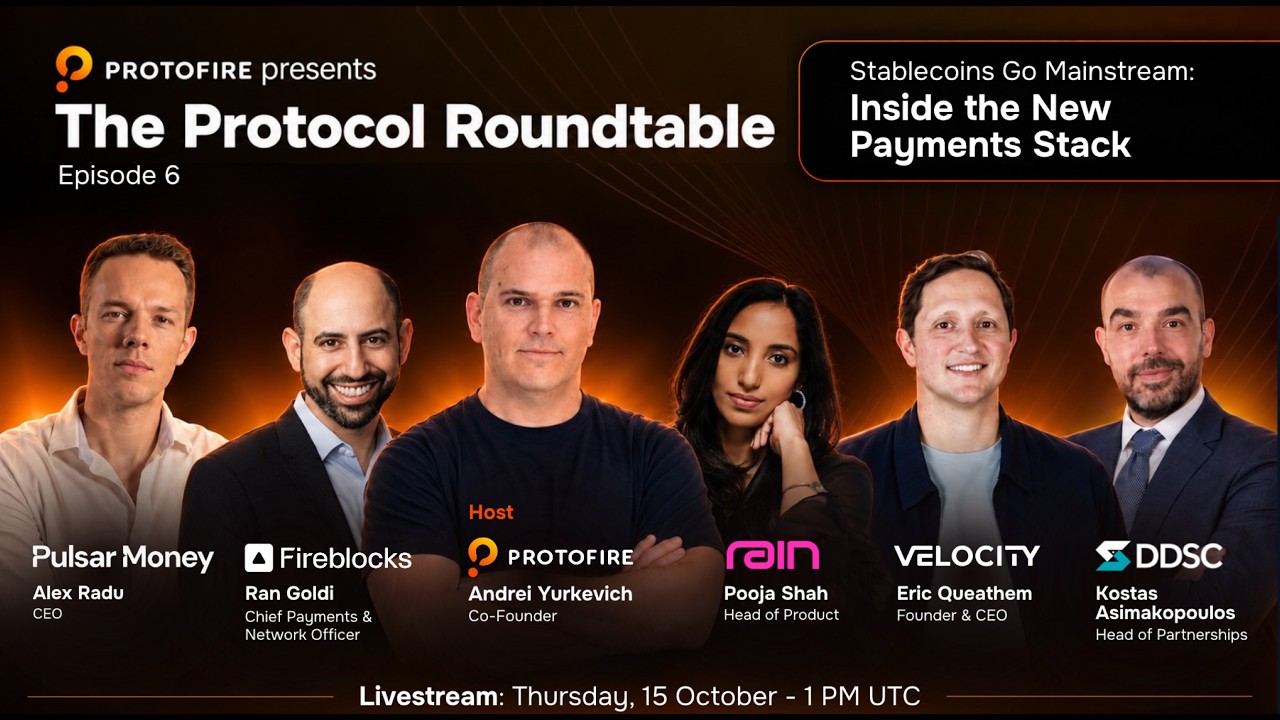
Stablecoins Go Mainstream: Inside the New Payments Stack
Episode 6 ·

 Andrei YurkevichProtofire

 Kostas AsimakopoulosDDSC
 Ran GoldiFireblocks
 Eric QueathemVelocity

 Alex RaduPulsar Money

 Pooja ShahRain

TradFi Goes Onchain, Part 2: From Pilots to Market Infrastructure
Episode 5 ·
- Andrei YurkevichProtofire
- Rado PatusProtofire
 Emma LandriaultJ.P. Morgan Payments
 Martin QuenselCentrifuge
 Ryan ZegaAptos Labs
TradFi Goes Onchain: Who's Building the New Financial System?
Episode 4 ·
- Andrei YurkevichProtofire
- Luis MedeirosProtofire
 Brian ButlerPolygon Labs
 Gagan MacCircle
 Ilia ShirobokovADI Foundation
Ghost Town Markets: Building Secondary Liquidity for Real-World Assets
Episode 2 ·
- Rado PatusProtofire
 Renat KhasanshynProtofire
 Jason WindawiPharos Network

 Alan ChiuBoba Network

 Zach PraterBase
 Ivan PostavskyyCentrifuge
 Dillon HansonDIA
The next table has an empty seat
We invite founders and senior leaders building onchain finance in payments, banking and blockchain protocols. Tell us who you are and what you would like to discuss.
- In good companySpeakers so far have come from J.P. Morgan Payments, Circle, Fireblocks, Base and Polygon Labs.
- On the recordYour episode gets its own page with your key quotes and the full transcript, built so search engines and AI assistants can find and quote it.
- Among peersA conversation with people solving the same problems from other sides of the market.