Tokenized Private Credit Fund With Borrowing Against Units
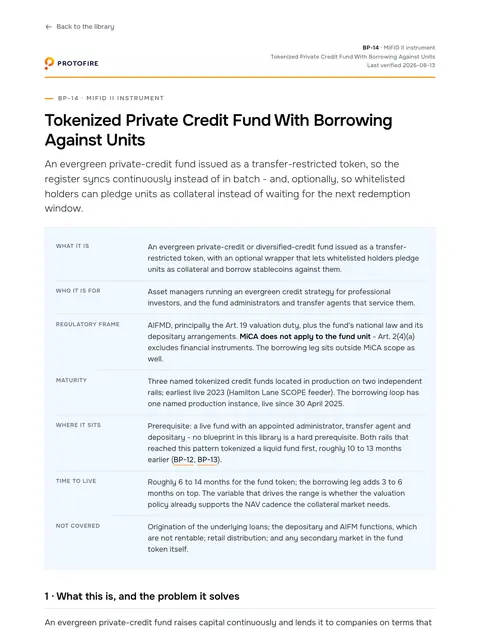
An evergreen private-credit fund issued as a transfer-restricted token, so the register syncs continuously instead of in batch - and, optionally, so whitelisted holders can pledge units as collateral instead of waiting for the next redemption window.
The full blueprint adds all 12 risks with their controls and owners, the DORA third-party pack and the delivery plan in 4 phases.
Web document · ~17 pages · 27 min read · one link opens all 22 blueprints
- Maturity
- Emerging
- Regime
- MiFID II instrument
- Proven stack (4 of 6)
- Securitize · Centrifuge (Anemoy) · RedStone · Morpho
- Last verified
- August 2026

Reviewed by Andrei Yurkevich, Founding Member at Protofire
distributed value in tokenized credit across 2,543 assets by 13 Aug 2026 (rwa.xyz).
The scale of individual instances is much smaller and worth knowing: the reference fund had 72 holders at the same date - a small institutional distribution list. Every tokenized private-credit fund located is US, BVI or Cayman domiciled; no EU AIF and no named live tokenized ELTIF was found.
01. The opportunity
An evergreen private-credit fund raises capital continuously and lends it to companies on terms that do not trade. Investors accept that in exchange for spread, and they accept the consequence: units are subscribed and redeemed against a reported net asset value on a monthly or quarterly cycle, and capital committed to the strategy cannot be moved without leaving it. This pattern issues those units as a transfer-restricted token on a public chain, so the register is synchronised continuously instead of in batch, and so a holder who needs liquidity can pledge units as collateral instead of waiting for the next redemption window. The manager keeps the strategy, the administrator keeps the register, and the token is the representation the two agree on. MiCA does not apply to the unit, which Art. 2(4)(a) excludes as a financial instrument, while AIFMD applies, principally the Art. 19 valuation duty and Art. 21 depositary.
The conditions that make this current are recent and narrow. Tokenized credit reached USD 7.27 billion of distributed value across 2,543 assets by 13 August 2026 (rwa.xyz). Apollo and Securitize launched the ACRED feeder on 30 January 2025, and Anemoy and Centrifuge launched a second feeder into the same Apollo strategy on 1 October 2025, on an entirely different rail. The borrowing leg, where fund units are wrapped, pledged and borrowed against in a curated credit market, has been live on one named instance since 30 April 2025. That is enough evidence to describe the pattern accurately, and not enough to call it settled.
02. The regulatory position
03. Who's already done this
A tokenized feeder into the Senior Credit Opportunities Fund - senior secured loans to North American borrowers - on Polygon, later Ethereum and Optimism, and TRON from June 2026. The oldest instance located, and the one that shows what the pattern is for: the minimum subscription fell from USD 2 million to USD 10,000. Onchain assets are small, about USD 4.28 million.
A tokenized feeder into the Apollo Diversified Credit Fund, across seven chains, at USD 95.0 million total asset value and 72 holders as at 13 August 2026 (rwa.xyz). The reference instance for the pattern including the borrowing leg, and the clearest evidence of its scale.
A second tokenized feeder into the same Apollo diversified-credit strategy, on the Centrifuge rail, at USD 31.0 million as at 13 August 2026 (rwa.xyz). Proves the pattern is rail-independent: the identical underlying strategy distributed through two unrelated stacks.
04. Does this fit you?
Yes, if you run an evergreen credit strategy for professional investors, you already have an appointed administrator, transfer agent and depositary, and you are adding a distribution channel rather than launching a first fund.
Probably not, if your fund is closed-ended with capital calls, or if your underlying is liquid and priced daily - in that case a tokenized share class on the existing fund is a cheaper route to the same distribution. And not yet, if the goal is EU retail: that route has no live precedent.
05. The stack, layer by layer
Most of these layers can be rented from a named vendor, and usually should be. The part that matters is the one layer you have to own yourself.
The strategy, the manager and the valuation policy
The credit strategy, origination relationships and underwriting; an AIFM or equivalent manager and a depositary; an appointed administrator and transfer agent with a register; and an approved valuation policy with the investor relationships behind it. AIFMD Art. 19 requires an independent or functionally separated valuer, which caps how often NAV can move on-chain for illiquid underlyings.
Token contracts, register sync and the NAV feed
Audited token contracts with transfer restriction enforced at the token, register synchronisation between the transfer agent's system and chain state, multichain issuance, and a NAV feed suitable for a collateral market. Explicitly not included: no depositary, no AIFM, no valuation, no origination and no distribution permission.
The collateral standard and the valuation-to-oracle path
Reconciliation between the register of record and chain state, including what happens when they disagree; the valuation-to-oracle path and the rule that stops a stale NAV being published as a live price; the written collateral standard - which markets, which ratios, which curators, which caps; the liquidation arrangement and whitelisted liquidator set agreed before the first unit is pledged; and investor reporting with out-of-hours monitoring and a tested exit from each provider.
06. Why this stack
The register stays where the law puts it. In every credible instance the legal register is maintained by a licensed transfer agent and the token is a synchronised representation of it. That is what makes an investor's claim enforceable independently of the chain, the token and the provider's own front end.
NAV cadence sets the terms for everything downstream. AIFMD Article 19 requires the valuation function to be independent of portfolio management, and for an illiquid credit book the valuation policy fixes how often NAV moves. The oracle, the loan-to-value ratio and the liquidation trigger all inherit that cadence. A collateral market that prices continuously against a NAV that updates monthly is publishing a number the fund does not stand behind between updates.
MiCA does not apply to the fund unit. Article 2(4)(a) excludes financial instruments as defined in MiFID II Article 4(1)(15), and fund units sit in MiFID II Annex I Section C(3). No CASP authorisation is needed to issue or transfer the unit. The borrowing leg is a separate question and sits outside MiCA scope entirely, which means country-by-country credit law with no passport.
Risks, controls and owners
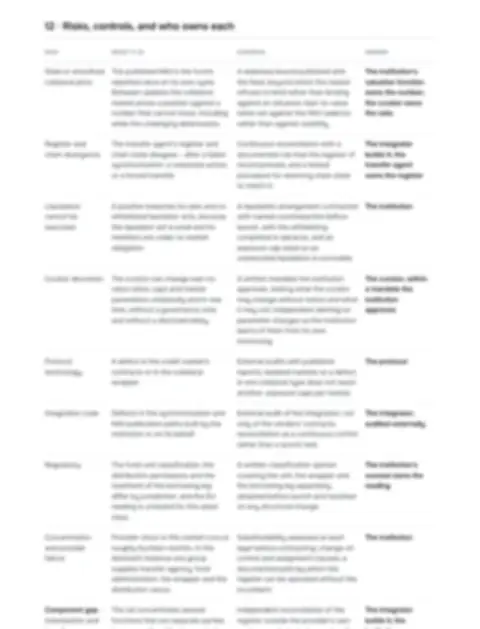
From the full blueprint · 3 of 12 shown, one with its control- Stale or smoothed collateral priceControl: A staleness bound published with the feed, beyond which the market refuses to lend rather than lending against an old price; loan-to-value ratios set against the NAV cadence rather than against volatility.Owner: The institution's valuation function owns the number; the curator owns the ratio
- Register and chain divergenceControl: in the full blueprintOwner: The integrator builds it; the transfer agent owns the register
- Liquidation cannot be executedControl: in the full blueprintOwner: The institution
The other 9 risks, and every control, are in the full blueprint.
Get all 12 with controls ↓Get the full BP-14
Web document · ~17 pages · 27 min read
This page is the short version. The full BP-14 adds all 12 risks with their controls and owners, the DORA third-party pack and the delivery plan in 4 phases. We email you a personal link, and it opens all 22 blueprints in the library.
We email your personal link and, now and then, a blueprint update. Privacy policy
Reviewed by Andrei Yurkevich, Founding Member at Protofire · last verified August 2026
What the full blueprint adds, by reader
- Counsel
- The regulatory position across 6 regimes, article by article
- Risk & compliance
- All 12 risks, each with its control and the party that owns it
- Third-party risk
- The DORA pack: critical-or-important classification, the Art. 28(4) pre-contract assessment, Art. 30(3) contract clauses and Art. 29 concentration. Any commission we may earn on a named vendor is disclosed
- Technical lead
- Which of the 9 building blocks are essential and which are optional, and why
- Delivery
- The delivery plan in 4 phases, with the decision that gates each, then monitoring and incident response once live
- Board
- For the board paper: what each function gets, and where this pattern does not work
FAQ
How is a tokenised private-credit fund unit regulated, and what limits how often its NAV can move on-chain?
In the Tokenized Private Credit pattern, the fund unit is MiCA-exempt because Art. 2(4)(a) excludes financial instruments defined in MiFID II Art. 4(1)(15), and units in collective investment undertakings sit in MiFID II Annex I Section C(3). AIFMD applies instead, principally the Art. 19 valuation duty, which requires an independent or functionally separated valuer and caps how often NAV can move on-chain for an illiquid book, plus Art. 21 depositary. The borrowing leg sits outside MiCA scope and is governed country by country.
Who already runs a tokenised private-credit fund, including the borrowing leg?
Apollo Global Management runs the reference instance, a tokenised feeder into the Apollo Diversified Credit Fund (ACRED) across seven chains, at USD 95.0 million total asset value and 72 holders as at 13 August 2026, with Securitize as transfer agent and administrator. Hamilton Lane's feeder into its Senior Credit Opportunities Fund (HLSCOPE) has run since 2023 and cut the minimum subscription from USD 2 million to USD 10,000. Anemoy Capital runs a second feeder into the same Apollo strategy (ACRDX) on the Centrifuge rail.
What does the manager build versus rent, and who is this not for?
The manager owns the credit strategy, origination and underwriting, an AIFM and depositary, the appointed administrator and transfer agent, and the approved valuation policy. It rents token contracts, register synchronisation and a NAV feed from providers such as Securitize, Centrifuge, Morpho, RedStone or Gauntlet. It builds the written collateral standard, the valuation-to-oracle path that stops a stale NAV being published as a live price, and the liquidation arrangement. It is not for closed-ended drawdown funds, nor for institutions seeking EU retail distribution, since no live tokenised ELTIF was located.
Already evaluating this for your institution?
When you are ready, we scope a business case on your own numbers: the costed build, the controls, the SLA and the ROI your board needs to approve it. Or talk it through first.
Run this pattern in production, or tried to and stopped? .