Stablecoin Earn Product
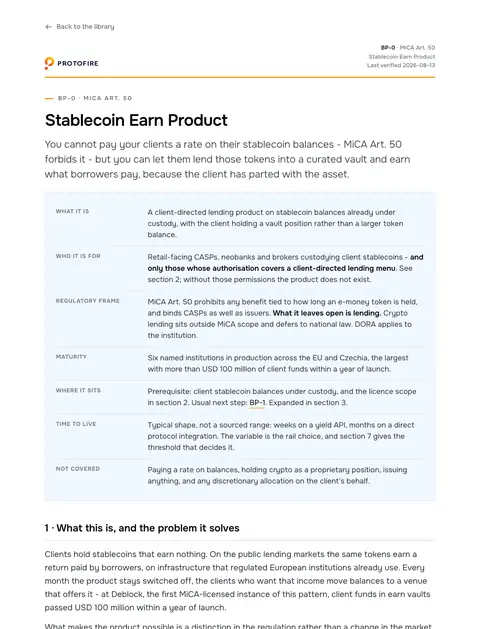
You cannot pay your clients a rate on their stablecoin balances - MiCA Art. 50 forbids it - but you can let them lend those tokens into a curated vault and earn what borrowers pay, because the client has parted with the asset.
The full blueprint adds all 8 risks with their controls and owners, the DORA third-party pack and the delivery plan in 4 phases.
Web document · ~14 pages · 23 min read · one link opens all 22 blueprints
- Maturity
- Proven
- Regime
- MiCA Art. 50
- Proven stack
- Morpho · Yield.xyz · Aave · Hypernative
- Last verified
- August 2026

Reviewed by Rado Patus, Offer Owner at Protofire
client funds earning at Deblock within one year of launch (2026 capture, not re-verified in the 2026-08-13 pass).
The only granular retail adoption figure in public. Evidence that the demand exists, not a forecast for a different institution.
01. The opportunity
Clients hold stablecoin balances that earn nothing, while the same tokens earn a return on the public lending markets that regulated European institutions already use. Every month the product stays switched off, the clients who want that income move their balances to a venue that offers it. A curated lending vault keeps those balances, and those clients, on the institution's own rails: the client's tokens leave the balance and enter an audited vault, the client holds a vault position against them, and earns what borrowers pay, using custody and a licence the institution already holds.
What makes the product possible is a distinction in the regulation. Paying a rate on a balance is prohibited outright under MiCA Art. 50, which is why one major venue switched off stablecoin rewards for European clients on 1 December 2024. Lending is not prohibited, and the model is already live: Deblock, a MiCA-licensed French neobank, reported more than USD 100 million of client funds earning within one year of launch, Societe Generale FORGE became the first regulated bank on this infrastructure in July 2025, and six named institutions are in production across the EU and Czechia. The institution's expensive parts, the authorisation, the custody, the fiat ramps and the years of client due diligence, are already built, and what remains is the connection and the discipline to build it in the shape the regulation permits.
02. The regulatory position
03. Who's already done this
Embedded earn across stablecoin and ETH vaults with two independent curators. More than USD 100 million of client funds earning within one year of launch - the number that answers whether clients actually use this.
Lending markets for its own MiCA stablecoins, with a vault integrated for its euro token. The first regulated bank on this infrastructure: a credit committee at a systemically important group signed the architecture off.
Stablecoin yields through the API rail rather than a direct integration. The rent-rather-than-build choice made by a household name, which is why the crossover threshold is a decision and not a foregone conclusion.
Earn integrations on the same lending infrastructure. Live at licensed exchanges in three jurisdictions, which is what moves this from a design to a pattern.
04. Does this fit you?
Check one thing before anything else. Does your authorisation cover reception and transmission of orders, and portfolio management? A curated vault menu can be read as both. On the engagement this blueprint comes from, counsel identified exactly those two characterisations as fatal for a CASP licensed only for custody, exchange and transfers - so those permissions decide whether the product exists at all.
- Yes if you hold those permissions, already custody client stablecoins that earn nothing, and want a disclosed fee line on balances you already hold.
- Not if the permissions are missing - a different blueprint fits those licences. Not if your clients' priority is a holding-period tax exemption: the vault exchange is a disposal, and in some jurisdictions it costs the client more in tax than it pays in yield. Not if you want to pay a rate on balances, which is the one thing Art. 50 actually prohibits.
05. The stack, layer by layer
Most of these layers can be rented from a named vendor, and usually should be. The part that matters is the one layer you have to own yourself.
The authorisation, the custody and the client relationship
The licence and its service lines, custodial accounts and signing infrastructure, fiat ramps and the exchange itself, and years of client due diligence. The expensive parts are already built; the licence-scope question is the gate that decides whether the product exists at all.
Lending protocol, curation and the yield rail
Audited vault and lending contracts with published audits and a bug bounty, independent curation of the lending markets, and APIs or SDKs for deposit, withdrawal and positions - or unsigned transactions on the API route. No wallet, no ramp, no client due diligence, no licence, by design.
The vault and curator standard, and everything that enforces it (built and operated by Protofire)
Integration into custody, signing and the client ledger; the written vault and curator standard and the limits that enforce it; statements that show the holding as a vault position rather than a larger token balance; detection, automated safeties and a rehearsed depeg exit. The standard is where the Article 50 structure becomes operable.
06. Why this stack
- Tokens leave, a position comes back. The statement shows that vault position, and it has to: the visible exchange is what the regulatory reading rests on.
- The counsel test is one sentence: would the client receive this benefit by simply keeping the balance? If no, the client is being paid for lending the tokens.
- You already hold the expensive parts: the licence, the custody, the ramps and the KYC. The rail provides audited contracts, independent curation and APIs, and holds no wallet, no keys, no KYC and no licence by design.
- Two rails, one structure. A direct protocol integration pays for itself above roughly EUR 15-25M of client funds in vaults; below that, a yield API delivers the identical client product in weeks instead of months. The rail choice changes nothing about the regulatory analysis, and the later migration is ordinary engineering - clients notice nothing.
- Positions are never hostage. They sit on-chain, client-owned, reachable directly on the underlying protocol. If a vendor disappeared tomorrow, the funds would not.
Risks, controls and owners
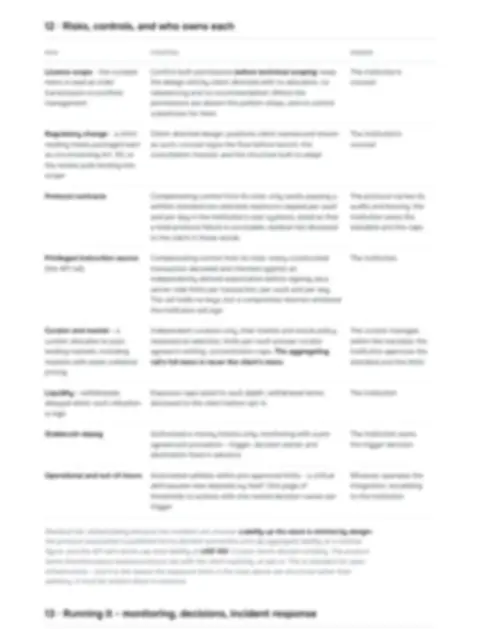
From the full blueprint · 3 of 8 shown, one with its control- Licence scopeControl: in the full blueprintOwner: The institution's counsel
- Regulatory changeControl: Client-directed design; positions client-owned and shown as such; counsel signs the flow before launch; the consultation tracked, and the structure built to adaptOwner: The institution's counsel
- Protocol contractsControl: in the full blueprintOwner: The protocol carries its audits and bounty; the institution owns the standard and the caps
The other 5 risks, and every control, are in the full blueprint.
Get all 8 with controls ↓Get the full BP-0
Web document · ~14 pages · 23 min read
This page is the short version. The full BP-0 adds all 8 risks with their controls and owners, the DORA third-party pack and the delivery plan in 4 phases. We email you a personal link, and it opens all 22 blueprints in the library.
We email your personal link and, now and then, a blueprint update. Privacy policy
Reviewed by Rado Patus, Offer Owner at Protofire · last verified August 2026
What the full blueprint adds, by reader
- Counsel
- The regulatory position across 5 regimes, article by article
- Risk & compliance
- All 8 risks, each with its control and the party that owns it
- Third-party risk
- The DORA pack: critical-or-important classification, the Art. 28(4) pre-contract assessment, Art. 30(3) contract clauses and Art. 29 concentration. Any commission we may earn on a named vendor is disclosed
- Technical lead
- Which of the 10 building blocks are essential and which are optional, and why
- Delivery
- The delivery plan in 4 phases, with the decision that gates each, then monitoring and incident response once live
- Board
- For the board paper: what each function gets, and where this pattern does not work
FAQ
Can a CASP pay interest on stablecoin balances under MiCA?
No. MiCA Art. 50 (Art. 40 for asset-referenced tokens) prohibits granting any remuneration or benefit tied to the length of time an e-money token is held, including benefits sourced from a third party. A curated lending vault is a different structure: the client's tokens leave the balance and earn what borrowers pay on an asset they lent, rather than a benefit for one they held.
Which institutions already run stablecoin earn on this lending model?
The model is live at licensed institutions today. Deblock is a MiCA-licensed neobank running embedded lending vaults; Societe Generale FORGE was the first regulated bank on this infrastructure for its own MiCA stablecoins; and licensed exchanges such as Gemini, Crypto.com and Bitpanda run earn integrations on the same rails. The lending infrastructure is the same everywhere; what changes is the licence scope and the client-facing flow.
Does moving stablecoins into a lending vault trigger tax for the client?
Exchanging a balance for a vault position is a disposal, so it can end a holding-period tax exemption. If preserving that exemption is the client's priority, this is not the right structure; a design that avoids the disposal is a separate blueprint.
Who bears the protocol risk in a curated vault?
The residual smart-contract and protocol risk sits explicitly with the client, disclosed in writing at opt-in. This structure is not for institutions unwilling to place that risk with the client explicitly.
Already evaluating this for your institution?
When you are ready, we scope a business case on your own numbers: the costed build, the controls, the SLA and the ROI your board needs to approve it. Or talk it through first.
Run this pattern in production, or tried to and stopped? .