Tokenized Euro Money Market Fund (UCITS)
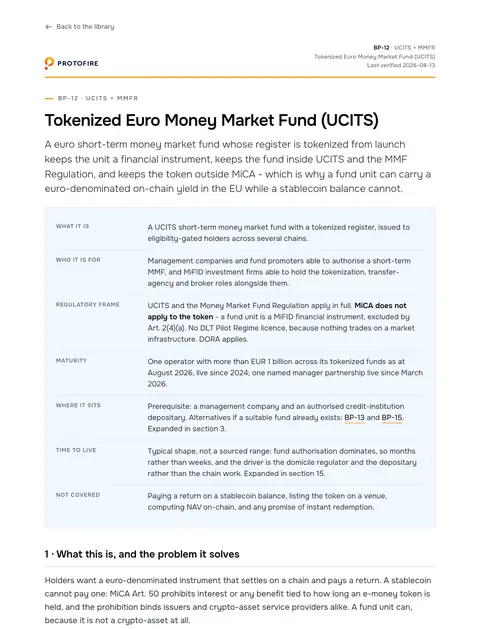
A euro short-term money market fund whose register is tokenized from launch keeps the unit a financial instrument, keeps the fund inside UCITS and the MMF Regulation, and keeps the token outside MiCA - which is why a fund unit can carry a euro-denominated on-chain yield in the EU while a stablecoin balance cannot.
The full blueprint adds all 8 risks with their controls and owners, the DORA third-party pack and the delivery plan in 4 phases.
Web document · ~16 pages · 26 min read · one link opens all 22 blueprints
- Maturity
- Proven
- Regime
- UCITS + MMFR
- Proven stack
- Spiko · CACEIS · Tokeny (T-REX) · Securitize
- Last verified
- August 2026

Reviewed by Rado Patus, Offer Owner at Protofire
across one operator's tokenized funds as at August 2026, on a French UCITS structure live since 2024.
For calibration, and date-flagged: the ECB put the whole tokenised MMF market at roughly EUR 7 billion globally and EUR 725 million EU-domiciled in April 2026, with the ten largest funds holding over 90% of capitalisation. One operator has since passed EUR 1 billion alone.
01. The opportunity
Holders want a euro-denominated instrument that settles on a chain and pays a return. A stablecoin cannot pay one, because MiCA Art. 50 prohibits interest or any benefit tied to how long an e-money token is held, and that prohibition binds issuers and crypto-asset service providers alike. A fund unit can, because it is a MiFID financial instrument that MiCA Art. 2(4)(a) excludes from the crypto-asset regime. This pattern builds that instrument properly: a short-term money market fund authorised under UCITS and the Money Market Fund Regulation, with its register tokenized from launch instead of bolted onto an existing share class, so the yield the fund already produces reaches the holder on-chain.
This is the strongest EU-native tokenization evidence available. One operator crossed EUR 1 billion across its tokenized funds during August 2026, on a French UCITS structure with a credit-institution depositary, a statutory auditor and a regulator-registered prospectus, and the European Central Bank published its own analysis of the category in April 2026. For a management company, or a MiFID investment firm partnering with one, it is a regulated euro cash-equivalent that settles on public chains and reaches holders who want on-chain access without leaving the fund framework. No DLT Pilot Regime licence is needed, because nothing trades on a market infrastructure, and DORA applies to the operation.
02. The regulatory position
03. Who's already done this
A French SICAV whose sub-funds include euro and dollar short-term MMFs with tokenized registers, with CACEIS as depositary and administrator, PwC as statutory auditor, a regulator-registered prospectus and deployment across seven chains. The only operator located holding tokenization, transfer agency and broker roles for its own authorised funds.
A tokenized MMF partnership reported at USD 136.4 million as at 8 August 2026. The division of labour is the reusable part: the manager owns alpha, brand and distribution while the operator owns the register, the tokens and the chains. A named large manager choosing to partner rather than build is the strongest signal in the set.
04. Does this fit you?
- Yes if you are a management company or fund promoter able to stand up a UCITS short-term MMF, or a MiFID investment firm able to hold the tokenization, transfer-agency and broker roles and partner with a manager who owns the portfolio.
- Not if you are a CASP looking to pay yield on a stablecoin balance - that is closed, and while this is one lawful destination for the demand, it is a fund product with a fund's authorisations (the other route is a client-directed lending structure, covered by a sibling blueprint). Not if you want a token on a fund that already exists, or to supply this as an administrator's servicing line - different blueprints fit both. Not if the token has to trade on a venue: that changes the regime entirely.
05. Keeping transferability from being mistaken for liquidity
A token can move faster than the fund can redeem. The ECB named this as the central risk of the category: tokenised shares can move instantly and around the clock while the fund itself redeems at a cut-off. If holders treat continuous transferability as continuous redemption, the mismatch can become a run, because a token-side disruption while traditional markets are closed forces fire sales when they reopen, and a programmable ledger can synchronise redemptions faster than any traditional fund would see. Redemption follows the dealing cycle, stated in those words; transferability is disclosed as a secondary-market property; caps are sized to what the cycle clears; and no contract path exists that could trigger mass redemption. The token's price against NAV is monitored as a distress signal, because it is the earliest one available.
06. The stack, layer by layer
Most of these layers can be rented from a named vendor, and usually should be. The part that matters is the one layer you have to own yourself.
The fund, the depositary and the NAV chain
The management company or access to one and the portfolio capability, distribution and the client relationships, the depositary, administrator and auditor relationships, and the dealing cycle and NAV production chain. The depositary must be an EU credit institution and is never rentable; nor is the ManCo, the transfer agent of record or the statutory auditor.
The tokenization layer
Audited token and identity contracts with deployment across chains, the chain-facing half of the register synchronisation, and position and transfer reporting interfaces. No depositary function, no NAV, no portfolio and no distribution, by design.
The register seam and the multichain invariant (built and operated by Protofire)
The register-facing half of the synchronisation, per chain, for which no standard transfer-agency integration exists; the multichain supply invariant and the daily reconciliation with depositary escalation; the NAV publication pipeline with staleness detection; and the redemption guardrails that keep transferability from being mistaken for liquidity.
07. Why this stack
- The token is not a crypto-asset. A fund unit is a MiFID financial instrument and MiCA Art. 2(4)(a) excludes it, so the interest prohibition that closes balance-paying stablecoin yield in the EU does not reach a fund unit at all, which is what lets this product carry an on-chain return lawfully.
- No DLT Pilot Regime licence is needed, because nothing trades on a DLT market infrastructure.
- The regulated core cannot be rented. The depositary (an EU credit institution under UCITS Art. 22), the management company, the transfer agent of record and the statutory auditor cannot be rented from a technology provider, and a plan that assumes otherwise fails at the first supervisory conversation. What is rented is the tokenization, the identity layer and the chains.
- The register of record stays with the transfer agent and the chain mirrors it, which is the same design choice that keeps tokenized fund structures out of trouble elsewhere.
Risks, controls and owners
From the full blueprint · 3 of 8 shown, one with its control- Liquidity mismatchControl: Redemption follows the dealing cycle and is disclosed in those words; transferability described as a secondary-market property; exposure caps sized to what the cycle clears; no contract path capable of triggering mass redemptionOwner: The management company
- Amplified run dynamicsControl: in the full blueprintOwner: The management company sets thresholds; the integrator builds them
- Multichain supply divergenceControl: in the full blueprintOwner: The transfer agent owns the register; the integrator builds the control
The other 5 risks, and every control, are in the full blueprint.
Get all 8 with controls ↓Get the full BP-12
Web document · ~16 pages · 26 min read
This page is the short version. The full BP-12 adds all 8 risks with their controls and owners, the DORA third-party pack and the delivery plan in 4 phases. We email you a personal link, and it opens all 22 blueprints in the library.
We email your personal link and, now and then, a blueprint update. Privacy policy
Reviewed by Rado Patus, Offer Owner at Protofire · last verified August 2026
What the full blueprint adds, by reader
- Counsel
- The regulatory position across 6 regimes, article by article
- Risk & compliance
- All 8 risks, each with its control and the party that owns it
- Third-party risk
- The DORA pack: critical-or-important classification, the Art. 28(4) pre-contract assessment, Art. 30(3) contract clauses and Art. 29 concentration. Any commission we may earn on a named vendor is disclosed
- Technical lead
- Which of the 11 building blocks are essential and which are optional, and why
- Delivery
- The delivery plan in 4 phases, with the decision that gates each, then monitoring and incident response once live
- Board
- For the board paper: what each function gets, and where this pattern does not work
FAQ
Why can a tokenised money market fund pay on-chain yield in the EU when a stablecoin cannot?
In the Tokenized Euro Money Market Fund pattern, the fund unit is a MiFID II financial instrument that MiCA Art. 2(4)(a) excludes, so the fund stays inside UCITS and the Money Market Fund Regulation (Reg. 2017/1131) and the token stays outside MiCA. Because the unit is a fund unit rather than an e-money token, MiCA Arts. 40 and 50, which close the balance-paying stablecoin yield product, do not apply. A short-term VNAV money market fund is the proven shape, and no DLT Pilot Regime licence is needed.
Who already runs a tokenised euro money market fund?
Spiko, an investment firm authorised by the ACPR under number 19183 and supervised by the AMF in France, has run a French SICAV since 2024 whose sub-funds include euro and dollar short-term money market funds with tokenised registers, with CACEIS as depositary and administrator, PwC as statutory auditor, a regulator-registered prospectus and deployment across seven chains. Amundi partnered with Spiko from March 2026 on a tokenised MMF reported at USD 136.4 million, with the manager owning distribution and the operator owning the register and tokens.
What parts of a tokenised MMF cannot be rented?
The fund itself cannot be rented: the depositary must be an EU credit institution, and the management company, the transfer agent of record and the statutory auditor all stay with the fund. The tokenization layer is rented from providers such as Spiko, Tokeny (T-REX, ERC-3643) or Securitize, covering audited token and identity contracts and the chain-facing half of the register synchronisation. What gets built is the register-facing half of the synchronisation, the multichain supply invariant with daily reconciliation and depositary escalation, and the NAV publication pipeline.
Already evaluating this for your institution?
When you are ready, we scope a business case on your own numbers: the costed build, the controls, the SLA and the ROI your board needs to approve it. Or talk it through first.
Run this pattern in production, or tried to and stopped? .