Crypto-Backed Lombard Loans
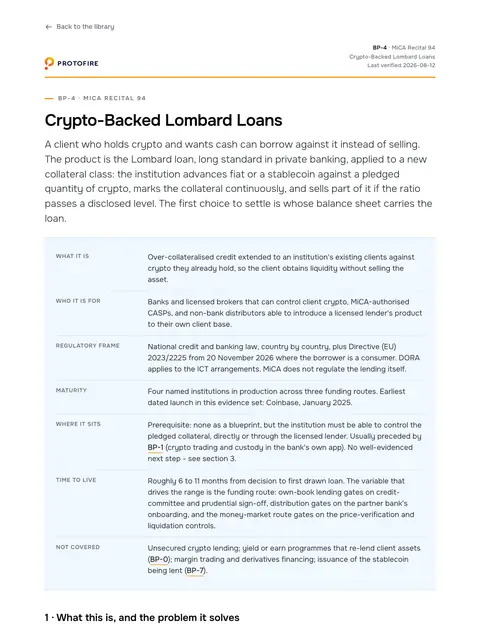
A client who holds crypto and wants cash can borrow against it instead of selling. The product is the Lombard loan, long standard in private banking, applied to a new collateral class: the institution advances fiat or a stablecoin against a pledged quantity of crypto, marks the collateral continuously, and sells part of it if the ratio passes a disclosed level. The first choice to settle is whose balance sheet carries the loan.
The full blueprint adds all 11 risks with their controls and owners, the DORA third-party pack and the delivery plan in 4 phases.
Web document · ~17 pages · 29 min read · one link opens all 22 blueprints
- Maturity
- Proven
- Regime
- MiCA Recital 94
- Proven stack (4 of 7)
- Morpho · Aave · Copper · Anchorage Digital
- Last verified
- August 2026

Reviewed by Andrei Yurkevich, Founding Member at Protofire
originations through Coinbase's US borrowing product as at 14 Apr 2026 - a Coinbase figure.
Four named institutions in production across three structurally different funding routes. ESMA confirmed on 18 June 2026 that authorised CASPs may offer crypto-asset lending and that the lending itself sits outside MiCA.
01. The opportunity
A client who holds crypto with an institution and wants cash has two moves: sell, which crystallises a disposal and ends the position, or borrow against the holding. Lending keeps the client invested while giving them liquidity, and gives the institution a credit product on assets it already custodies. The product is the Lombard loan, long standard in private banking, applied to a new collateral class: the institution advances fiat or a stablecoin against a pledged quantity of crypto, marks the collateral continuously, and sells part of it if the ratio deteriorates past a disclosed level. Because the collateral is already custodied, priced and screened, the work that remains is the credit machinery, and the audited, open-source credit primitives that regulated firms already use carry no licence cost.
Named institutions now run this at scale in three structurally different ways. Sygnum Bank lends on its own balance sheet against more than 20 eligible collateral tokens; Coinbase routes bitcoin- and ether-backed USDC borrowing to an on-chain money market and reported more than USD 2.17 billion originated in its US product as at 14 April 2026; Relai distributes bitcoin-backed loans up to 50 per cent loan-to-value that Sygnum Bank originates; and Cantor Fitzgerald runs a third-party desk with Anchorage Digital and Copper as custodians. The European legal position was recently clarified: on 18 June 2026 ESMA published a question and answer confirming that authorised crypto-asset service providers may offer crypto-asset lending, and that the lending service itself sits outside MiCA. Directive (EU) 2023/2225 on consumer credit applies from 20 November 2026, which fixes a date by which any institution lending to consumers in the European Union has to have settled how the agreement is documented and how creditworthiness is assessed.
02. The regulatory position
03. Who's already done this
Bitcoin-backed loans in Swiss francs and euro at up to 50 per cent loan-to-value, distributed to its own high-net-worth and business clients. The distribution route, and the most instructive row for an institution without a lending licence: the introducer owns the client and the interface, the licensed bank owns the credit.
Lombard loans on its own balance sheet against more than 20 eligible collateral tokens, drawable in four currencies, including staked SOL where staking rewards continue to accrue. The own-book route, and the only one of the four where the lender carries the credit risk directly. Sygnum reported Lombard loan volume doubling over the preceding twelve months as at May 2025 - a Sygnum figure, more than fifteen months old.
USDC borrowing against bitcoin and ether, routed to the Morpho protocol on Base with cbBTC as the collateral representation. Coinbase operates the interface and is not the lender - loans are funded by depositors in the money market. The money-market route at the largest scale found, with a minimum 133 per cent collateral ratio and liquidation at 86 per cent loan-to-value.
Bitcoin financing for institutional holders, with Anchorage Digital and Copper appointed as collateral managers and custodians. Announced 11 March 2025 with USD 2 billion of initial financing capacity and reported fully operational during May 2025. The third-party desk route, where custody and collateral management were deliberately separated from the lender.
04. Does it fit?
It fits an institution that can perfect a pledge over client collateral, holds an authorisation permitting credit in the borrower's country or has a licensed lender behind it, and serves clients whose holdings are large enough that selling is a considered decision.
It does not fit where clients hold crypto at venues the institution cannot reach; where the institution wants clients to earn on holdings rather than borrow against them; where an EU credit institution plans a large own-book exposure, because the Article 501d CRR3 capital treatment caps that route before demand does; or where consumer lending is planned across several EU countries at once, since each is a separate authorisation question.
05. The stack, layer by layer
Most of these layers can be rented from a named vendor, and usually should be. The part that matters is the one layer you have to own yourself.
The client, the collateral control and the licence to lend
The client relationship, the KYC file and the suitability assessment; custody of the collateral or a custodial partner the institution can control; a core banking or brokerage ledger the loan has to appear in; and the authorisation making the credit lawful where it lends - or a licensed lender to originate behind it. National credit law governs, country by country.
Credit primitives and market state
Audited, open-source credit primitives - over-collateralisation, interest accrual, liquidation logic - with public, continuously observable market state and rates, and immutable core contracts so market terms cannot change under an existing borrower. Explicitly not provided: no licence, no KYC, no fiat ramp, no client disclosure, no statement, no tax reporting, and no margin-call telephone call.
The written credit standard and the defensible liquidation
Mapping loans, interest and liquidations into the core ledger, the client statement and the tax file; the written eligibility, haircut and loan-to-value standard with the pre-pledge disclosure; independent price verification, so a liquidation can be defended to the client whose assets were sold; and margin-call communications, monitoring, out-of-hours cover and a tested exit path.
06. Why the stack looks the way it does
The collateral is already custodied, already priced and already screened, so the work that remains is the credit machinery on top of it. What has to be built sits in three places: collateral control wired into a credit engine, independent price verification that can be defended to a client whose assets were sold, and the loan mapped into the core ledger, the client statement and the tax file. The credit primitives themselves are audited and open source, and carry no licence cost.
The regulatory position is straightforward. Crypto lending sits outside MiCA scope - Recital 94 says MiCA does not address lending and borrowing, and ESMA confirmed on 18 June 2026 that an authorised provider may offer it while the service itself stays unregulated. There is no passport, so the authorisation to grant credit is national, country by country. Directive (EU) 2023/2225 applies from 20 November 2026 where the borrower is a consumer.
Risks, controls and owners
From the full blueprint · 3 of 11 shown, one with its control- Protocol technologyControl: in the full blueprintOwner: The protocol
- Integration codeControl: in the full blueprintOwner: The integrator; audited externally
- RegulatoryControl: A jurisdiction-by-jurisdiction opinion before onboarding borrowers in each country, re-tested against Directive (EU) 2023/2225 as transposed, and borrower classification recorded at onboarding.Owner: The institution's counsel owns the reading
The other 8 risks, and every control, are in the full blueprint.
Get all 11 with controls ↓Get the full BP-4
Web document · ~17 pages · 29 min read
This page is the short version. The full BP-4 adds all 11 risks with their controls and owners, the DORA third-party pack and the delivery plan in 4 phases. We email you a personal link, and it opens all 22 blueprints in the library.
We email your personal link and, now and then, a blueprint update. Privacy policy
Reviewed by Andrei Yurkevich, Founding Member at Protofire · last verified August 2026
What the full blueprint adds, by reader
- Counsel
- The regulatory position across 5 regimes, article by article
- Risk & compliance
- All 11 risks, each with its control and the party that owns it
- Third-party risk
- The DORA pack: critical-or-important classification, the Art. 28(4) pre-contract assessment, Art. 30(3) contract clauses and Art. 29 concentration. Any commission we may earn on a named vendor is disclosed
- Technical lead
- Which of the 8 building blocks are essential and which are optional, and why
- Delivery
- The delivery plan in 4 phases, with the decision that gates each, then monitoring and incident response once live
- Board
- For the board paper: what each function gets, and where this pattern does not work
FAQ
Does MiCA regulate lending against a client's crypto holdings?
No. Under the Credit against a client's own crypto holdings pattern, MiCA Recital 94 states that MiCA does not address the lending and borrowing of crypto-assets, and ESMA Q&A 2883 of 18 June 2026 confirms a CASP may offer the service while the lending itself stays unregulated under MiCA. MiCA applies only to the custody and transfer legs, including Art. 70(1) safeguarding and Art. 75 custody, and client assets may be lent only with prior, express and specific consent. The authorisation to grant credit is national, country by country, with no passport.
Who already runs crypto-collateralised lending, and through what funding routes?
Four institutions run three structurally different routes. Sygnum Bank makes Lombard loans on its own balance sheet against more than 20 eligible collateral tokens in four currencies, the own-book route. Coinbase routes USDC borrowing against bitcoin and ether to the Morpho protocol on Base, funded by money-market depositors, with a minimum 133 per cent collateral ratio and liquidation at 86 per cent loan-to-value. Relai distributes bitcoin-backed loans up to 50 per cent loan-to-value that Sygnum Bank originates, and Cantor Fitzgerald runs a third-party desk with Anchorage Digital and Copper as custodians.
What is the decisive choice in this credit product, and who is it not for?
The decision that drives everything is whose balance sheet carries the loan: own book, a third-party desk or a money market. It is not for institutions whose clients hold crypto at venues they cannot control, so no pledge can be perfected, nor for EU credit institutions holding large crypto exposures on their own book, where CRR3 Art. 501d applies a 1,250 per cent risk weight under a 1 per cent Tier 1 cap. It is also not for lending to consumers across several EU countries at once, for which there is no passport.
Already evaluating this for your institution?
When you are ready, we scope a business case on your own numbers: the costed build, the controls, the SLA and the ROI your board needs to approve it. Or talk it through first.
Run this pattern in production, or tried to and stopped? .