Zerohash Integration for Platforms That Keep Their Own Customer Ledger
On zerohash, a platform that keeps its own customer ledger holds each withdrawal's funds until a final state. It recovers state after zerohash drops a webhook and matches the next-day float settlement. Protofire builds that platform side. In 2018 and 2019, Protofire built the Payroll dApp for Aragon's apps framework.

Reviewed by Luis Medeiros, Field CTO at ProtofireLast reviewed: November 2026
On this page
Work shipped for 60+ networks and 95+ protocols, including











What zerohash leaves to a platform that keeps its own ledger
A zerohash integration leaves the balance check to the platform. In its brokerage example for Account Funding, zerohash credits a customer's deposit in USDC, converts it to USD and transfers it to the brokerage's account. At that point, zerohash "relinquishes control of the End Customer's account balance (ie, the ledger)" to the brokerage. Its withdrawal guide then makes the platform "completely responsible for ensuring that the end customer does not withdraw more than their current balance" (zerohash). Before the platform can go live, zerohash administers a conformance test of its withdrawal handling. Protofire builds that side: the withdrawal holds, the event handling and the settlement match.
The platform recovers what a dropped webhook missed. After a failed delivery, zerohash makes up to four fast retries and three more with exponential backoff, then drops the notification. "The client must then perform a manual state recovery upon resuming operation," its webhook documentation says (webhooks). For example, if zerohash drops the "failed" event of a withdrawal, the customer's funds remain on hold until the platform recovers the state.
The float settles the next day. Under the Novated liquidity model, zerohash runs credit checks for customer trades against the platform's float account (liquidity models). The platform and zerohash settle the net amount daily. By default, settlement happens at 12:00 PM EST the following day, and Friday to Sunday trades settle together on Monday (settlement). A float balance that is too low makes customer trades fail with "insufficient balance". If the platform misses a settlement wire, the net delivery obligation accrues.
Who runs each part of a zerohash withdrawal or payout
A request starts in the platform's app, and its events and settlement return to the platform's ledger.
Customer app and balances
Customer ledger and close
Withdrawal and payout service
Event receiver and recovery
Settlement and movement match
Participants, accounts and custody
Conversion, payouts and Travel Rule
Payout networks
Bank rails
What Protofire builds for your zerohash integration
Protofire builds five parts on the platform's side, each answering a duty in zerohash's documentation.
Withdrawals held until zerohash reports a final state
The ledger blocks a second withdrawal of the same balance and credits a failed one back once. The withdrawal service locks the funds when the platform invokes zerohash's Withdraw SDK. It matches each event on participant_code, amount and payment_id, because zerohash calls reference_id solely "metadata". It credits funds back only on a failed or abandoned state, after a check with GET /payments/{payment_id}. A withdrawal ends as abandoned when its JWT, currently valid for five minutes, expires before the customer initiates it.
One ledger entry per zerohash event, with recovery after a drop
Each zerohash event changes the ledger once, in the order zerohash recorded it. The receiver verifies the RSA or HMAC signature and checks the timestamp against an accepted window. It drops repeats by the x-zh-hook-notification-id header and orders events by their timestamp field, because arrival order can differ. After a dropped notification, a recovery job reads open withdrawals and payouts back from zerohash's API.
Payouts sent once and checked before they go
The platform can resend a timed-out payout request without paying the beneficiary twice. POST /payouts is idempotent at zerohash: the same Idempotency-Key and payload return the original response, and a changed payload returns a 400 error (payouts guide). The key comes back on webhooks, GET responses and reports, so the ledger books each payout by it. With "validate": true, zerohash runs its checks "without executing any actions". The payout service sends each run through that dry run first.
The float and each day's net amount matched to the ledger
Finance sees what the platform owes zerohash before the settlement wire is due, beside the float balance. The match reads the net amount from GET /trades or the net delivery obligations endpoint. It compares that amount with the ledger by zerohash's trading session, EST by default, and by the platform's local close. It also matches movements to ledger entries, and GET /movements returns only the last two months (movements). Protofire adds a float alert.
Travel Rule data on file before an EU withdrawal
An EU withdrawal starts with the data zerohash checks. In its Travel Rule guide, zerohash says "the receiving wallet's information must be on file before the withdrawal call is made" (Travel Rule). For a self-custody wallet, zerohash asks for proof of ownership once more than €1,000 has been sent to the wallet in the last 12 hours. Until zerohash approves that proof, its EU payouts guide limits payouts to the wallet to €1,000 every 12 hours. Protofire builds the intake for platform-hosted remediation. Our EU Travel Rule guide covers the rules.
Who becomes zerohash's customer under each account model
In zerohash's payouts guide, each POST /payouts call names its account_model, and the account must be configured for that model first.
Customer of zerohash
Fully disclosed: The ultimate payor is a legal zerohash customer
Omnibus: The payor, a licensed money service business that puts the activity within its own licenses, is the legal zerohash customer
The ultimate payor
Fully disclosed: Signs zerohash's terms and is subject to KYB or KYC
Omnibus: Is not a direct zerohash customer
What Protofire builds
Fully disclosed: Onboarding of each ultimate payor with zerohash, and a mirror of that payor's participant status
Omnibus: A sub-ledger for each ultimate payor in the platform's own books
Entities, licenses and limits behind a zerohash build
- United States
- According to its disclosures page, zerohash llc is a FinCEN-registered money service business and a regulated money transmitter that "can operate in 51 U.S. jurisdictions".
- New York and Canada
- The same page states that the New York State Department of Financial Services licenses zerohash llc and zerohash liquidity services llc for virtual currency business. In Canada, the page states, zerohash llc is registered with FINTRAC as a money service business.
- European Union
- ESMA's interim MiCA register lists zerohash europe B.V. as authorized by the Dutch AFM on 29 October 2025 (ESMA). The register lists custody, a trading platform, exchange and transfer services for the EU member states, Norway, Iceland and Liechtenstein.
- Environments
- The platform works in Cert and Prod, on US or EU API hosts. Production API keys come after zerohash's Compliance and Sales Engineering teams approve the platform's flow of funds.
- Networks and stablecoins
- The production list of 23 September 2026 names 40 blockchain networks. The stablecoin table of 26 October 2026 lists USDC on 21 networks for the US entity (stablecoins).
Read on 16 November 2026 in zerohash's documentation and disclosures and in ESMA's register. Protofire integrates zerohash for firms that have chosen it.
Our record: a multi-token payroll dApp for Aragon
A payroll run becomes many payouts, and the ledger must record each payout once.
The Aragon Payroll dApp, 2018 to 2019
In 2018 and 2019, Protofire built the Payroll dApp for Aragon's apps framework, which let a DAO pay contributors in several tokens.We built its aragonOS contracts, a React front end and a subgraph. Aragon merged the UI milestones, titled "Payroll: UI Milestones 2-4 (Protofire)", on 14 May 2019 (pull request 613). Aragon's apps repository is now archived. The Aragon case study describes the build.
Steps of a zerohash build with Protofire
- Step 1
A first read of your Cert data
Before the call, an engineer reads the platform's Cert webhook log, a week of movements and zerohash's settlement emails against the ledger. A written proposal follows. It sets a posting rule for each withdrawal state, payout status and movement type that the platform's flows use. - Step 2
Withdrawal holds and the event receiver in Cert
Protofire builds the withdrawal service, the event receiver and the recovery job first, and tests them in Cert against zerohash's withdrawal rules. Then zerohash administers its conformance test. The receiver reads the new timestamped signature headers, because zerohash says the legacy ones "will be deprecated in the future". - Step 3
Settlement match, Travel Rule intake and customer statuses
The float alert and the settlement match follow, with Travel Rule intake and the handling of locked and disabled customers. An archive keeps movements older than the two months that GET /movements returns. - Step 4
Ownership after launch
The code, the configuration and the runbooks belong to the platform. The platform's team runs the services, or Protofire operates them under a written scope.
How a zerohash project with Protofire starts
The platform's own users create the zerohash API keys in the Client Portal, which shows the private key and passphrase only once.A new key gets the Created status and is not live until it has two additional approvals. Where Protofire operates a service, the scope lists each write call the service sends to zerohash, and read-only keys cover the rest.
- Proposal
- In writing, one business day after the discovery call: findings, a plan in phases and the first step we recommend.
- Price
- Fixed per phase when you commission it, against written acceptance criteria. Overruns inside them are ours to absorb, invoices follow delivered milestones, and you can stop at any phase boundary. Anything we operate after launch is priced in the proposal as its own recurring line, with the notice to end it.
- Ownership
- Code we write for you, contracts, the keys and credentials this work creates and the accounts your infrastructure runs in are yours by contract, within the license of any third-party software involved. Keys that a custody platform or a staking provider holds under its own key model stay with it under your contract; every other custody key stays with you or the custodian you appoint. Where the scope places something on servers we rent, it says what moves to you and when. An NDA is available from your first message, and we sign a data processing agreement (DPA) together with it.
- After launch
- Delivery closes with a hypercare window and a defect warranty, with their terms written into the proposal. A service we operate continues under its written scope until that scope ends.
- Access
- Read-only by default. A role that can start requests only if your written scope names one; never a signer, approver, administrator, key holder or recovery role on your contracts, wallets or custody platform. Services we build call each platform on credentials your staff issue and keep in your vault. Anything that approves or moves funds runs in your environment, and a scope under which we operate a service lists every write call it makes. Where the scope has us operate nodes, validators, monitors, explorers or indexers, it names the role and any key we hold on those servers, and in your own cloud account you can remove it.
- Licenses
- Protofire is an engineering firm and holds no financial or crypto-asset license; licensed activity stays with you and your providers.
How we work shows a worked proposal.
Where a Protofire zerohash build does not fit
Some requests need a license, another product or only zerohash's own tools.
- The platform wants Protofire to hold a license, customer funds or keys, or to act as the omnibus payor. Protofire holds no financial or crypto-asset license. The omnibus model needs a licensed money service business as payor, and your counsel decides whether the platform qualifies.
- A platform with few payouts and no ledger of its own may manage with zerohash's SDK, no-code Modular Payouts and portal CSV reports.
- A bank wants crypto trading for its own clients, which our crypto-as-a-service integration page covers.
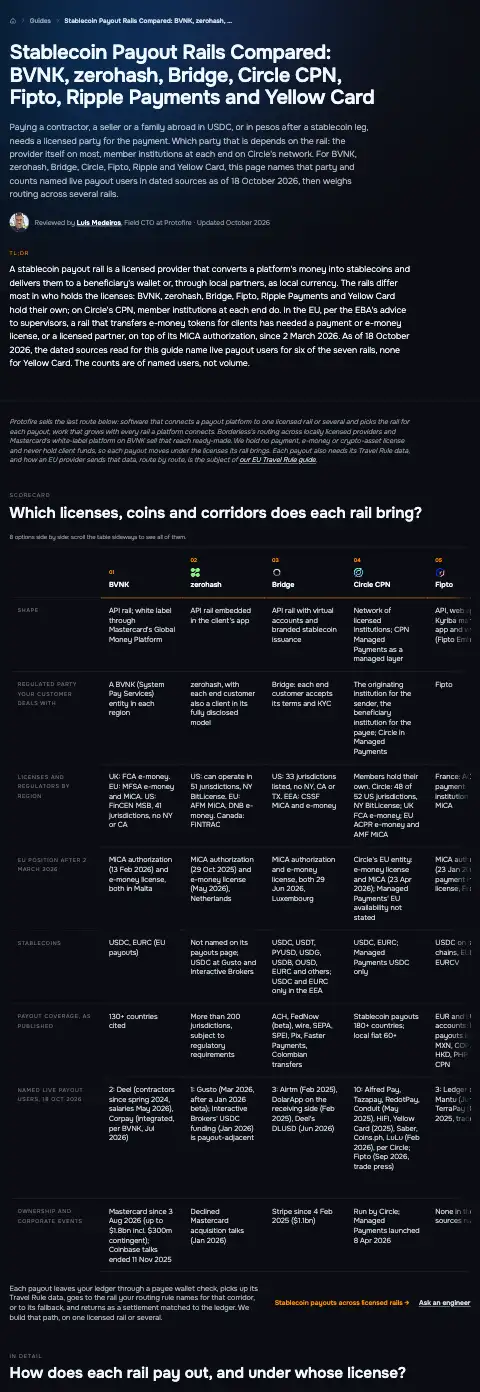
- The platform has not chosen a payout provider yet. Our stablecoin payout rails guide compares zerohash with other providers.
Related guides and services
FAQ
What is a zerohash integration?
Who can build a zerohash integration for a payment or payroll platform?
What happens when zerohash cannot deliver a webhook?
Which stablecoins does zerohash support for EU customers?
What happens to a customer's balance when zerohash disables the customer?
How should a platform retry a zerohash transfer after a timeout?
Get a proposal
Tell us what you are building. An engineer reads it, we have a short call, and the written proposal follows within one business day.