Stablecoin Payout Rails Compared: BVNK, zerohash, Bridge, Circle CPN, Fipto, Ripple Payments and Yellow Card
Paying a contractor, a seller or a family abroad in USDC, or in pesos after a stablecoin leg, needs a licensed party for the payment. Which party that is depends on the rail: the provider itself on most, member institutions at each end on Circle's network. For BVNK, zerohash, Bridge, Circle, Fipto, Ripple and Yellow Card, this page names that party and counts named live payout users in dated sources as of 18 October 2026, then weighs routing across several rails.

Reviewed by Luis Medeiros, Field CTO at Protofire · Updated October 2026
A stablecoin payout rail is a licensed provider that converts a platform's money into stablecoins and delivers them to a beneficiary's wallet or, through local partners, as local currency. The rails differ most in who holds the licenses: BVNK, zerohash, Bridge, Fipto, Ripple Payments and Yellow Card hold their own; on Circle's CPN, member institutions at each end do. In the EU, per the EBA's advice to supervisors, a rail that transfers e-money tokens for clients has needed a payment or e-money license, or a licensed partner, on top of its MiCA authorization, since 2 March 2026. As of 18 October 2026, the dated sources read for this guide name live payout users for six of the seven rails, none for Yellow Card. The counts are of named users, not volume.
Protofire sells the last route below: software that connects a payout platform to one licensed rail or several and picks the rail for each payout, work that grows with every rail a platform connects. Borderless's routing across locally licensed providers and Mastercard's white-label platform on BVNK sell that reach ready-made. We hold no payment, e-money or crypto-asset license and never hold client funds, so each payout moves under the licenses its rail brings. Each payout also needs its Travel Rule data, and how an EU provider sends that data, route by route, is the subject of our EU Travel Rule guide.
Which licenses, coins and corridors does each rail bring?
8 options side by side: scroll the table sideways to see all of them.
How does each rail pay out, and under whose license?
BVNK (Mastercard)
- +Two live payroll flows at Deel: contractors have withdrawn earnings in stablecoins since spring 2024, per BVNK, and employees in the US and the Eurozone can take salary in stablecoins since May 2026
- +Both EU licenses sit in one Malta entity: an e-money license and a MiCA crypto-asset service authorization, the latter dated 13 February 2026 in ESMA's register
- +Payouts funded in EUR, GBP or USD and delivered in USDC or EURC, by API or CSV upload, from a platform that cites 130+ countries
- +Sold white label through Mastercard's Global Money Platform from 15 October 2026, for clients that want accounts, cards and payouts under their own brand
- −Its US license table lists 41 jurisdictions, with no license row for New York or California
- −Its EU payouts page converts fiat funding into USDC or EURC for the final payout and names no other payout coin
- −Local bank payouts under the Mastercard platform run through Mastercard Move, whose expansion to 40+ currencies across 200+ countries and territories is a 2027 target
BVNK's regulated companies carry the System Pay Services name. Its license page, read through an archive copy of 13 October 2026, lists three: an FCA e-money institution in the UK, an e-money institution and MiCA crypto-asset service provider in Malta supervised by the MFSA, and a FinCEN-registered money services business in the US. The US company holds licenses in 41 jurisdictions, 39 states plus DC and Puerto Rico. ESMA's register dates the Malta authorization 13 February 2026, for custody, exchange, execution and transfer. Its EU payouts product takes funding in EUR, GBP or USD, converts to USDC or EURC for the final payout, cites 130+ countries and quotes TransferMate, Worldpay and Deel.
Deel's contractors have been able to withdraw earnings in stablecoins through BVNK since spring 2024, and BVNK's case study, dated 22 October 2025, counts 10,000+ contractors in 100+ countries who opted in. On 20 May 2026 Deel added stablecoin salary payouts for employees in the US and the Eurozone, also on BVNK, and counted $250 million in crypto payouts in 2025. BVNK's data release of 28 July 2026 says Corpay "has integrated" its stablecoin wallets and settlement, reducing "reliance on pre-funded accounts". The same release reports more than $36 billion of annualized payment volume, 75% of it from PSPs and fintechs, BVNK figures that cover every flow on the platform. Worldpay announced payouts on BVNK "across more than 180 markets" in May 2025, with a pilot "expected to go live in H2 2025". BVNK's payouts page now quotes Worldpay's head of payouts saying "Worldpay clients can now make streamlined payouts without handling digital assets", and Worldpay has published no dated go-live.
Mastercard agreed on 17 March 2026 to buy BVNK for up to $1.8 billion, including $300 million in contingent payments, and completed the acquisition on 3 August 2026; the completion release states no price. On 15 October 2026 the two launched the Global Money Platform, one API through which banks, fintechs and enterprises embed fiat and stablecoin accounts, conversion, stablecoin-linked cards and local bank payouts through Mastercard Move "under their own brand". Nuvei, Marqeta, Ontop, Beem and Almond FinTech are named among the first to integrate.
zerohash
- +Says it can operate as a money transmitter in 51 US jurisdictions, and holds New York's virtual currency license (BitLicense)
- +Both EU licenses in zerohash europe B.V.: a MiCA authorization from the AFM (29 October 2025) and an e-money license from DNB (May 2026)
- +Payouts across more than 200 jurisdictions through one API, sold to PSPs, banks, brokerages, marketplaces and gaming platforms
- +Gusto's USDC contractor payouts, in beta in January 2026 and live for eligible employers by March 2026, plus USDC account funding at Interactive Brokers by January 2026
- −In its fully disclosed model each end customer also becomes a zerohash client and passes its KYC, and zerohash accounts are not covered by FDIC or SIPC; its EU entity also offers an omnibus model in which only the platform is the client
- −The Visa Direct capability 'will become available', per zerohash's August 2026 release, and Visa's production announcement of 15 October 2026 names Inyo Global, not zerohash
- −Its payouts page names no stablecoin; its releases cite 'dozens of blockchains and stablecoins' without listing them
zerohash sells payouts, pay-ins, ramps and custody to platforms by API. Its payouts page offers "payouts across more than 200 jurisdictions globally, subject to regulatory and compliance requirements". Its footer lists zerohash llc as a FinCEN-registered money services business and money transmitter that "can operate in 51 U.S. jurisdictions", licensed for virtual currency business in New York and registered with FINTRAC in Canada. In Europe, zerohash europe B.V. holds a MiCA authorization from the AFM, dated 29 October 2025 in ESMA's register, and received an e-money license from DNB in May 2026.
The shape is embedded. In its Gusto release of 20 January 2026, zerohash cites a regulatory footprint across the EU, Latin America, Australia, New Zealand, Bermuda and the US, and says "zerohash accounts are not subject to FDIC or SIPC protections". The same release calls Gusto's contractor stablecoin payouts "currently in beta". On 18 March 2026 Gusto said eligible employers can now pay international contractors in USDC, without naming its provider. zerohash's EU commercial policy describes two models: omnibus, where only the platform is its client, and fully disclosed, where the platform and each end customer are both clients and pass its KYC. At Interactive Brokers, zerohash converts USDC deposits on Ethereum, Solana or Base into USD, for a fee The Block reported as 0.30% per deposit with a $1 minimum. For Visa Direct, stablecoin prefunding and payouts powered by zerohash "will become available" to eligible clients, per a release of 5 August 2026.
Mastercard was reported in October 2025 to be in late-stage talks to buy zerohash. In January 2026 zerohash said it is "not entertaining an acquisition by Mastercard", and PYMNTS reported that Mastercard was considering an investment instead.
Bridge (Stripe)
- +Local payout rails named in its documentation: ACH, FedNow and wire in USD, SEPA, SPEI, Pix, Faster Payments and Bre-B and bank transfers in Colombia
- +Both EEA licenses in Bridge Building S.A., granted by the CSSF on 29 June 2026, with EUR payouts in all 27 member states
- +Named payout users: Airtm pays workers across Latin America and DolarApp receives USD payroll payments for individuals (Stripe, February 2025), and Deel's DLUSD contractor wallet has run in Argentina since June 2026
- +Issues a client's own branded stablecoin through Open Issuance, the route Deel took for DLUSD
- −Each end customer accepts Bridge's terms of service and passes Bridge's KYC or KYB checks (identity checks on a person or a business), so the platform's payees become Bridge customers
- −Its US license page, last updated 8 December 2025, lists 33 jurisdictions, and New York, California and Texas are not among them
- −Its API documentation supports only USDC and EURC for users in the EEA, 'due to regulatory restrictions'
Bridge is the stablecoin company Stripe bought for $1.1 billion, closing on 4 February 2025. Its EEA entity, Bridge Building S.A., holds a CSSF crypto-asset service authorization and an e-money license, both granted on 29 June 2026, and on 2 July Bridge launched named virtual IBANs, EUR payouts in all 27 member states and custom euro stablecoins. In the US, its license page lists 32 states plus DC.
Bridge's payment routes pair those bank rails with stablecoins including USDC, USDT, PYUSD, USDG, USDB, OUSD and EURC, and add that "USDC & EURC are the only stablecoins supported for users in the EEA due to regulatory restrictions". Each end customer must agree to Bridge's terms of service before Bridge processes their KYC or KYB information.
Stripe's 2024 annual letter says "Airtm uses Bridge to disburse payments to workers all over Latin America", and that DolarApp, a Mexican neobank, uses it "to help individuals receive USD payments from payroll providers like Deel". The letter adds that SpaceX uses Bridge to repatriate Starlink sales from Argentina, Nigeria and other markets, a collections flow. On 3 June 2026 Deel launched DLUSD, a stablecoin issued through Bridge's Open Issuance that holds contractor balances in an embedded wallet from Privy, also a Stripe company, "available today in Argentina". Stripe's own Connect stablecoin payouts are a private preview for platforms based in the US and pay only individuals and sole proprietors.
Circle Payments Network (CPN)
- +Licensed at both ends: an originating institution verifies the sender and converts to stablecoins, a beneficiary institution pays out locally under its own licenses, and Travel Rule data (the sender and beneficiary details that must travel with a transfer) passes between them
- +175+ financial institutions enrolled as of 5 August 2026, and $14.7 billion of annualized volume over the 30 days to the end of Q2 2026, both Circle's figures
- +Named live members: Alfred Pay, Tazapay, RedotPay and Conduit since the May 2025 launch, and payout partners such as Saber, Coins.ph and LuLu since February 2026, per Circle
- +Stablecoin payouts to 180+ countries and local fiat payouts in 60+, in USDC and EURC across 25+ blockchains, per its page
- +A managed version for PSPs that stay in fiat: CPN Managed Payments, launched 8 April 2026, where Circle runs minting, compliance and settlement
- −Members join after a request for information and an eligibility review, and Circle signs its participation agreement with financial institutions
- −Circle reports enrollment and network volume, and no count of the institutions that send or receive; it names live members in separate posts and releases
- −Only Circle's own tokens: USDC and EURC on CPN, and USDC alone on Managed Payments
- −Managed Payments' developer documentation describes payouts only as USDC sent onchain to registered payees; its product page lists fiat payments, through CPN, without documenting them
- −Managed Payments is provided by Circle Internet Financial, LLC, a US money transmitter whose California DFAL license application is pending, and Circle does not say whether its EU entity offers it
Circle Payments Network is a set of rules and a messaging layer operated by Circle Technology Services, LLC, which Circle's CPN page names as operator; each participating institution signs a participation agreement with it. In Circle's field guide for prospective participants, originating institutions initiate payments, verify senders and convert to stablecoins, while beneficiary institutions receive them, convert and "facilitate third-party local currency payouts", for which they must "hold appropriate licenses". Fees combine the beneficiary institution's fee and FX spread with a CPN "variable basis-point charge, tiered by country group", plus gas.
On 18 October 2026 the CPN page showed "175+ Financial institutions enrolled As of August 5, 2026", with logos including dLocal, MoneyGram, Nium, Thunes, Tazapay, Wirex and zepz. Circle's second-quarter results put CPN at $14.7 billion of annualized volume for the trailing 30 days at the end of Q2, up 76% on the quarter, with 175 institutions enrolled, up 29%. When the mainnet went live on 21 May 2025, Circle named four members "already operating": Alfred Pay and Tazapay as beneficiary institutions paying out through PIX and SPEI and into Hong Kong, and RedotPay and Conduit as originating institutions. Circle has since named more live members. HIFI was one in June 2025, and Yellow Card was among the beneficiary institutions behind the payouts Circle had added by September 2025. Saber, Coins.ph and LuLu Financial Holdings were among the payout partners "now live" on 17 February 2026, when Tazapay added Singapore and the US. Fipto, which joined as an originating institution in September 2026, per trade press, says on its coverage page that its local-currency payouts are delivered through CPN. Nium joined as a payout partner in a partnership Circle announced on 27 May 2026.
CPN Managed Payments launched on 8 April 2026 in collaboration with Veem and other PSPs "exploring stablecoin settlement use cases", with quotes from Thunes and Worldline. Its product page says clients "operate fully in fiat while Circle powers stablecoin settlement behind the scenes" and lists fiat payments among its capabilities. The developer documentation says "Circle takes on licensing, compliance, minting, and global settlement", with payouts funded by wire and sent as USDC to payees in an address book. Circle's EU entity holds an ACPR e-money license and an AMF crypto-asset authorization for custody and transfer, dated 23 April 2026 in ESMA's register, per its license page. Worldline says it "will enable" stablecoin settlement for PSPs and financial institutions across Europe through Managed Payments.
Fipto
- +Two French licenses in one company: an ACPR payment institution license (CIB 17908) and an AMF crypto-asset service authorization (23 January 2026)
- +Live corporate flows: Ledger's supplier payments and Mantu's Europe to Colombia intercompany transfers have run inside Kyriba on Fipto since June 2026
- +Payouts in fiat or stablecoins to merchants, partners and contractors, with named EUR and USD IBANs, and a white-label version under the client's brand
- +TerraPay's clients fund in stablecoins on Fipto, and its payout partners receive them where supported (October 2025, trade press)
- −Its seven local-currency payouts (BRL, MXN, COP, SGD, HKD, PHP and CNY) are delivered through Circle Payments Network, so that leg depends on CPN's beneficiary institutions
- −Its coverage page lists three stablecoins: USDC on six chains, EURC and SG-Forge's EURCV
- −Its site lists French licenses only, with no UK or US license shown
Fipto PI SAS says in its site's footer that it is "licensed as a Crypto-Assets Services Provider (CASP) under the authorisation number A2026-009" by the AMF "and as a Payments Institution under the code 17908" by the ACPR. ESMA's register dates the AMF authorization 23 January 2026, for custody, exchange, execution and transfer. On its home page Fipto offers PSPs, crypto brokers and enterprises fiat and stablecoin payouts, collections with optional conversion to fiat, named EUR and USD IBANs, segregated stablecoin wallets and "Instant FX & on/off-ramp". It sells the same stack white label as Fipto Embedded ("Your brand, our licence"). Its coverage page lists local-currency payouts in BRL, MXN, COP, SGD, HKD, PHP and CNY, "delivered on domestic rails via Circle Payments Network", and stablecoin pay-ins and payouts in USDC, EURC and EURCV. Those two euro tokens are compared with five other euro e-money tokens, issuer by issuer, in euro stablecoins under MiCA.
Kyriba announced on 8 June 2026 that Ledger and Mantu "have deployed live stablecoin payment flows inside the Kyriba Treasury Management System" through Fipto. Ledger sweeps EUR into USDC to pay suppliers, and Mantu moves intercompany funds from Europe to Colombia at "approximately 1%" all-in, against 3% to 5% before, by the release's own figures. TerraPay, a cross-border payments network, began with a "stablecoin sandwich", fiat converted to stablecoins and back, and now lets clients fund directly in stablecoins.
Ripple Payments
- +First- and third-party payouts in fiat or stablecoins across 60+ markets and 17+ fiat currencies, through a single integration
- +EU licenses in Luxembourg: a CSSF e-money license (2 February 2026) and a MiCA authorization (29 June 2026), offered across the 30 EEA countries
- +The Ripple Group cites 85+ licenses, including the NYDFS trust charter under which RLUSD is issued
- +Settles in RLUSD or other stablecoins, on a settlement layer its page says is not tied to one issuer's token
- +Named users in Ripple releases of March and August 2026, including Banco Genial for cross-border payouts from Brazil, AltPayNet for B2B outbound payments from the Philippines and Jeonbuk Bank for remittances from Korea
- −Its MiCA authorization covers exchange and transfer, without custody, per ESMA's register
- −RLUSD has no white paper in ESMA's e-money token register, and Ripple does not say which token carries payouts in the EEA
- −The payout users it names operate outside the EEA, from Brazil to the Philippines, and MassPay's stablecoin-funded payouts are still a plan
Ripple Payments is Ripple's cross-border payments product: one integration to "accept, hold, exchange, and pay out in fiat and stablecoin across 60+ markets", with settlement in "RLUSD and other stablecoins, or fiat". The page reports more than $100 billion processed on its payout network, quotes MassPay's head of global financial partnerships as a customer, and says product availability varies and "may be provided by different Ripple entities". A Ripple release of 3 March 2026 names users: Banco Genial uses Ripple Payments "to enable cross-border payouts from Brazil", AltPayNet runs B2B outbound payments from the Philippines, and alfred runs "cross-border stablecoin-to-fiat flows". AMINA Bank, a Swiss bank, and ECIB, a Malaysian investment bank, use it for cross-border flows for their clients, while CambioReal "is integrating" Ripple's settlement layer. In the same release, Corpay funds and settles positions across Asia-Pacific in RLUSD, and MassPay has "plans to expand into stablecoin-funded payouts". A second release of 17 March 2026 adds Brazilian users: Azify is "now using Ripple Payments to exchange stablecoins into local currencies", Frente Corretora funds USD and EUR payouts across the US and Europe, Braza Bank "has selected Ripple Payments" and Nomad runs treasury flows on it. On 18 August 2026 Ripple said Jeonbuk Bank, a Korean regional bank, "can now offer" faster remittance services to its global business customers.
Ripple received a full e-money license from the CSSF on 2 February 2026, after a UK FCA e-money license and cryptoasset registration the month before. Its MiCA authorization followed, dated 29 June 2026 in ESMA's register for exchange and transfer services, and Ripple says the product is available to financial institutions, corporates and businesses across all 30 EEA countries. ESMA's e-money token register of 16 October 2026 has no white paper for RLUSD. Ripple agreed on 7 August 2025 to buy Rail, a stablecoin payments firm, for $200 million, and its March 2026 release lists Rail's virtual accounts and collections among the "recent acquisitions" built into Ripple Payments.
Yellow Card
- +60+ countries, USD plus 50+ local currencies and 106+ banking and liquidity partners, per its site, with most of its licenses and registrations in African markets
- +A license page that lists its status in each country, from an FSCA crypto-asset authorization in South Africa to a virtual asset service provider (VASP) license in Botswana
- +Focused on business clients from 1 January 2026, after it discontinued retail services
- −Several countries are registration-only or sandbox: Ghana, Zambia, Rwanda, Malawi and Uganda; Nigeria's approval is conditional, Tanzania's application is pending, and Kenya is not listed
- −No EU authorization: its Polish VASP registration 'does not service customers in the European Union'
- −No payout client named on its site, which cites Visa as a treasury and liquidity user
- −Its home page names no stablecoin
Yellow Card's home page describes infrastructure for banks, financial institutions, corporates and other businesses to "access, store, send, and manage Stablecoins and facilitate payments across USD and 50+ local currencies", and reports $10B+ of processed volume, its own figure. The company told retail users to withdraw their funds by 31 December 2025 and said it would focus entirely on institutional business from 1 January 2026; TechCabal then counted 34 operating countries and $88 million raised.
Its license page sets out each market. South Africa: a Category I financial services provider with crypto-asset authorization from the FSCA (FSP 53790), and a third-party payments provider sponsored by Standard Bank and Nedbank. Botswana: a VASP license. Ghana: a VASP registration with the Bank of Ghana and a place in the SEC sandbox. Zambia: a Bank of Zambia registration. Nigeria: conditional approval-in-principle in the SEC's incubation program (14 August 2026). Rwanda, Malawi and Uganda: financial-intelligence registration only. Outside Africa it lists FinCEN registrations in the US and a FINTRAC registration in Canada.
Several rails behind one routing layerProtofire's model
- +A rail per corridor, since licenses and reach differ: Bridge lists no New York, California or Texas license while zerohash holds New York's BitLicense, and Yellow Card is licensed or registered country by country across Africa
- +A second rail already wired if the first changes terms, coverage or owner, with the routing rules that choose between them kept in the platform's own systems
- +Each payout can be routed on what the rails publish: the payee's country and currency, the coins a rail allows there (Bridge supports only USDC and EURC for EEA users) and whether the payee has already passed that rail's KYC
- −A contract, a due-diligence review and a KYB file for every rail: each one onboards the platform separately, and rails that contract with every end customer, such as Bridge, onboard the same payees again
- −Borderless sells multi-provider reach ready-made: one orchestration layer over 19+ locally licensed providers, Bridge and Yellow Card among them, with no routing for the platform to build
- −Each added rail is another integration and another test cycle to pay for, where a single-rail platform builds and tests one
- −More to reconcile: one ledger has to match the reports and timing of every rail it uses
- −A routing layer to build and keep running, with alerts and incident handling that cover every connected rail, staffed by the platform or the firm it hires
A multi-rail platform connects two or more of the rails above to its own payout ledger, payee records and routing rules: one rail per corridor, or one held as fallback. Protofire is an onchain engineering firm founded in 2016, and the layer between a platform and its rails is the part it builds and can run; each payout still moves under the licenses of the rail that carries it, and Protofire holds none.
In the EU, a platform that itself transfers or holds e-money tokens for clients is covered by the EBA's advice that those are payment services, whichever rails it connects. The first design rule to settle is how a payout that fails on one rail moves to another without being paid twice. One payout ID runs across every rail, and the second rail gets the retry only once the first reports that payout as failed or cancelled. Where one rail already covers every corridor, its single contract and onboarding cost less than a routing layer.
Which stablecoin payouts are live, and which are only announced?
How we counted: a payout user is live where the rail or its client says in a dated source that the flow runs now, or dated trade press does where marked; pilot, beta and announced mean the source uses those words or only forward-looking ones such as "will enable". Each user counts once per rail, a receiving-side user such as DolarApp on Bridge counts as CPN's beneficiary institutions do, Yellow Card's own payouts as one of them count under CPN, and the counts are named users, not volume. Not counted: undated quotes or case studies on a rail's own page, such as Worldpay's on BVNK's page, MassPay's on Ripple's or zerohash's Félix Pago remittance case study, and payout-adjacent funding and treasury flows, such as Interactive Brokers' USDC deposits on zerohash, SpaceX's collections on Bridge and Corpay's RLUSD settlement and Nomad's treasury flows on Ripple, and customers named without a flow, such as the Australian firms in Ripple's release of 11 March 2026. License dates come from each provider's license page and ESMA's interim MiCA register (file of 16 October 2026), in which zerohash was the first of the seven rails authorized, on 29 October 2025, and Bridge and Ripple the last, on 29 June 2026. Beyond the sources in each option, the Visa rows cite BVNK's Visa Direct pilot release, Visa's payouts pilot release and Visa's production release of 15 October 2026. Each date is that of the source stating the status, read on 18 October 2026.
Where should each of your payout corridors run?
your payouts look like Deel's, funded in EUR, GBP or USD and delivered in USDC or EURC, and both EU licenses in one entity matter more to you than New York or California, where it lists no license.
your users are spread across the US, and you accept that, in its fully disclosed model, each one becomes a zerohash client with an account outside FDIC and SIPC cover.
beneficiaries are paid by Pix, SPEI or a Colombian bank transfer, or in EUR in any EU state, and every payee can accept Bridge's terms and KYC.
you are a licensed financial institution that can pass Circle's eligibility review, and counterparties that each hold their own license, with Travel Rule data exchanged inside the network, suit your corridors.
you can fund by wire and your payees take USDC onchain, the payout flow its documentation describes, or Circle confirms that the fiat payments its page lists cover your corridors.
you pay suppliers or affiliates from Kyriba or a similar system and want a French payment institution that also holds a MiCA authorization, with local-currency payouts to Latin America and Asia that run over CPN.
one integration should pay out in fiat or stablecoins across 60+ markets under EU e-money and MiCA licenses, once Ripple confirms which token carries your EEA flows.
your beneficiaries are in Africa and you have checked each destination on its license page, since several are registration-only or in a sandbox.
your corridors need more than one rail's coverage, or a second rail should be live before the first becomes critical, and you will fund and run a routing layer, or pay a partner to, in place of buying one such as Borderless.
Who else pays out stablecoins, from card schemes to banks?
- Card networks as managed layers: Visa began a stablecoin payouts pilot in November 2025 that lets US platforms using Visa Direct send payouts to recipients' stablecoin wallets, with "select partners" and a broader rollout planned for the second half of 2026. BVNK supplies the infrastructure for Visa Direct pilot programs, and zerohash said in August 2026 that its prefunding and payout capability for Visa Direct "will become available". On 15 October 2026 Visa said its stablecoin prefunding had moved into commercial production, with Inyo Global, a Visa Direct processor, as the first enabler, funding cross-border payouts in USDC; the release names no stablecoin rail. Mastercard's Global Money Platform runs on BVNK, covered above.
- Borderless (a network with no license of its own): Borderless connects "19+ locally-licensed providers", among them Bitso, Bridge, Cobre, Koywe and Yellow Card, into one orchestration and liquidity layer for on- and off-ramps in "113+" countries and "72+" currencies. Its site says Borderless is not a broker-dealer or financial institution, and that "All financial products are offered by and through financial institutions directly", so each local provider is the regulated party.
- Banking Circle (a bank as rail): the Luxembourg bank launched stablecoin settlement in April 2026, converting fiat to and from USDC, USDG and its own EURI from its core platform; the bank says it serves more than 750 payment companies, financial institutions and marketplaces. ESMA's register dates its MiCA authorization 16 February 2026, while the release gives 15 April 2026.
- Conduit: a B2B rail registered as a money services business with FinCEN in the US and with FINTRAC in Canada, where it is also registered with the Bank of Canada as a payment service provider. Its site offers USD accounts, virtual IBANs, wallets and payouts over Fedwire, SWIFT, PIX, SEPA Instant, FedNow, SPEI and other rails, in USDC, USDT and USDH, to "100+ markets". It was not in ESMA's MiCA register file of 16 October 2026, and no client is named in the sources we read; Circle named it in May 2025 as an originating institution live on CPN.
- Thunes and MoonPay: Thunes appears among the logos on CPN's page and was quoted at the launch of CPN Managed Payments. MoonPay Europe B.V. holds a MiCA authorization from the AFM, dated 30 December 2024 in ESMA's register, and announced Deel's salary payouts in the UK and the EU, then the US, in February 2026.
- Planning a corridor: the stablecoin payout corridors blueprint is written for a payment or e-money institution, or an agent of one, that already runs cross-border payouts for business clients, and names reconciling onchain movements into the core ledger as the part that takes longest. For a corporate paying its own suppliers and affiliates from a treasury system, the stablecoin payments in your TMS blueprint covers the same rails from the payer's side.
FAQ
What is a stablecoin payout rail?
Who are the main stablecoin payout providers?
Which rail has the most named live payout users?
Which stablecoin payout rail should a PSP choose?
Can a platform use more than one rail?
Did Mastercard buy BVNK?
Mastercard bought BVNK and completed the acquisition on 3 August 2026. The deal, announced on 17 March 2026, set a price of up to $1.8 billion, including $300 million in contingent payments, and Mastercard's second-quarter 10-Q gives $1.5 billion before closing adjustments plus up to $300 million if performance targets are met. BVNK still sells under its own name and powers Mastercard's Global Money Platform.
It is one of four purchases of payout businesses tied to the rails in this guide since 2025. Stripe closed its $1.1 billion purchase of Bridge on 4 February 2025, and MoonPay bought the stablecoin API firm Iron in March 2025, now MoonPay Enterprise. Ripple agreed in August 2025 to buy Rail, a stablecoin payments firm, for $200 million and now counts it among its recent acquisitions. Two approaches did not close. Coinbase had reportedly held exclusive talks to buy BVNK in late 2025. A Coinbase spokesperson told The Block on 11 November 2025 that "both parties mutually agreed to not move forward". zerohash said in January 2026 that it was not entertaining an acquisition by Mastercard, which was reported to be considering an investment instead.
What is the Circle Payments Network?
How is CPN Managed Payments different from CPN?
Does a stablecoin payout provider need a payment license in the EU?
A stablecoin payout provider in the EU needs a payment or e-money license, or a partnership with a licensed payment provider, on top of its MiCA authorization when it transfers e-money tokens for clients. The EBA has advised supervisors to treat those transfers, and their custody, as payment services under PSD2, with a transition that ended on 2 March 2026.
The advice is in the EBA's No Action letter of 10 June 2025, which set the transition and under which exchanging e-money tokens for funds or other crypto-assets is not a payment service. Its opinion of 12 February 2026 sets supervisory priorities for the end of that transition. From then, supervisors are advised to make a provider with no license, no partnership and no qualifying application stop those services and offboard the clients. One whose pending application meets the EBA's conditions may keep serving existing clients, without marketing and without new clients. Both documents are opinions to supervisors, resting on PSD2 and MiCA. ESMA's register of 16 October 2026 lists MiCA authorizations for the EU entities of BVNK, zerohash, Bridge, Fipto, Ripple and Circle. Each of them also holds an e-money or payment institution license, per its own license page or release, and Banking Circle is a bank with a MiCA authorization.
Does sending stablecoins to a customer's own wallet count as a payment service?
Can a PSP pay out in stablecoins without its own license?
A PSP can pay out in stablecoins without a crypto license of its own where a licensed rail holds the stablecoins and performs the transfer; it still needs a license, or an agent role, for the payment services it performs itself. Which steps a platform performs, and so which license it needs, is a question for counsel in each market.
The rails split those roles differently: Bridge, and zerohash in its fully disclosed model, take each end customer as a client, CPN connects licensed institutions at both ends, and in CPN Managed Payments Circle carries the stablecoin leg. For a crypto-asset service provider whose services count as payment services, the EBA's February 2026 opinion names its own payment authorization or, for example, acting as an agent of an authorized PSP. In the US, FinCEN's 2019 guidance treats a person paying in virtual currency for goods or services on its own behalf as a user, and users are not money transmitters; moving value for clients is a different case.
Which stablecoin payout rails have cut a client's prefunding?
Are stablecoin payouts instant?
A stablecoin payout in local currency is not always instant, because the off-ramp into the beneficiary's bank account still runs on traditional bank rails. Prefunding also continues inside stablecoin corridors: in the Artemis study, stablecoin loans that let payment firms deliver local currency before the stablecoin settles ran at $2.5 billion a year in February 2025.
Kostas Asimakopoulos, Head of Partnerships at DDSC, which issues a dirham stablecoin, said of his firm's own off-ramp on The Protocol Roundtable in October 2026: "the bottleneck here we see is only the case of off-ramping, because then we will rely on traditional rails. And this will limit us from offering the instantaneous payout that we might like if, for example, somebody requests that during a weekend."
Which stablecoins do payout rails support?
Stablecoin payout rails support USDC most widely: BVNK, zerohash, Bridge, CPN and Fipto all carry it. In the EEA the list is shorter: Bridge's documentation supports only USDC and EURC for EEA users "due to regulatory restrictions", BVNK's EU payouts settle in USDC or EURC, and CPN carries USDC and EURC.
For users outside the EEA, Bridge's routes also include USDT, PYUSD, USDG, USDB, OUSD and others. CPN Managed Payments carries USDC only, Fipto lists USDC, EURC and EURCV, and Ripple settles in RLUSD and other stablecoins. The EBA classified USDC as the EU's first significant e-money token on 14 October 2026, with EBA supervision of its issuer's own funds, reserve, liquidity and recovery plans starting on 12 November 2026. ESMA's e-money token register of 16 October 2026 holds white papers for USDC, EURC and Paxos's USDG, and none for USDT, PYUSD or RLUSD; why EEA venues stopped trading USDT is covered in our guide to stablecoin models. Market-wide the mix looks different: among the payment firms Artemis sampled worldwide up to February 2025, Tether's USDT carried about 90% of volume, followed by USDC.
Does the Travel Rule apply to stablecoin payouts?
Do stablecoin payout providers cover every US state?
How does the GENIUS Act affect stablecoin payout rails?
What do stablecoin payout rails charge?
How large are stablecoin payments?
Discussed on The Protocol Roundtable
All episodes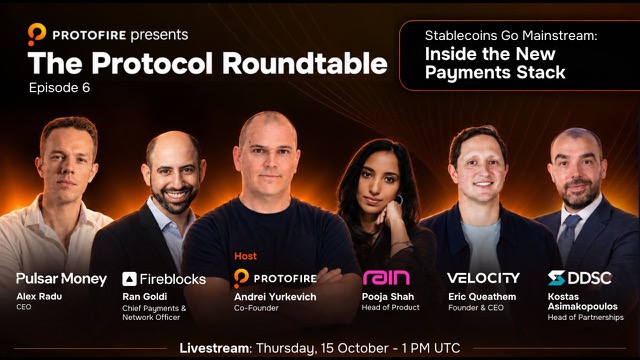
Whether stablecoin payouts should cost anything to run
 Ran Goldi, Fireblocks
Moment at 19:42Episode 6 · Stablecoins Go Mainstream: Inside the New Payments Stack
Each payout leaves your ledger through a payee wallet check, picks up its Travel Rule data, goes to the rail your routing rule names for that corridor, or to its fallback, and returns as a settlement matched to the ledger. We build that path, on one licensed rail or several.
Stablecoin payouts across licensed rails →Get a proposal
Tell us what you are building. An engineer reads it, we have a short call, and the written proposal follows within one business day.
Budget
An NDA is available from the first message and can cover anything you share. How it works