Stablecoin Payments in Your TMS
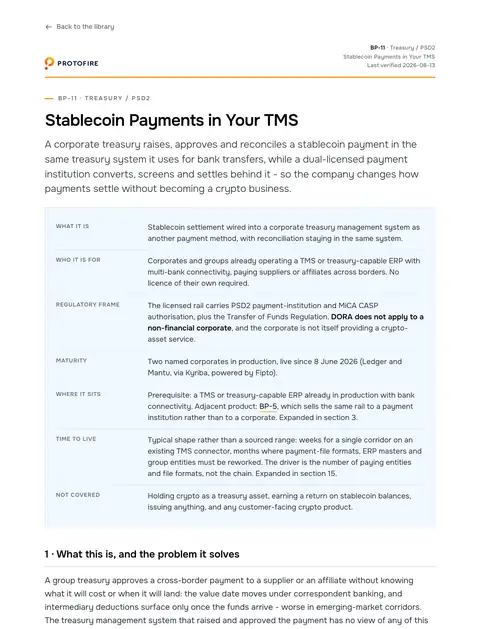
A corporate treasury raises, approves and reconciles a stablecoin payment in the same treasury system it uses for bank transfers, while a dual-licensed payment institution converts, screens and settles behind it - so the company changes how payments settle without becoming a crypto business.
The full blueprint adds all 8 risks with their controls and owners, the DORA third-party pack and the delivery plan in 4 phases.
Web document · ~15 pages · 22 min read · one link opens all 22 blueprints
- Maturity
- Proven
- Regime
- Treasury / PSD2
- Proven stack (4 of 5)
- Fipto · Kyriba · BVNK · Zerohash
- Last verified
- August 2026

Reviewed by Rado Patus, Offer Owner at Protofire
named non-financial corporates in production since 8 Jun 2026, settling through their existing treasury system.
The only public examples of stablecoin settlement inside a mainstream corporate treasury system. Two use cases on identical plumbing show it is a repeatable pattern, proven beyond a single company.
01. The opportunity
A group treasury pays suppliers and affiliates across borders through correspondent banking, where value dates are uncertain, intermediary deductions surface after the fact, and emerging-market corridors are the worst of both. The treasury management system where payments are raised, approved, released and reconciled has no view of anything that does not arrive as a bank statement. This pattern adds stablecoin settlement as another payment method inside that same system: the treasury raises and approves a payment as it already does, a licensed payment institution converts, screens and settles behind it, and balances reconcile back without a separate workflow.
It is possible now because one provider can hold both a PSD2 payment authorisation and a MiCA crypto-asset authorisation in the same jurisdiction, the combination the European Banking Authority pointed to on the overlap between payment services and crypto-asset services in e-money tokens. The corporate stays a client of that licensed provider and takes on no crypto-asset authorisation of its own. The first live corporate deployments were announced on 8 June 2026: Ledger runs automated supplier payments and Mantu runs cross-border intercompany settlement, both inside their Kyriba treasury system and executed by Fipto, a payment institution authorised by the ACPR and a CASP authorised by the AMF.
02. The regulatory position
03. Who's already done this
Live stablecoin payment flows inside its Kyriba treasury system, executed by a dual-authorised payment institution, announced as automated supplier payments. The clearest proof that the pattern runs inside a mainstream treasury system with no separate workflow.
The same rail and the same system, applied to cross-border intercompany settlement rather than supplier payments. The second distinct treasury use case on identical plumbing.
The execution layer behind both deployments: conversion, settlement and compliance monitoring. Both authorisations are verifiable on public registers before contracting, which is the point of the dual-licence design.
04. Does this fit you?
- Yes if you already run a TMS or treasury-capable ERP with multi-bank connectivity, you pay suppliers or affiliates across borders, and you have corridors where correspondent banking is slow or expensive.
- Not if you are a payment institution wanting to offer this to your clients - that is the same rail from the other side, and a different blueprint. Not if you have no treasury system to wire into. Not if the goal is yield on idle cash: MiCA prohibits paying interest on e-money tokens, and the honest destination for that demand is a fund unit, not a balance.
05. Four things worth knowing first
- DORA does not apply to an ordinary corporate treasury. It binds financial entities. Any provider or adviser implying a non-financial company owes DORA third-party obligations here is overstating - though if the payer is a bank, insurer or investment firm, the full regime does apply.
- The treasury-system layer has effectively one proven option. Only one treasury system was found with a named corporate running this in production. On any other system, expect to fund first-of-kind connector work and treat roadmap statements as roadmap.
- Supplier onboarding is the usual constraint, and it is slow. The corridor advantage depends on a beneficiary who can receive, which takes longer to arrange than the technical build.
- Accounting treatment is unsettled and jurisdictional, even for a balance held only in transit. That question belongs to the auditor and is worth raising early, well before year end.
06. The stack, layer by layer
Most of these layers can be rented from a named vendor, and usually should be. The part that matters is the one layer you have to own yourself.
The treasury system of record and the controls around it
The treasury management system, its approval matrix and its segregation of duties; multi-bank connectivity and existing payment-file formats; supplier and affiliate master data with the reconciliation process that consumes it; the treasury policy, internal audit and the external auditor. The corporate needs no licence of its own and is not providing a crypto-asset service.
The licensed payment rail
Payment execution under the provider's own PSD2 and MiCA authorisations with client-funds safeguarding, fiat conversion, on-chain settlement and local payout legs, and counterparty screening and travel-rule handling as the provider's own obligation. No treasury system, no ERP, no supplier master and no accounting, by design.
The connector, the mapping and the evidence (built and operated by Protofire)
The connector between the treasury system and the rail - instructions out, status and balances back, mapped to objects that already exist; payment-file mapping per paying entity with the exception path for held or returned payments; reconciliation rules and the evidence pack the auditor will ask for; and independent observability of settlement with the thresholds-to-actions policy behind it.
07. Why this stack
- The company needs no licence. It is a client of a licensed payment institution executing its own payments, and it is not a provider of crypto-asset services to anyone. That keeps the work a treasury project, with no authorisation for the company to obtain.
- One provider holds both licences. Executing a payment is a payment service under PSD2; doing it in an e-money token also engages MiCA, and the workable answer in the market is one provider authorised on both sides in the same jurisdiction.
- The workflow stays in one system. The payment is raised under the existing approval matrix and segregation of duties, and it reconciles in the same ledger and the same report as every other method. No second tool, no parallel process, no new team.
- No keys, no wallet, no holding. The corporate never takes custody. The stablecoin serves only as a payment rail and never sits on the balance sheet as a holding, which keeps the accounting and disclosure question as small as it can be.
Risks, controls and owners
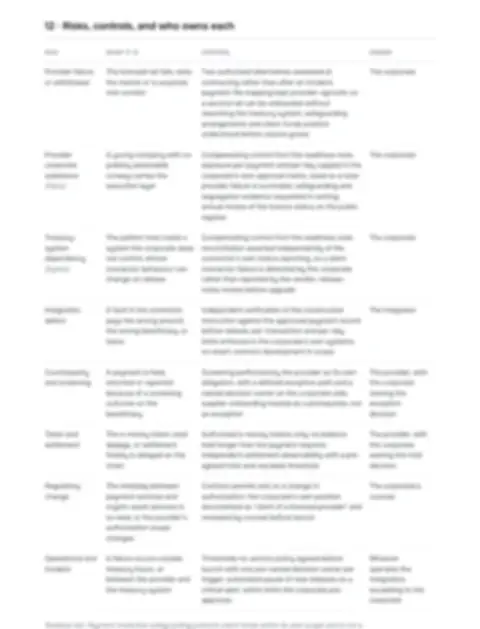
From the full blueprint · 3 of 8 shown, one with its control- Provider failure or withdrawalControl: Two authorised alternatives assessed at contracting rather than after an incident; payment-file mapping kept provider-agnostic so a second rail can be onboarded without reworking the treasury system; safeguarding arrangements and client-funds position understood before volume growsOwner: The corporate
- Provider corporate substance (Fipto)Control: in the full blueprintOwner: The corporate
- Treasury-system dependency (Kyriba)Control: in the full blueprintOwner: The corporate
The other 5 risks, and every control, are in the full blueprint.
Get all 8 with controls ↓Get the full BP-11
Web document · ~15 pages · 22 min read
This page is the short version. The full BP-11 adds all 8 risks with their controls and owners, the DORA third-party pack and the delivery plan in 4 phases. We email you a personal link, and it opens all 22 blueprints in the library.
We email your personal link and, now and then, a blueprint update. Privacy policy
Reviewed by Rado Patus, Offer Owner at Protofire · last verified August 2026
What the full blueprint adds, by reader
- Counsel
- The regulatory position across 5 regimes, article by article
- Risk & compliance
- All 8 risks, each with its control and the party that owns it
- Third-party risk
- The DORA pack: critical-or-important classification, the Art. 28(4) pre-contract assessment, Art. 30(3) contract clauses and Art. 29 concentration. Any commission we may earn on a named vendor is disclosed
- Technical lead
- Which of the 8 building blocks are essential and which are optional, and why
- Delivery
- The delivery plan in 4 phases, with the decision that gates each, then monitoring and incident response once live
- Board
- For the board paper: what each function gets, and where this pattern does not work
FAQ
Does a corporate treasury need a crypto licence to settle payments in stablecoins?
No. In the Stablecoin Settlement Inside the Treasury System pattern, the corporate acquires no licence of its own, because it is a client of a licensed payment institution executing its own payments rather than a provider of crypto-asset services. The licensed rail carries both a PSD2 payment-institution authorisation and a MiCA CASP authorisation, the combination the EBA pointed to on the overlap between payment services and crypto-asset services in e-money tokens. MiCA Art. 50 bars interest on e-money token balances, and DORA does not apply to a non-financial corporate.
Which corporates already settle stablecoin payments inside their treasury system?
Ledger, a non-financial corporate in France, went live on 8 June 2026 with stablecoin payment flows inside its Kyriba treasury system, executed by a dual-authorised payment institution as automated supplier payments. Mantu, an international group, went live the same day on the same rail and system, applied to cross-border intercompany settlement. The execution layer behind both is Fipto, a payment institution authorised by the ACPR and a CASP authorised by the AMF, whose authorisations are verifiable on public registers before contracting.
What does the corporate build versus rent in this pattern?
The corporate owns the treasury management system with its approval matrix and segregation of duties, its multi-bank connectivity and payment-file formats, the supplier and affiliate master data, and its treasury policy and auditor. It rents the licensed payment rail from providers such as Fipto and Kyriba, which handle payment execution under their own PSD2 and MiCA authorisations, fiat conversion, on-chain settlement, counterparty screening and travel-rule handling. What it builds is the connector between the treasury system and the rail, the payment-file mapping per paying entity, reconciliation rules and the auditor evidence pack.
Already evaluating this for your institution?
When you are ready, we scope a business case on your own numbers: the costed build, the controls, the SLA and the ROI your board needs to approve it. Or talk it through first.
Run this pattern in production, or tried to and stopped? .