Tangany Integration for Brokers and Banks With Their Own Liquidity Provider
Tangany holds and transfers crypto for your clients, and a liquidity provider of your choice fills their orders. So your systems send each completed trade into Tangany's ledger. Protofire, which has worked on Safe since 2018, builds that trade feed, onboarding and transfer flows and the daily match to core.

Reviewed by Luis Medeiros, Field CTO at ProtofireLast reviewed: November 2026
On this page
Work shipped for 60+ networks and 95+ protocols, including





Tangany keeps custody, and your firm brings the trading
Tangany holds and transfers crypto for your clients, and Protofire builds the part that Tangany leaves to your firm. A Tangany integration joins a custodian that does not trade to a broker or bank that does. Protofire builds the trade bookings and the daily match to core banking. We also build the onboarding and transfer flows.
Every completed trade has to reach Tangany's ledger. Tangany's terms say that the platform "transmits, among other things, information about completed trading transactions" through Tangany's interfaces (GTC 3.7). If your systems book a fill late or twice, the client's position at Tangany no longer matches your core banking system.
For example, a client sells bitcoin in your app. Your booking service then posts a transfer from the client account to the market-maker account in Tangany's ledger. Until that post arrives, Tangany shows the bitcoin as the client's, while your app shows it as sold.
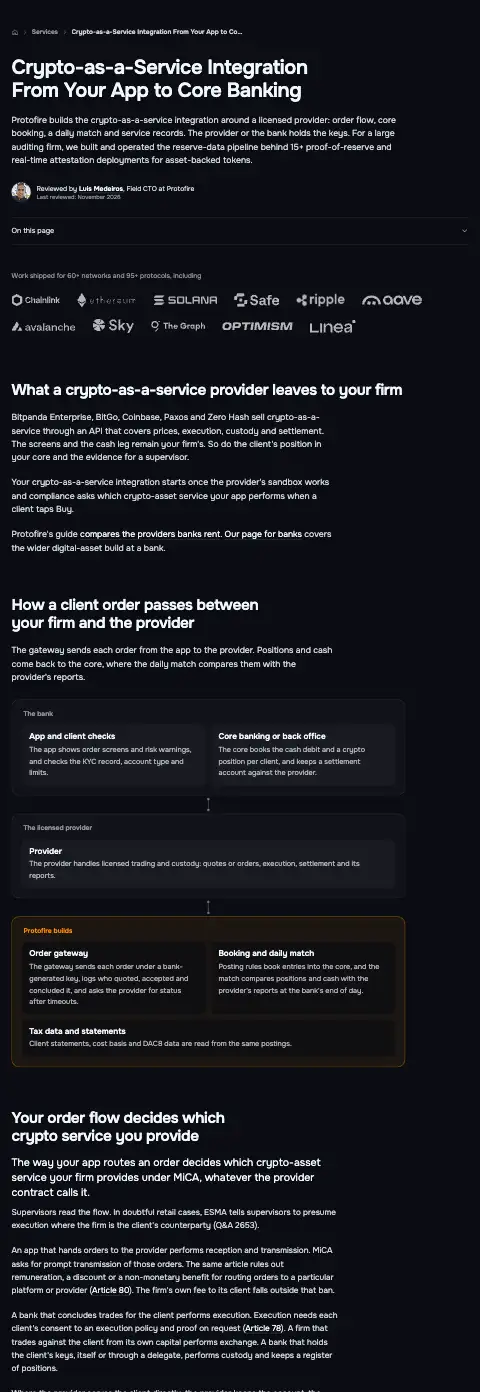
How a fill reaches Tangany's ledger and your core
Your booking service posts each fill to Tangany, and the match compares Tangany's file with core banking each night.
App and liquidity provider
Core banking
Trade booking service
Onboarding and transfer flows
Daily match and event receiver
Custody, ledger and client contract
Wallet checks
Six jobs Tangany leaves to your firm, and what Protofire builds
Tangany's documentation and terms leave six jobs to the firm that runs the client relationship.
The app your clients use
Tangany offers your clients no wallet app and no trading screen. Its custody page tells platforms, "Your front-end and user-interface are in your hands" (Tangany). Protofire builds the order, balance and transfer screens. Tangany advises against calling its API from client devices, so your servers make every call.
Prices and fills from your liquidity provider
"Tangany cannot buy or sell assets on your behalf," says Tangany's FAQ for eToro clients of 9 January 2024 (Tangany). So your firm chooses and contracts a liquidity provider for prices and fills. Protofire builds the link that brings each fill into your order records.
Each fill booked once in Tangany's ledger
In Tangany's Settlement API, a trade is a transaction between a client account and a market-maker account. Each transaction must state its total fiat value (Tangany). Funds with a future value date cannot be withdrawn. Protofire's booking service posts each fill under your own transaction ID, which Tangany requires to be unique in the ledger. Tangany accepts or discards a bulk post as a whole. So after a timeout, the service reads the ledger before it posts again with the same IDs.
The market-maker account and its funding
In Tangany's ledger, "the sum of all account balances always equals to 0" (Tangany). So when the market-maker account delivers crypto to clients, its balance goes negative until your firm books a funding deposit to it. Protofire builds that funding flow and a daily match of the account against your liquidity provider's settlement.
Client positions in core banking, matched every day
Tangany generates daily balance files in CSV or JSON. A file can take up to 15 minutes after its scheduled time (Tangany). The report date takes a time zone (Tangany's example is Europe/Berlin), so the cut-off follows local time. Protofire's match compares Tangany's booked and available balances with core, flags a late file and lists each break.
Events in order per object, and none for trades
Since 28 July 2026, Tangany has delivered webhooks in parallel, and "ordering is guaranteed per business object only" (changelog). No webhook fires for a ledger transaction. So the booking service reads trades back by polling the transaction list with an updatedAt filter. Protofire's receiver checks each signature and timestamp, drops repeats and asks Tangany to resend failed notifications (Tangany).
Crypto-asset service providers providing custody and administration of crypto-assets on behalf of clients shall keep a register of positions, opened in the name of each client, corresponding to each client's rights to the crypto-assets.
Tangany's register entries, API versions and limits
- BaFin register
- The register lists Tangany GmbH, Brienner Straße 53, 80333 Munich, BaFin-ID 50085612. Its MiCA entries are custody and administration of crypto-assets for clients and transfer services, both from 8 August 2025 (BaFin).
- Other register entries
- The register also lists qualified crypto custody under the German Banking Act (KWG) from 30 December 2024. It lists payment services under the ZAG, for deposit, withdrawal and credit-transfer business, from 2 March 2026.
- API versions
- The changelogs list Settlement API 2.111.6 (3 November 2026) and Customers API 2.14.0 (9 October 2026).
- Custody model
- Tangany keeps one omnibus wallet per blockchain and records each client's movements in its internal booking system (GTC 3.2). A single wallet per client applies "if agreed between Tangany and the Platform" (GTC 3.3).
- Webhooks
- Tangany's documentation labels webhooks beta in November 2026. Events cover deposits, withdrawals, funding requests, wallets and customer status, signed with HMAC-SHA256.
- Staked balances
- The ledger balance endpoint includes staked balances by default, and the daily file account_staked_balances_v1 reports them. Staking.LiquidityRiskDetected and Staking.LiquidityRiskResolved are webhook events.
- Rate limits and amounts
- By default, the Settlement API allows 2,400 calls per 60 seconds, and the Custody and Customers APIs allow 600. Amounts take up to 18 decimal places.
Checked 16 November 2026 against Tangany's documentation, its terms (version 2.2.0) and the BaFin register.
Each client's Tangany contract starts and ends in your platform
Your clients contract with Tangany directly, through your platform (GTC 1.4).
Tangany's terms, accepted in your onboarding
Each client concludes the agreement "via registration through the Platform and acceptance of the GTC" (GTC 2.1). Through the Customers API, your firm fetches the latest contract, shows it and records the acceptance (Tangany). After your own KYC, your systems create the client with the signed date. Protofire builds that hand-off and reads the Customer.StatusChanged webhook.
Holdings reports and transfer confirmations
Tangany sends each client a quarterly holdings report through your platform "if it supports transmission" (GTC 3.11). Transfer confirmations list the addresses, transaction hash, amount and fees (GTC 4.10 and 5.10). Protofire builds the screens that show these documents.
A client who leaves your platform also leaves Tangany
When the client's agreement with your platform ends, "the contract with Tangany shall automatically terminate" (GTC 10.4). Your offboarding flow sets a cancelled date in the Customers API, with the reason TERMINATION, REVOCATION or OFFBOARDED. Protofire builds that flow and the transfer-out path. The same records feed your exit plan if you change custodian.
Deposits and withdrawals need a verified wallet and Travel Rule data
Tangany requires a verified wallet for each deposit and withdrawal (Tangany).Its terms also stop a transfer when the Travel Rule data exchange fails (GTC 4.7 and 5.7).
Wallet check
Deposits: A deposit not covered by the sender wallet's verification waits in action_required, with the reason WALLET_VERIFICATION_REQUIRED.
Withdrawals: Each verification type has a EUR limit per workspace, and Tangany refuses a larger amount.
Ledger effect
Deposits: A completed deposit credits the client account from System:CustomerDeposit.
Withdrawals: Creating a withdrawal debits the client at once. Tangany confirms the debit at broadcast, or cancels it and restores the balance.
Other refusals
Deposits: Since 27 October 2026, Tangany rejects a deposit below the minimum as BELOW_MINIMUM. It holds a deposit from an unknown sender until a wallet with that address is created.
Withdrawals: Tangany returns amount_too_low, amount_too_low_to_cover_fees or customer_status_not_eligible. A suspended wallet blocks withdrawals.
Protofire builds
Deposits: The redirect to the verificationUrl that Tangany returns, a held-deposit queue and the credit booking.
Withdrawals: The estimate and create flow with its time-limited token, client messages and status bookings.
Our record: Safe deployments for on-chain custody
Protofire has worked on Safe, the multisig smart account, since 2018.We deployed Safe on 120+ EVM networks, where it secures $2B+. A Safe holds assets for its owners. It moves them once the set number of owners has approved, and the chain records each movement. The Safe deployments matter to a broker or bank on Tangany, because the booking service that Protofire builds also records each movement of client assets.
How a Tangany integration goes from sandbox to the first booked trade
- Step 1
What your firm sends first
Your firm sends the scope of its Tangany contract: the APIs enabled, omnibus or single wallets, and the customer lifecycle mode. You also send your liquidity provider's fill format and your core system's name. - Step 2
A buy, a sell and a withdrawal traced in the sandbox
A Protofire engineer traces one buy, one sell and one withdrawal through Tangany's sandbox scenarios. The scenarios step transactions, deposits and withdrawals through successful, cancelled and rejected outcomes and fire webhooks (Tangany). The trace shows which postings your core needs. - Step 3
Bookings and the daily match in the first phase
Protofire builds the booking service and the daily match in the first phase. Onboarding, transfers and statement screens follow in the next phase. - Step 4
Your team or Protofire runs it after launch
Your team runs the integration, or Protofire operates it under a written scope through managed onchain operations. The code, posting rules and runbooks are yours.
How work on a Tangany build starts
Protofire's services call Tangany with OAuth2 client credentials that your staff create in Tangany's Partner Portal and keep in your vault.Where Protofire operates a service, the scope lists each write call it makes, such as trade postings and withdrawals. Tangany keeps the custody keys, and its Custody API documentation says keys generated in its HSMs cannot be exported.
- Proposal
- In writing, one business day after the discovery call: findings, a plan in phases and the first step we recommend.
- Price
- Fixed per phase when you commission it, against written acceptance criteria. Overruns inside them are ours to absorb, invoices follow delivered milestones, and you can stop at any phase boundary. Anything we operate after launch is priced in the proposal as its own recurring line, with the notice to end it.
- Ownership
- Code we write for you, contracts, the keys and credentials this work creates and the accounts your infrastructure runs in are yours by contract, within the license of any third-party software involved. Keys that a custody platform or a staking provider holds under its own key model stay with it under your contract; every other custody key stays with you or the custodian you appoint. Where the scope places something on servers we rent, it says what moves to you and when. An NDA is available from your first message, and we sign a data processing agreement (DPA) together with it.
- After launch
- Delivery closes with a hypercare window and a defect warranty, with their terms written into the proposal. A service we operate continues under its written scope until that scope ends.
- Access
- Read-only by default. A role that can start requests only if your written scope names one; never a signer, approver, administrator, key holder or recovery role on your contracts, wallets or custody platform. Services we build call each platform on credentials your staff issue and keep in your vault. Anything that approves or moves funds runs in your environment, and a scope under which we operate a service lists every write call it makes. Where the scope has us operate nodes, validators, monitors, explorers or indexers, it names the role and any key we hold on those servers, and in your own cloud account you can remove it.
- Licenses
- Protofire is an engineering firm and holds no financial or crypto-asset license; licensed activity stays with you and your providers.
How we work shows a worked proposal.
Where Protofire's Tangany work does not fit
Protofire's Tangany build fits a firm that keeps its own trading.
- You want one provider for trading and custody. Tangany holds and transfers only, so compare providers in our crypto-as-a-service guide for banks.
- You want prices or liquidity from Protofire. Protofire builds the link to your liquidity provider and does not quote or trade.
- Your clients should hold their own keys. Tangany is the custodian, so that product calls for a self-custody wallet.
- You need a view on your own license. Protofire holds no license and gives no legal opinion.
After launch, Protofire holds no custody key and no client funds.
Related guides and services
FAQ
What is a Tangany integration?
Who can build a Tangany integration for a broker or bank?
Which Tangany APIs does a broker need?
Who runs KYC when a broker uses Tangany?
Does our firm need its own license to offer crypto or stablecoins through Tangany?
Why can a Tangany withdrawal fail after its estimate succeeded?
Get a proposal
Tell us what you are building. An engineer reads it, we have a short call, and the written proposal follows within one business day.