Boerse Stuttgart Digital Integration for Banks Using the BSD Broker API
Boerse Stuttgart Digital executes crypto orders and holds custody. Your bank imports KYC data, books orders that BSD revokes and matches each branch's net settlement. Protofire builds those services and connects them to your core. It built the DEX core for Swarm Markets, a BaFin-licensed DEX at launch.

Reviewed by Luis Medeiros, Field CTO at ProtofireLast reviewed: November 2026
On this page
Work shipped for 60+ networks and 95+ protocols, including





The BSD Broker API leaves booking and matching to your bank
Boerse Stuttgart Digital runs execution and custody for your clients. A Boerse Stuttgart Digital integration connects your app and core banking to the BSD Broker API. EUWAX AG, the trading operator of BSD Broker, executes the orders, and Boerse Stuttgart Digital Custody GmbH holds the crypto. Your bank onboards the clients, books their orders and matches BSD's settlement. Protofire builds the software for those jobs and connects it to your core.
BSD's API reference lists two webhook events, and both report KYC. Your services read trades, revoked orders, withdrawals and the settlement from the API or the FIX TradeReport channel. A bank that does not read revoked orders keeps a position in its core that BSD's back office has reversed.
meinKrypto is one example of the model. DZ BANK and Atruvia built meinKrypto, the crypto service that cooperative banks switch on in the VR Banking App. Boerse Stuttgart Digital holds the custody, and EUWAX executes the trades. In May 2026, VR-Bank Würzburg became the first cooperative primary bank on meinKrypto.
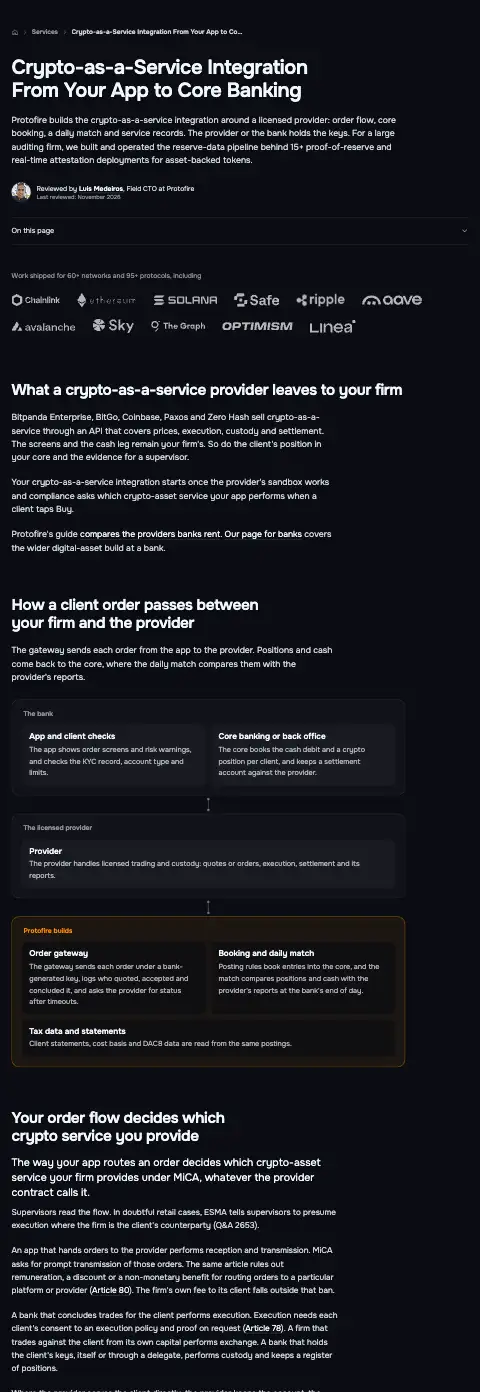
How a BSD Broker order and its settlement reach your core
The gateway sends orders to BSD, and jobs post the results back to the core.
App and onboarding
Core banking
BSD Broker
BSD Custody
User sync and order gateway
Revocation and settlement jobs
Statements and tax data
Your bank's jobs in a Boerse Stuttgart Digital integration
Five jobs around BSD's execution and custody remain with your bank.
Clients trade once BSD confirms their KYC data
In BSD's B2B2C model, your app imports each client's KYC data to BSD, including the PEP flag and tax residency. BSD's back office then runs AML checks. A webhook reports Confirmed or Rejected (BSD Broker API). Protofire builds the webhook receiver and an import that sends one update per client at a time, as BSD expects.
One BSD user for each client and branch
BSD identifies a user by your own reference plus the branch, and your bank stores the userId that BSD returns. Since version 1.83 of 5 November 2026, a repeated create call for that pair returns the existing userId. Protofire builds the mapping, so a retry after a timeout leaves one user per client.
An order's outcome checked after a timeout
Each market, limit or stop order needs a clientOrderId of up to 35 characters, unique per user. After a timeout, a retry with the same clientOrderId returns 409 Conflict if the order was already placed. A 503 means the order "might still be executed". Protofire builds the order gateway, which checks the order's state with GetOrder before it reports a failure.
Withdrawals booked on your own request ID
BSD requires your clientWithdrawalId on fiat withdrawals, takes it on crypto withdrawals and answers a repeated ID with 409. BSD pays fiat withdrawals only to a whitelisted IBAN, and its custody service offers whitelisting and four-eyes approval rules. Protofire builds the withdrawal service and a status job keyed on your clientWithdrawalId.
Statements and tax data built from your postings
A bank that provides custody owes each client a statement of position at least once every three months and on request (MiCA Article 75(5)). BSD's API returns portfolio and holdings data, and its files differ per integration. Protofire builds the client statements and tax data from the postings in your core.
Crypto-asset service providers that outsource services or activities to third parties for the performance of operational functions shall take all reasonable steps to avoid additional operational risk. They shall remain fully responsible for discharging all of their obligations pursuant to this Title [...]
How each BSD Broker change reaches your bank
BSD reports each kind of change through its own channel and identifier.
KYC status
How BSD reports it: A webhook signed with HMAC-SHA256. BSD retries a failed delivery up to 3 times, 2 to 8 seconds apart, and then stops.
Protofire builds: A receiver that checks the signature and stores each event, plus a job that reads BSD's events list after a gap.
Executed trade
How BSD reports it: An execution report on the FIX TradeReport channel for each trade, placed through REST or FIX, whether or not your session was connected.
Protofire builds: A trade feed that books each report once on BSD's order ID, execution type and order status, and requests a resend after a disconnect.
Revoked or price-improved order
How BSD reports it: The revoked-orders list, which BSD's sample job polls every 5 minutes with a cursor, or FIX tags 20021 to 20024 on the trade report.
Protofire builds: A revocation job that reads both sources and books each change on the order IDs that BSD returns.
BSD's back office can revoke an order after execution
BSD's back office can revoke an executed order, so a trade that your core has booked can change afterward.BSD starts the process by hand from its dashboard, "usually triggered by an email or a support ticket" (BSD Broker API). The original order moves to Revoked status, and BSD creates a storno order with the same amount and the reversed side.
A price improvement adds a third order on the same side at a better price, and your bank can set the commission on that order. One client trade can end as three orders.
Protofire's revocation job books the storno order as the reversal of the original posting, linked by BSD's order IDs. The job books a price-improved order as a new trade with your commission.
BSD nets settlement per branch and asset on the TARGET2 calendar
The BSD Broker API splits users and settlement by branch, which fits a central institution with member banks.BSD uses the branch to classify users, "for example by bank branch, department or any other smaller divisions". The order commission is a fixed fee that "can be different per customer once the customer is at a different bank".
A settlement period starts at midnight Europe/Berlin on a TARGET2 working day and ends at midnight of the next working day. Weekends and TARGET2 holidays belong to the period of the preceding working day. Under post-trade settlement, the snapshot becomes available after BSD's settlement run at 00:10 Berlin time, and the call returns 404 until then. The snapshot gives one entry per branch, with a net amount per asset and its own reference such as PartnerB-BranchA-20261029.
BSD returns the start and end of each period in UTC. Your core may close at another hour. Protofire's match job converts each period to Berlin time and maps it to your core's business dates. The job then lists each branch's differences against your postings.
Boerse Stuttgart Digital companies and API terms
- Business unit
- Boerse Stuttgart Digital is a business unit of Boerse Stuttgart Group. Since the merger closed on 5 August 2026, tradias is its trading brand (merger release).
- Custody company
- Boerse Stuttgart Digital Custody GmbH, Stuttgart: MiCA authorization from BaFin of 17 January 2025 for custody and administration and for transfer services (ESMA register).
- Trading companies
- EUWAX AG: Article 60 notifications for exchange of crypto for funds or other crypto (1 April 2025) and for execution of orders (21 November 2025). Tradias GmbH: Article 60 notification of 19 March 2025.
- API
- BSD Broker API v1.83 of 5 November 2026: REST, FIX 4.4 on four channels (Quotes, RfQ, TradeReport, Trading) and WebSocket market data. It supports B2B and B2B2C set-ups.
- Access
- A bearer token from the clientId and clientSecret that BSD issues, valid for one hour.
- Assets
- 69 assets in the API's asset table on 16 November 2026. All trade against EUR, and seven also against USD, "activated upon request".
Read on 16 November 2026 in BSD's API reference, ESMA's interim MiCA register and the merger release.
Our record in KYC-gated trading: the Swarm Markets DEX
In 2021 Protofire built the DEX core (a Balancer fork) and the subgraph for Swarm Markets and contributed to dOTC.Swarm Markets was a BaFin-licensed DEX at launch where only KYC-verified wallets trade. Swarm Markets held the license and ran KYC and permissioning.
A bank on Boerse Stuttgart Digital works with the same split of roles. BSD's companies execute and hold custody. Protofire builds the software around them.
The build moves through BSD's Sandbox and Prelive first
Four steps take the build from your BSD setup to Production.
- Step 1
Your BSD model, branches and core system
You send your BSD model, B2B or B2B2C, your branches with the fee for each, and your core system. A written proposal then scopes the services. - Step 2
Timeouts and errors forced in Sandbox and Prelive
BSD's Sandbox and Prelive accept test values that force timeouts and errors. A Protofire engineer runs the gateway and the user import against those values. - Step 3
KYC import and order gateway before the jobs
Protofire builds the KYC import and the order gateway first, because a client cannot trade without them. The revocation job and branch match follow. - Step 4
Runbooks for the FIX reset and BSD's changelog
A FIX session "must not remain active for longer than one week", except on the Quotes channel. Your services place no trades during the reset, because the TradeReport channel can otherwise miss an execution report. Your team also gets a changelog check, because BSD marked a change in version 1.79 of 28 October 2026 as breaking.
How a BSD Broker project with Protofire starts
The services that Protofire builds call the BSD Broker API with the clientId and clientSecret that BSD issues to your bank.Your bank keeps them in its own vault, and BSD's API shows the webhook signing secret once, so your staff store it there too. Where Protofire runs the services under a written scope, through managed onchain operations, the scope lists each write call: orders, withdrawals and user deletions.
- Proposal
- In writing, one business day after the discovery call: findings, a plan in phases and the first step we recommend.
- Price
- Fixed per phase when you commission it, against written acceptance criteria. Overruns inside them are ours to absorb, invoices follow delivered milestones, and you can stop at any phase boundary. Anything we operate after launch is priced in the proposal as its own recurring line, with the notice to end it.
- Ownership
- Code we write for you, contracts, the keys and credentials this work creates and the accounts your infrastructure runs in are yours by contract, within the license of any third-party software involved. Keys that a custody platform or a staking provider holds under its own key model stay with it under your contract; every other custody key stays with you or the custodian you appoint. Where the scope places something on servers we rent, it says what moves to you and when. An NDA is available from your first message, and we sign a data processing agreement (DPA) together with it.
- After launch
- Delivery closes with a hypercare window and a defect warranty, with their terms written into the proposal. A service we operate continues under its written scope until that scope ends.
- Access
- Read-only by default. A role that can start requests only if your written scope names one; never a signer, approver, administrator, key holder or recovery role on your contracts, wallets or custody platform. Services we build call each platform on credentials your staff issue and keep in your vault. Anything that approves or moves funds runs in your environment, and a scope under which we operate a service lists every write call it makes. Where the scope has us operate nodes, validators, monitors, explorers or indexers, it names the role and any key we hold on those servers, and in your own cloud account you can remove it.
- Licenses
- Protofire is an engineering firm and holds no financial or crypto-asset license; licensed activity stays with you and your providers.
How we work shows a worked proposal.
Firms that need a different build or a licensed provider
Three kinds of firm need something other than this build.
- Your bank is a member of a network with a central service such as meinKrypto. The central institution builds the connection once, and your bank switches the service on. Protofire's member-bank network blueprint shows that rollout.
- Your portfolio or core vendor already connects to BSD. Trever, for example, connects financial institutions to BSD's trading and custody. Protofire then builds only what the vendor's connector leaves out.
- You need a firm to hold a license, client money or crypto. Protofire is an engineering firm and holds no MiCA authorization or notification.
After launch, Protofire holds no client asset and no signer, admin or approver role at BSD.
Related guides and services
FAQ
What is a Boerse Stuttgart Digital integration?
Who can build a Boerse Stuttgart Digital integration for a bank or a broker?
Does our bank need its own MiCA notification to offer crypto through BSD?
Do we have to share client KYC data with Boerse Stuttgart Digital?
How does Protofire's work appear in our DORA register of information?
Get a proposal
Tell us what you are building. An engineer reads it, we have a short call, and the written proposal follows within one business day.