Bitpanda Enterprise Integration for Banks Offering Crypto and Stocks in Their App
Bitpanda Enterprise runs crypto and stock investing for banks. The bank accepts offers under its own transaction ID, funds settlement and books positions. Protofire builds the bank's side. For a large auditing firm, we built and operated the reserve-data pipeline behind 15+ proof-of-reserve and real-time attestation deployments for asset-backed tokens.

Reviewed by Luis Medeiros, Field CTO at ProtofireLast reviewed: November 2026
On this page
Work shipped for 60+ networks and 95+ protocols, including





What Bitpanda Enterprise runs and what your bank keeps
A Bitpanda Enterprise integration connects Bitpanda's investing service to your bank's app, treasury and core banking. Protofire builds the bank's side of that connection. Bitpanda introduced Bitpanda Enterprise on 4 March 2026, "formerly known as Bitpanda Technology Solutions" (Bitpanda). Its Investment-as-a-Service product comes in two models. Under "Our license", Bitpanda's entities execute trades and keep terms with each client, and custody can be part of the setup. Under "Bring-your-own license", Bitpanda offers to "integrate selected modules into your own licensed and operational environment" (Bitpanda).
Under both models, your bank's systems do jobs that Bitpanda's API leaves to them. Your app accepts each offer under a transaction ID that your bank generates. Your treasury funds the settlement balance at Bitpanda where the contract sets one. Your core books each client's position. Under bring-your-own license, Bitpanda restricts its user endpoints, so client records and KYC data remain in your own systems.
For example, Bitpanda can answer a client's purchase with 202 while the trade is still in progress. Your app has to learn the outcome before your core books the trade. The same purchase can take your settlement balance below its lower threshold, and Bitpanda then asks for a top-up by webhook.
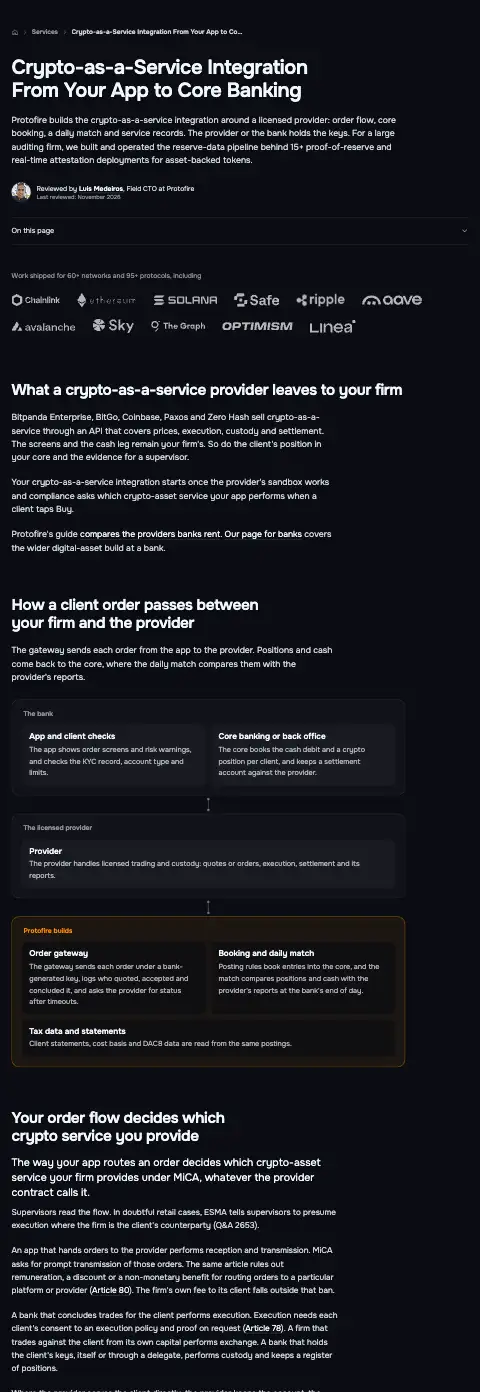
Who runs each part of a Bitpanda Enterprise trade
App and client onboarding
Core banking and treasury
Execution, custody and terms
API, webhooks and reports
Offer service and webhook receiver
Settlement and ledger match
Where a Bitpanda Enterprise integration needs your bank's systems
Bitpanda's documentation describes four jobs that the bank's own systems must do.
Your transaction ID on each accepted offer
A trade on Bitpanda Enterprise takes two calls. Your app creates an offer and accepts it with an external_transaction_id that your bank generates. If processing exceeds a short, predefined time frame, for example 10 seconds, Bitpanda answers 202. Its docs then say "Retry sending the same request until you receive a 200", or check the offer status (Bitpanda Enterprise docs). "A user can only accept the newest offer created."
A prefunded balance that Bitpanda asks you to top up
Where your contract sets a prefunded balance, client buys draw on your bank's money at Bitpanda. Bitpanda sends a top-up webhook when a buy trade takes the balance below a lower threshold. A daily webhook compares the balance with a set baseline (Bitpanda Enterprise docs). Your system announces each transfer with POST /v1/deposit, "essentially a promise for payment" (Bitpanda Enterprise docs). The deposit is pending until Bitpanda confirms receipt.
Signed webhooks that can arrive more than once
Bitpanda signs its webhooks under RFC 9421 with ECDSA P-256 and SHA-256 (Bitpanda Enterprise docs). New integrations must verify the sig2 signature with keys from Bitpanda's JWKS endpoint (Bitpanda Enterprise docs). The docs ask for idempotent processing, because "the events might be sent one or multiple times". Each delivery includes an X-BTS-Idempotency-Key header, and GET /v1/events lists events after a given ID.
Client positions and the bookings Bitpanda makes on its own
Bitpanda keeps a portfolio for each client under a Bitpanda user ID, and your core needs its own record of each portfolio. Bitpanda also books transactions the client did not start, such as staking rewards, tax refunds, deductions and OTC trades (Bitpanda Enterprise docs). Bitpanda deducts metal storage fees weekly. Corporate actions arrive by webhook.
Bitpanda's two license models decide who keeps the client record
Your license model changes which client data your bank sends to Bitpanda.Bitpanda's product FAQ says responsibilities "are agreed during solution design and reflected in the contractual setup" (Bitpanda).
Client terms
Our license: Bitpanda keeps its own terms for each user.
Bring-your-own license: Bitpanda's create-user call lists no accepted terms for this model.
Client data sent to Bitpanda
Our license: Master data, KYC data and accepted terms, plus AML, appropriateness, DAC8 and FATCA answers. Your app shows the ex-ante cost report and KID per offer.
Bring-your-own license: An external_id, an account level and a language. Bitpanda restricts user details, user search and verification upload (API reference).
Custody
Our license: Bitpanda's entities can hold the assets. Bitpanda says custody depends on the asset class and operating model.
Bring-your-own license: Bitpanda's page lists "self-custody setups" among the fits.
What Protofire builds
Our license: Onboarding hand-off, offers and accepts, deposit calls and core booking.
Bring-your-own license: Client records and KYC in your systems, module calls and core booking.
[...] a CASP cannot designate agents in order to provide crypto-asset services on behalf of the CASP concerned. If a CASP appoints an agent, the agent needs to be a CASP itself.
Bitpanda Enterprise facts that shape the build
- Assets
- Bitpanda's Investment-as-a-Service page lists 650+ crypto assets and 10,000+ stocks, ETFs, metals and commodities (Bitpanda).
- MiCA, Austria
- ESMA's interim register lists Bitpanda GmbH as authorized by Austria's FMA on 9 April 2025, with services offered cross-border in 29 other EEA states (ESMA).
- MiCA, Germany
- ESMA's interim register lists Bitpanda Asset Management GmbH as authorized by Germany's BaFin on 24 January 2025 (ESMA).
- Tokens
- Bitpanda's OAuth 2.0 access token lasts 10 minutes. A refresh token becomes invalid after 24 hours or as soon as it is used (Bitpanda Enterprise docs).
- API version
- Version 3.0.5 came with Bitpanda's release of 5 November 2026, which shows each endpoint's required permission and rate limit (Bitpanda Enterprise changelog).
- Reports
- Report endpoints cover trades, swaps, users and AUM. A search of settlement transactions covers at most 31 days per query (Bitpanda Enterprise docs).
Read on 16 November 2026 from Bitpanda's product page, its documentation and ESMA's interim MiCA register.
What Protofire builds on your bank's side of Bitpanda
Protofire builds five services that your treasury, finance and operations teams use after launch.
One booking per client trade
Your core books a trade once, after Bitpanda reports the offer as finished. Protofire builds the offer service, which generates your transaction ID and, after a 202 or a lost answer, repeats the call or reads the status.
Top-up requests that treasury can act on
Treasury sees each top-up request with the amount Bitpanda asks for. Your staff send the wire. Protofire builds the webhook handler, the deposit call and the general ledger account for your balance at Bitpanda.
Holdings in your core that agree with Bitpanda's portfolio
Your core shows each client's holdings, including the fees, staking rewards and corporate actions that Bitpanda books on its own. Protofire writes the posting rules and a job that mirrors each portfolio.
A webhook receiver that checks each event
The receiver checks each Bitpanda event and counts it once before your systems act on it. Protofire builds the receiver with an IP filter, the sig2 check and deduplication on the idempotency key, plus a job that reads missed events.
A daily match at your bank's cut-off
Finance gets a daily list of differences between your ledger and Bitpanda's reports, at your bank's cut-off in local time. Bitpanda's trade search uses UTC, so Protofire's job assigns each record to your business day and flags a late report. Your team confirms with Bitpanda which clock its settlement search uses.
What Protofire brings to matching a provider's records
For a large auditing firm, Protofire built and operated the reserve-data pipeline behind 15+ proof-of-reserve and real-time attestation deployments for asset-backed tokens.Your match against Bitpanda's reports also depends on a pipeline that reads records another firm writes. Protofire's proof of reserve page describes that service.
Work starts with one offer traced through Bitpanda's staging
- Step 1
Your contract model and core system
Your team sends the license model and the settlement type from your Bitpanda contract. It also names your core banking system. - Step 2
One offer from creation to booking in staging
A Protofire engineer follows one offer through Bitpanda's staging environment. The trace runs from accept to the top-up webhook, the deposit call and a test position in your core. Protofire builds the offer service and the settlement flow before the other services. - Step 3
Production IDs and the token chain
Staging and production use different asset, terms, AML question and fiat IDs, so Protofire maps each one before go-live. One service owns the token refresh chain, because a refresh token stops working once used. - Step 4
What your bank owns at the end
The code, configuration and runbooks belong to your bank. Your team runs the services, or Protofire operates them under a written scope through managed onchain operations.
How work with Protofire starts
Bitpanda issues a client_id and a client_secret for each environment, encrypted to a PGP public key that your bank provides (Bitpanda Enterprise docs).Your staff keep both in your bank's own vault. A scope under which Protofire operates a service lists each write call that service makes, such as accept and deposit.
- Proposal
- In writing, one business day after the discovery call: findings, a plan in phases and the first step we recommend.
- Price
- Fixed per phase when you commission it, against written acceptance criteria. Overruns inside them are ours to absorb, invoices follow delivered milestones, and you can stop at any phase boundary. Anything we operate after launch is priced in the proposal as its own recurring line, with the notice to end it.
- Ownership
- Code we write for you, contracts, the keys and credentials this work creates and the accounts your infrastructure runs in are yours by contract, within the license of any third-party software involved. Keys that a custody platform or a staking provider holds under its own key model stay with it under your contract; every other custody key stays with you or the custodian you appoint. Where the scope places something on servers we rent, it says what moves to you and when. An NDA is available from your first message, and we sign a data processing agreement (DPA) together with it.
- After launch
- Delivery closes with a hypercare window and a defect warranty, with their terms written into the proposal. A service we operate continues under its written scope until that scope ends.
- Access
- Read-only by default. A role that can start requests only if your written scope names one; never a signer, approver, administrator, key holder or recovery role on your contracts, wallets or custody platform. Services we build call each platform on credentials your staff issue and keep in your vault. Anything that approves or moves funds runs in your environment, and a scope under which we operate a service lists every write call it makes. Where the scope has us operate nodes, validators, monitors, explorers or indexers, it names the role and any key we hold on those servers, and in your own cloud account you can remove it.
- Licenses
- Protofire is an engineering firm and holds no financial or crypto-asset license; licensed activity stays with you and your providers.
How we work shows a worked proposal.
When your bank needs a different build
Four kinds of request go elsewhere or need a smaller build.
- Your clients use Bitpanda's configurable interface. The build then comes down to sign-in, settlement funding and the position mirror.
- You want an institutional trading desk or corporate custody. Bitpanda Enterprise sells Liquidity and Institutional Custody as separate products, and Protofire's custody platforms guide covers custody that a bank runs itself.
- Your clients should hold their own keys. That calls for a wallet product outside Investment-as-a-Service.
- Your bank is still choosing a provider. Protofire's crypto-as-a-service guide compares Bitpanda Enterprise with the other providers that banks use.
Protofire holds no license and no client funds or keys, and gives no legal opinion on your bank's role. Bitpanda's entities and your bank hold the licenses.
Related guides and services
FAQ
What is a Bitpanda Enterprise integration?
Who can build a Bitpanda Enterprise integration for a bank?
Can a client be charged twice if an accept call times out?
Can our bank offer Bitpanda's crypto service without its own MiCA notification?
Where does a Bitpanda Enterprise build appear in our DORA register?
What changed in Bitpanda Enterprise's API in November 2026?
Get a proposal
Tell us what you are building. An engineer reads it, we have a short call, and the written proposal follows within one business day.