Sygnum Integration for Banks on the Sygnum B2B API
Sygnum Bank AG supplies custody, brokerage, staking and transfers to other banks through its B2B API. The bank's side covers certificates, core booking, a daily balance match and staking records FINMA asks for. Protofire builds and connects it. In 2020 we built the pool-master proxy contract for KyberDAO staking.

Reviewed by Luis Medeiros, Field CTO at ProtofireLast reviewed: November 2026
On this page
Work shipped for 60+ networks and 95+ protocols, including





What Sygnum's B2B platform leaves to the bank
Sygnum is a bank that supplies other banks. Sygnum Bank AG offers custody, brokerage, staking and transfers to banks through its B2B Banking platform, with "dedicated Bank-to-Bank integration via APIs" (Sygnum). A Sygnum integration connects a bank's own channels and core banking system to that platform. Sygnum leaves the bank's side of the connection to the bank, and Protofire builds and connects it.
The bank keeps the client and the books. The bank's app takes each order, and its core banking system books the cash leg and the client's crypto position. A daily match then compares those positions with the balances Sygnum reports. A Swiss bank that offers staking also keeps the client mandates and records that FINMA's staking guidance asks for.
Protofire works inside the bank's own access to Sygnum. Calls to Sygnum run under an mTLS certificate that Sygnum signs from the bank's own request (Sygnum developer portal). Sygnum releases its API specifications to logged-in clients, so Protofire builds from the copy that the bank shares. Protofire tests each path in Sygnum's UAT environment before the bank moves it to Production.
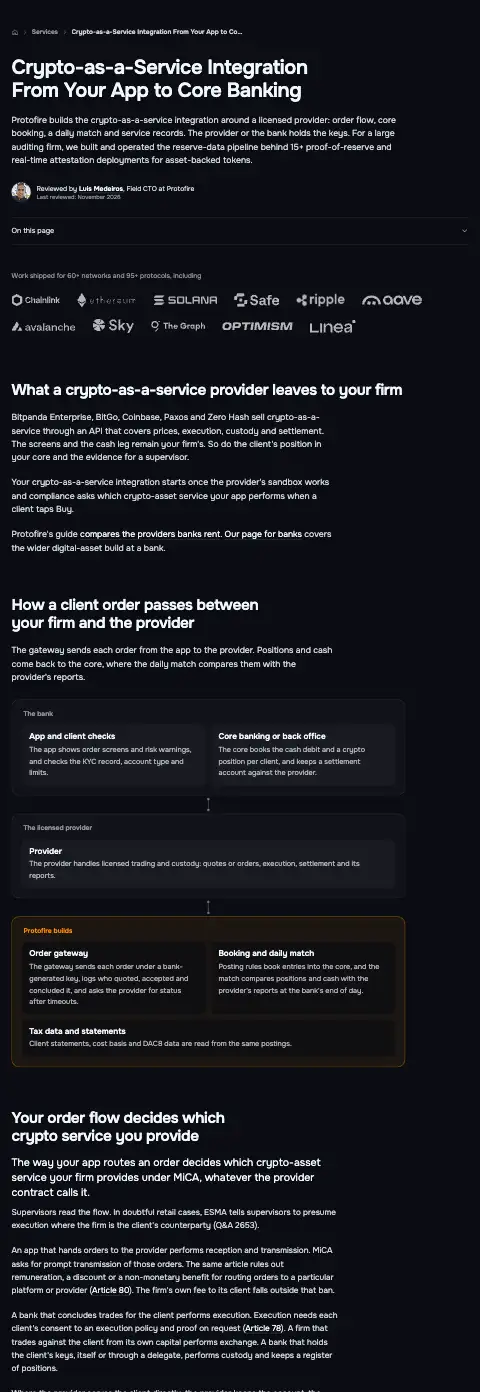
Where the bank's systems meet Sygnum's B2B platform
The bank's gateway sends each call to Sygnum under the bank's own certificate. Webhooks and balance reads come back into the core, where a daily job matches them with client positions.
Channels and onboarding
Core banking
Trading, custody and staking
B2B API
API gateway
Event receiver and posting rules
Balance match and staking records
What Protofire builds on the bank's side of Sygnum's B2B API
The bank's systems turn each Sygnum order, event and balance into postings that finance can check.
Credentials renewed before Sygnum's expiry time
Your staff replace each Sygnum credential on a plan, before its expiry time. On Sygnum's portal, each Auth0 credential has an expiry time (Sygnum developer portal). Protofire builds the rotation runbook and a check that the new credential works before your staff remove the old one.
Orders from your channels booked in your core
Your clients order in your own e-banking or app. Your core books the cash leg and the crypto position for each order. Protofire builds the order path to Sygnum's Trading API over REST or FIX, plus the posting rules for your core. After a timeout, the gateway holds the retry until it knows the outcome of the first attempt. Protofire takes the way to learn that outcome from the specification your bank shares.
Trade, staking and transfer events posted once
Each trade, staking change and transfer reaches your core as one posting. Sygnum's developer portal lists webhooks for trading, staking and digital transfers (Sygnum developer portal). Protofire's receiver checks and stores each event and drops a repeat. When an expected event is late, the receiver flags it for your operations staff, and the daily match against Sygnum's balances shows the difference.
A daily match against Sygnum's balances
Finance sees each day whether the client positions in your core add up to the balances Sygnum reports. Sygnum's portal lists a Custody API that returns a bank client's account balances. Protofire builds the job that reads those balances at your cut-off, in your time zone. The job lists each difference for a named person and marks a balance read after the cut-off as late.
The wallet type behind each position
Your ledger shows whether Sygnum holds an asset in a trading wallet or in a segregated wallet on-chain. Sygnum offers "wallets that support instant off-chain settlement for trading or storing assets in segregated wallets on-chain" (Sygnum). A trade settled off-chain has no transaction hash. So Protofire's posting rules take the booking key for a trade from your copy of Sygnum's specification.
Sygnum B2B API facts the build depends on
- Bank
- FINMA's list of authorized banks and securities firms names Sygnum Bank AG, Zürich, and gives its licensing as "Bank" (FINMA).
- APIs
- Sygnum's developer portal lists Banking, Trading over REST or FIX, Custody, Staking, Wallet, Digital Transfer, and Market data over REST or WebSocket (Sygnum developer portal).
- Environments
- UAT and Production. The bank supplies the IP addresses it calls from for each environment, and each environment requires an mTLS certificate.
- Certificates
- The bank submits a certificate signing request. Sygnum signs it and returns the certificate for the server that makes the API requests.
- FIX
- On request, Sygnum creates a FIX session to its FIX gateway for UAT and for Production.
- Credentials
- Auth0 client credentials with scoped access to Sygnum's APIs. Each holds a public key or certificate, a key identifier and an expiry time.
- Specifications
- Sygnum clients download the API documentation from the developer portal after login.
Protofire read these facts on 16 November 2026 on Sygnum's public developer portal and FINMA's list of authorized institutions.
Staking through Sygnum brings FINMA's delegation duties to the bank
FINMA's staking guidance covers an institution that delegates validator operation to a third party, with other banks named as an example.For the institution to treat its claim on that third party as a fiduciary claim, FINMA's guidance of 20 December 2023 requires, among other things:
- a fiduciary agreement with a specific mandate from each customer, which selects the crypto-assets and the amount
- a comprehensive risk disclosure, in particular on slashing and any lock-up period
- due diligence that the third-party provider records the validator addresses and informs the custodian of them
- a Digital Assets Resolution Package (DARP).
Staking also adds recurring work at the bank. PostFinance's release of 16 January 2025 says it opened crypto trading and custody to its customers in February 2024 "in cooperation with Sygnum" (PostFinance). The same release adds staking to that service. In August 2026, PostFinance wrote that it "executes staking and unstaking orders twice a week" (PostFinance).
For staking, Protofire builds the client mandate records, the batch of staking and unstaking orders on the bank's schedule, and the reward postings per client. The bank's counsel decides how FINMA's guidance applies to its own staking setup.
If an institution delegates the operation of the validator node in a staking chain to a third party (e.g. other banks or staking pool operators), in accounting terms the institution has a claim on this counterparty [...]
Our record: a delegated staking contract for KyberDAO
Protofire's record in delegated staking is a contract from which members claimed their own rewards.In 2020 we built the pool-master proxy contract for KyberDAO staking. Members delegated voting power to it and claimed rewards from it directly, and the operator had no control over their KNC or ETH rewards.
A bank that offers staking through Sygnum also has to attribute rewards to each client, because one service produces rewards for many clients. The Kyber case study describes Protofire's build.
How a Sygnum integration moves from UAT to Production
- Step 1
Your team shares its Sygnum scope and core release
Your team sends the Sygnum APIs in your contract, your copy of the specification and your core system and release. A Protofire engineer maps each order, transfer and staking request to the postings your core needs. The first written proposal scopes the modules from that map. - Step 2
Your staff open UAT access with Sygnum
Your staff send Sygnum the gateway's IP addresses and a certificate signing request for UAT. A bank that trades over FIX also asks Sygnum for a FIX session. Once Sygnum's team completes its setup, Sygnum provides test credentials (Sygnum developer portal). Protofire then builds the gateway, the receiver and the posting rules against UAT. - Step 3
Tests with a lost reply and a missing webhook
The UAT test plan runs orders, transfers and staking requests from your channels to your core. The plan includes an order whose reply times out and a webhook that never arrives. Each case has to end in one posting and a clean daily match. - Step 4
Production under your bank's own certificate
For Production, your staff submit a new certificate signing request and IP list and configure the Auth0 client credentials in Sygnum's Access Management. Sygnum's portal says its team assists with completing the integration with its production environment. Your bank receives the code, configuration and runbooks.
How work with Protofire starts
Your staff generate the key pair and signing request for each Sygnum environment and keep the private key and Auth0 credentials in your vault.The gateway Protofire builds calls Sygnum under those credentials. Where Protofire operates the gateway as a managed onchain operations service, the written scope lists each write call, such as order placement and staking requests.
- Proposal
- In writing, one business day after the discovery call: findings, a plan in phases and the first step we recommend.
- Price
- Fixed per phase when you commission it, against written acceptance criteria. Overruns inside them are ours to absorb, invoices follow delivered milestones, and you can stop at any phase boundary. Anything we operate after launch is priced in the proposal as its own recurring line, with the notice to end it.
- Ownership
- Code we write for you, contracts, the keys and credentials this work creates and the accounts your infrastructure runs in are yours by contract, within the license of any third-party software involved. Keys that a custody platform or a staking provider holds under its own key model stay with it under your contract; every other custody key stays with you or the custodian you appoint. Where the scope places something on servers we rent, it says what moves to you and when. An NDA is available from your first message, and we sign a data processing agreement (DPA) together with it.
- After launch
- Delivery closes with a hypercare window and a defect warranty, with their terms written into the proposal. A service we operate continues under its written scope until that scope ends.
- Access
- Read-only by default. A role that can start requests only if your written scope names one; never a signer, approver, administrator, key holder or recovery role on your contracts, wallets or custody platform. Services we build call each platform on credentials your staff issue and keep in your vault. Anything that approves or moves funds runs in your environment, and a scope under which we operate a service lists every write call it makes. Where the scope has us operate nodes, validators, monitors, explorers or indexers, it names the role and any key we hold on those servers, and in your own cloud account you can remove it.
- Licenses
- Protofire is an engineering firm and holds no financial or crypto-asset license; licensed activity stays with you and your providers.
How we work shows a worked proposal.
When Sygnum's bank-to-bank connection is the wrong build
A bank's B2B connection is one way to work with Sygnum, and other kinds of client need a different build.
- You manage client accounts at Sygnum as an external asset manager. Under Sygnum's offering for external asset managers, the manager handles its clients' wealth "with a Limited Power of Attorney (LPOA) agreement" (Sygnum). Sygnum presents that offering separately from B2B Banking, and the build on this page does not apply to it.
- You run an exchange that checks client collateral held at Sygnum. In Sygnum Protect, exchanges "verify the collateral of clients via API" (Sygnum developer portal). Sygnum Protect has an API of its own, outside the bank-to-bank build.
- Your bank wants to hold the custody keys itself. That calls for custody software your bank runs under its own license. Protofire's Taurus integration page and custody platforms guide cover that route.
Protofire holds no banking license or client assets. After launch, Protofire holds no Sygnum certificate or credential, and it gives no legal opinion on FINMA's guidance.
Related guides and services
Open source we’ve shipped
The Protofire repositories behind this page.
FAQ
What is a Sygnum integration?
Who can build a Sygnum integration for a Swiss bank?
Does Sygnum's API connect straight into Avaloq, finnova or Temenos, or do we need an order management system?
Who holds our clients' crypto, and on whose balance sheet?
Can we offer the service under our own brand?
Does Sygnum hold a MiCA authorization for the EU?
Get a proposal
Tell us what you are building. An engineer reads it, we have a short call, and the written proposal follows within one business day.