Ripple Payments Integration for Banks and Payment Firms
Ripple Payments quotes, screens and delivers fiat and stablecoin payouts. Approvals of API payments and one payment per quote are left to your firm. Protofire builds that side, including returns and a daily ledger match. Protofire was one of the original validators of the xDai chain (now Gnosis Chain).

Reviewed by Luis Medeiros, Field CTO at ProtofireLast reviewed: November 2026
On this page
Work shipped for 60+ networks and 95+ protocols, including











Ripple delivers payouts and leaves approvals and booking to you
Ripple delivers the payout, and your firm decides who approved it and how it is booked. You have chosen Ripple Payments to send cross-border payouts in fiat or stablecoins. Ripple handles routing, delivery and sanctions screening through its Payments Direct service. Your firm keeps its customers, its four-eyes rule and its ledger. Protofire builds your side of the Ripple Payments integration and connects it to your payment hub and books.
Two behaviors of the Payments Direct API cause breaks unless your integration handles them. Ripple deduplicates payments on the quote, so your integration must resend a timed-out create call with the same quoteId (Ripple). A fresh quote after a timeout can create a second payment. In October 2026, Ripple wrote that its earlier guidance on retrying a create payment request "was incorrect". A payment marked COMPLETED can also come back later as RETURNED, and an ACH return "may take multiple days". Left unhandled, the first case can pay a beneficiary twice. The second leaves a booked payout whose funds are back in your Ripple balance.
The parts of a Ripple Payments payout and who owns each
A payout starts in the firm's payment hub and becomes one payment per Ripple quote. Each state change returns as a signed webhook and a ledger transaction.
Payment hub and approvals
Ledger and customer records
Payments Direct connector
Receiver, sweep and daily match
Ripple Payments
Local rails and chains
What Protofire builds around the Payments Direct API
Ripple's Payments Direct documentation, read in November 2026, leaves six jobs to the customer, and Protofire builds a service for each.
One payment for each payout instruction
Your payment hub can retry a timed-out payout without paying the beneficiary twice. Ripple turns the quoteId into the paymentId, so one quote produces at most one payment. A resend with the same quoteId returns the stored payment with 201 Created, even after the quote has expired (Ripple). The connector that Protofire builds stores the quoteId before the call and resends it unchanged. The connector requests a new quote only after a USR_058 answer and a search that finds no payment for the instruction. USR_058 means that Ripple had stored no payment for that quote when it processed the resend.
Four-eyes approval before the API call
Payments that your systems send by API pass your four-eyes rule before Ripple receives them. Ripple documents its maker-checker approvals for the Payments Direct UI, and your Ripple Payments account manager enables them (Ripple). An approval request there expires with its quote. Protofire builds the approval step into your payment hub. Your staff record each decision there and see the quote's expiresAt time before the connector creates the payment.
Customer records mapped to Ripple identities
Each payment includes the customer and compliance data that its corridor requires. Each originator identity needs your internalId, which must be unique among active identities. Ripple answers a clash with 409 Conflict. Each update creates a new version and keeps earlier versions for audit. Some corridors require fields such as purposeCode, sourceOfCash and receiverRelationship, and a payment that omits a required field fails Ripple's validation. Protofire builds the sync from your KYC records and logs each conflict and version.
Each state change booked once
Finance sees one entry for each change in a payment's state. PAYMENT_STATE_TRANSITION is currently the only webhook event type, and Payments Direct does not support authenticated callback URLs (Ripple). So the receiver checks the ripple-signature header with the public key from your Ripple liaison and drops repeats. Ripple reserves funds at VALIDATING, debits them at TRANSFERRING and releases them at DECLINED or FAILED. Webhooks include no error codes, so the receiver fetches the error details from the payment itself. Protofire builds the receiver and a posting rule for each state.
Returns posted as reversals
Finance books a returned payout as its own reversal, and your support team sees the reason. Ripple's documentation says a returned payment "was previously marked as COMPLETED, but was later reversed". The same page says that only Ripple can initiate a return "in this first release". Ripple re-credits your balance automatically. Protofire builds the workflow that posts the reversal, keeps the reason code and opens a case for the customer.
A daily match on Ripple's ledger transactions
Finance can tie your Ripple balance to your books each day. Ripple purges reports in its UI after 90 days. So the match runs on ledger transactions, which give the balance before and after each line. Ripple's documentation describes these lines as actions on your prefunded ledger account. For payments, the txnReference equals the paymentId. The API filters by UTC dates, so finance sets which UTC hours belong to its local business day. Protofire builds the match for each currency, sends MANUAL lines to a named owner and archives each report and invoice file.
Ripple's funding method decides what your treasury watches
Ripple sets one funding method during onboarding, and the method "applies to all payments made from your account".Each method gives treasury a different job.
How Ripple is paid
Pre-funding: Your firm pays into a Ripple-managed account before it sends payments.
Credit funding: Ripple invoices your firm on the next business day. Your firm pays by bank transfer or in stablecoin.
Just-in-time funding: Each payment waits in AWAITING_FUNDING until your firm funds it.
When funds fall short
Pre-funding: Ripple answers a short balance with HTTP 402. The connector retries once your firm tops up the balance.
Credit funding: Ripple answers with HTTP 402 at the credit limit or when an invoice is past due.
Just-in-time funding: The payment expires at jitFundingExpiresAt. It then needs a new quote and a new payment.
What Protofire builds
Pre-funding: Balance alerts measured against the payouts in your queue.
Credit funding: Matching of payments against Ripple's invoices, which show Paid, Partially Paid or Not Paid.
Just-in-time funding: A job in your payment hub that tracks jitFundingExpiresAt for each waiting payment.
[...] saving on capital requirements of prefunding, especially around not just the banks but also remittance companies. And once they start doing it, again, they don't look back, because they realize there's a lot of savings there.
 Ran Goldi, Chief Payments & Network Officer, Fireblocks · The Protocol Roundtable by Protofire, Episode 6, 58:06
Ripple entities, coverage and API release
- Product
- Firms reach Ripple Payments through the Payments Direct API, release v2026.04 in November 2026, or the Payments Direct UI. Each firm signs a service agreement and configures its corridors with its Ripple representative (Ripple).
- Coverage
- In November 2026, Ripple's documentation lists "60+ destination countries" in six regions. Payments Direct supports six use cases: B2B, B2C, B2B2B, B2B2C, C2B2B and C2B2C.
- European Union
- The CSSF has authorized Ripple Payments Europe S.A., Luxembourg, as an e-money institution and a MiCA crypto-asset service provider for exchange and transfer (Ripple). Its EEA crypto-asset services are for institutional customers only.
- United Kingdom
- The FCA has authorized Ripple Markets UK Ltd (FRN 1028021) as an electronic money institution. The firm is also registered with the FCA as a cryptoasset business, subject to conditions (Ripple).
- United States
- Ripple Markets DE LLC (NMLS 2314015) holds state money transmitter licenses, New York included (Ripple).
- Middle East and Asia-Pacific
- The DFSA regulates Ripple Middle East Limited (F008529). The MAS licenses Ripple Markets APAC Pte. Ltd. for digital payment token services (Ripple).
We read these facts in Ripple's documentation and legal pages in November 2026.
Our record: validating transfers between two chains
Protofire was one of the original validators of the xDai chain (now Gnosis Chain).In November 2022, Maker's risk team listed Protofire among the validators of the Ethereum to Gnosis Chain bridge. Bridge validators confirm each transfer between two ledgers before it counts. Today Protofire runs no validators of its own.
A Ripple Payments integration built in two phases
- Step 1
An engineer reads your UAT log first
Before the call, a Protofire engineer reads your UAT webhook log and a week of ledger transactions against your books. A written proposal follows with the findings, the phases and the first step that we recommend. - Step 2
First phase: connector, identities, receiver and postings
Protofire first builds the Payments Direct connector and the identity sync. The webhook receiver and the posting rules come in the same phase. UAT runs on simulated payout partners and currency, so Protofire tests each corridor's fields and each payment state there before production. - Step 3
Next phase: daily match, funding job and returns
Protofire then builds the ledger-transaction match, the job for your funding method and the returns workflow. A runbook covers returns and Ripple's maintenance windows. During a window, a request can fail with SYS_401 (HTTP 503), and the error states when Ripple expects service to resume. - Step 4
Your firm owns the code and decides who runs it
The code, configuration and runbooks are yours. Your team runs the integration, or Protofire operates it under a written scope.
How work with Protofire starts on Ripple Payments
You send your funding method, your corridors and a UAT webhook log.The services call Ripple under API credentials that your staff create in the Payments Direct UI and keep in your vault. Where Protofire operates a service, the scope for that service lists each call it makes to Ripple, including payment creation.
- Proposal
- In writing, one business day after the discovery call: findings, a plan in phases and the first step we recommend.
- Price
- Fixed per phase when you commission it, against written acceptance criteria. Overruns inside them are ours to absorb, invoices follow delivered milestones, and you can stop at any phase boundary. Anything we operate after launch is priced in the proposal as its own recurring line, with the notice to end it.
- Ownership
- Code we write for you, contracts, the keys and credentials this work creates and the accounts your infrastructure runs in are yours by contract, within the license of any third-party software involved. Keys that a custody platform or a staking provider holds under its own key model stay with it under your contract; every other custody key stays with you or the custodian you appoint. Where the scope places something on servers we rent, it says what moves to you and when. An NDA is available from your first message, and we sign a data processing agreement (DPA) together with it.
- After launch
- Delivery closes with a hypercare window and a defect warranty, with their terms written into the proposal. A service we operate continues under its written scope until that scope ends.
- Access
- Read-only by default. A role that can start requests only if your written scope names one; never a signer, approver, administrator, key holder or recovery role on your contracts, wallets or custody platform. Services we build call each platform on credentials your staff issue and keep in your vault. Anything that approves or moves funds runs in your environment, and a scope under which we operate a service lists every write call it makes. Where the scope has us operate nodes, validators, monitors, explorers or indexers, it names the role and any key we hold on those servers, and in your own cloud account you can remove it.
- Licenses
- Protofire is an engineering firm and holds no financial or crypto-asset license; licensed activity stays with you and your providers.
How we work shows a worked proposal.
When the Payments Direct UI or your core vendor is enough
Four kinds of firm can skip this build or start somewhere else.
- You send a few payments a month. In the Payments Direct UI, your staff create payments, approve them under maker-checker and export reports.
- Your bank runs on DXC Hogan. DXC announced in January 2026 that it integrates Ripple's digital asset custody and payments technology into Hogan (DXC). Ask DXC first.
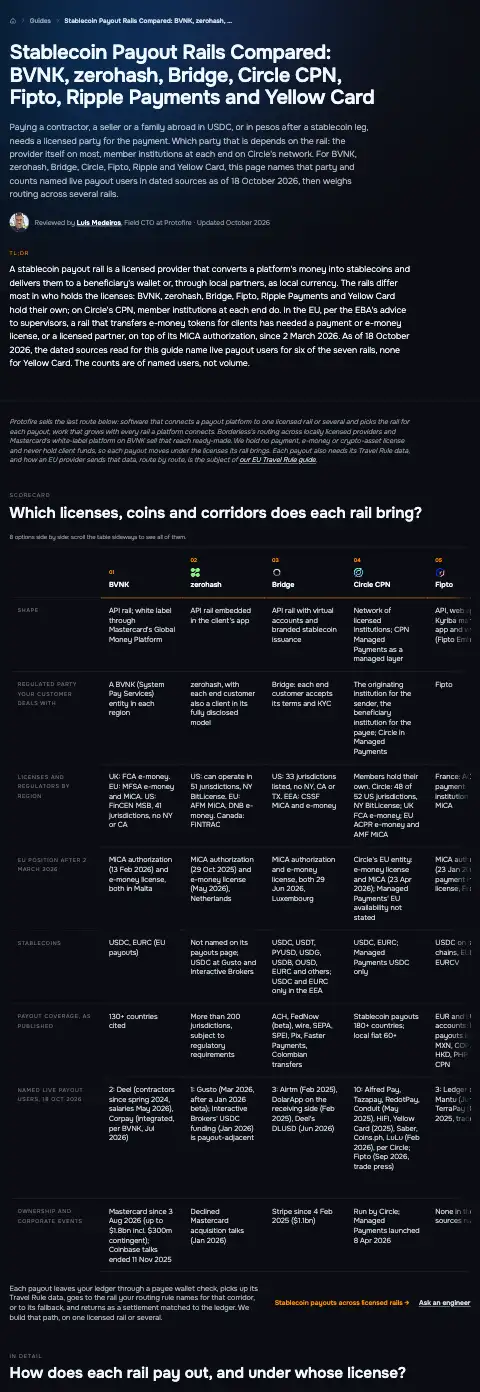
- You have not chosen a payout provider yet. Our payout rails comparison sets Ripple Payments beside BVNK, zerohash, Bridge and others.
- You want to mint and redeem RLUSD or hold digital assets for clients. Those jobs belong to other Ripple products, and our Ripple Custody integration page covers custody.
Protofire holds no financial or crypto-asset license and holds no client funds. Ripple's entities move the money.
Related guides and services
FAQ
What is a Ripple Payments integration?
Who can build a Ripple Payments integration for a bank or payment firm?
What happens to Ripple's webhooks when our endpoint is down?
Which stablecoins can Ripple Payments pay out?
Which Ripple entity contracts with our firm, and do we need our own license?
How do the Payments Direct API credentials work?
Get a proposal
Tell us what you are building. An engineer reads it, we have a short call, and the written proposal follows within one business day.