Centrifuge Integration for Fund Managers, Distributors and Lending Markets
Protofire builds what Centrifuge leaves to fund managers, distributors and lending markets. That is KYC decisions as allowlist entries, NAV on each network and orders in a ledger. In 2021 we built the DEX core and subgraph for Swarm Markets, a BaFin-licensed DEX at launch where only KYC-verified wallets trade.

Reviewed by Luis Medeiros, Field CTO at ProtofireLast reviewed: November 2026
On this page
Work shipped for 60+ networks and 95+ protocols, including





What Centrifuge runs and what the fund already runs
A Centrifuge integration starts where the pool meets what a fund already runs. On the fund's side, that means the administrator, the KYC process and the register. It also means the cash on each network and the ledger.
Centrifuge runs the pool, the share tokens and the vaults across 14 networks. Its docs say it "does not originate assets, manage money or issue financial products" (Centrifuge). The manager or a fund entity is the issuer, so the issuer's own systems have to reach the protocol.
For example, your administrator has signed off Friday's NAV. Is that NAV on the hub, on each network where investors hold shares, and in your fund ledger?
Protofire's RWA issuers page covers issuance beyond one protocol.
Who runs each part of a Centrifuge pool
Orders arrive on the spoke networks and are dealt on the hub. The manager's NAV and approvals also arrive on the hub. Protofire's connectors prepare the fund's records for the manager's wallet to sign.
Onboarding and KYC
Hub manager wallet
Fund administrator
Register
Hub, spokes and adapters
NAV and allowlist connectors
Order and holdings booking
Monitoring
What stalls a Centrifuge pool and who holds its keys
Centrifuge settles a pool on inputs the issuer supplies, and three of them fail in ways a ledger does not show.By default, the latest price may be no older than one day. A stale price rejects instant subscriptions until a new price arrives (pricing). A redemption pays out on the investor's own network, so the stablecoins must already be on that network (liquidity). A failed message between networks is not retried automatically (incident response). The order in that message is not applied until someone retries it.
If these inputs are left to chance, your ledger shows an order that the chain has not finished. A price that reaches one network late blocks instant subscriptions on that network, while another network already uses the new price.
The pool's keys matter as much as these inputs. The hub manager role appoints the other roles, sets prices and settles requests. A compromise of that role means full control, with no pool-level recovery beyond the protocol-wide pause. Centrifuge's security docs discourage a single EOA for the hub manager role (access levels). The issuer is responsible for investor checks, valuation and the cash on each network, and the issuer holds the pool's keys.
Centrifuge versions, networks, data and code license
- Version
- The latest release is v3.3.0, of 29 September 2026 (GitHub). The deployments page lists the v3.1.0 commit for the core mainnet contracts and the v3.2.0 commit for later ones (deployments).
- Networks
- 14: Ethereum, Base, Arbitrum, Avalanche, Plume, BNB Smart Chain, Optimism, HyperEVM, Monad, Pharos, X Layer, Arc, Solana and Stellar (deployments).
- Fixed at launch
- The hub network and the pool's denomination currency. Neither can change after the pool is created (pool guide).
- Messages
- Centrifuge has adapters for LayerZero, Wormhole, Chainlink and Axelar. Each pool sets how many providers must confirm a message (investment flows).
- Data
- A public, read-only GraphQL API without authentication. The API is typically 1-2 minutes behind onchain confirmation. Its documentation describes no webhooks (API).
- Code license
- Business Source License 1.1, with the Centrifuge Network Foundation as licensor. Non-production use is granted, and production use falls under the licensor's Additional Use Grant (LICENSE).
Checked November 2026 against Centrifuge's documentation and its GitHub repositories. Protofire integrates Centrifuge for firms that have chosen it.
What you get from a Centrifuge integration with Protofire
An allowlist that follows your KYC decisions
An investor you approve is on the allowlist for the right share class on the right network. The entry has an expiry date taken from your KYC record. Protofire builds the sync and prepares each change for your hub manager wallet to sign. Centrifuge's optional execution policy needs protocol v3.3 (policy). Where the pool installs that policy, a freeze applies at once and additions wait out the policy's delay. Without a policy, a change applies at once.
Administrator NAV checked and committed on each network
Investors see a current price on each network. Protofire reads the administrator's NAV file and its as-of date. We check the NAV against the last price and the pool's price-change bounds, then prepare it for the NAV manager to commit. Another check then confirms that each network has the new price.
Orders booked once at the price of their batch
Your ledger shows each request, approval, execution and claim a single time. Each entry that Protofire posts records its network, transaction hash and log index. We post an entry after the confirmations set for its network, and we reverse it if a reorganization drops it. A batch settles at one price, set at execution. That price "may differ from the price shown when the investor submitted their request" (orders).
Cash on the network where investors redeem
Treasury sees what each network needs before a claim date. Protofire builds the forecast of redemption claims per network and sets the on-ramp and off-ramp. The on-ramp and off-ramp settings name the accepted assets and the relayers allowed to start withdrawals. They also name the custodian addresses that those relayers may reach. The relayer wallet belongs to your firm.
Failed messages found and retried with the exact bytes
An alert names a failed or underpaid message while the order is still pending. That alert appears next to alerts on price age and escrow balances. The failure event contains a hash but no message bytes. So Protofire's indexer stores the bytes from the sending network, and the retry sends them back. Clearing a message leaves "the Hub order closed and the spoke never applied". So clearing waits for the issuer's decision and a manual ledger correction.
Client subledgers for distributors and price reads for lending markets
A distributor or custodian holds client shares behind one wallet that the manager approves. The distributor or custodian keeps the client record itself (access). Protofire builds a client subledger that is matched daily to that wallet's balance on each network. A lending market takes shares it did not issue. Centrifuge's docs name Sky, Aave and Morpho among the onchain markets that use the shares (Centrifuge). For a lending market, Protofire builds a price read with an age check. The fund's documents set whether a holder outside the allowlist may own the shares at all.
Which record is the register of a Centrifuge fund
The product's documents decide which record is the register, according to Centrifuge's records page (records).In one structure, the token ledger is the register. In the other, a transfer agent keeps the legal register and the token ledger runs alongside it.
The second structure needs a daily sync. Between dealing dates, shares move onchain through claims and through bridging between Centrifuge's networks. On a transferable class, shares also move through trades. Bridging and trades do not pass the manager's order list. Protofire reads those movements from the chain for the register keeper.
In the US, the SEC proposed on 1 September 2026 to update its transfer agent rules for blockchain use. A proposal changes no current rule until the Commission adopts it.
This proposal would streamline and modernize the Commission's rules to reflect transfer agents' current processes and operations, including the use of electronic communications and blockchain technology in connection with securities offerings and the transfer of shares.
Our record: Swarm Markets and Chainlink CCIP
Centrifuge's allowlist asks the same question of a wallet as a KYC-gated venue: is this holder approved now, and by whom?
Swarm Markets, a DEX open only to KYC-verified wallets
In 2021 Protofire built the DEX core (a Balancer fork) and the subgraph for Swarm Markets, and we contributed to dOTC. Swarm Markets was a BaFin-licensed DEX at launch where only KYC-verified wallets trade. Swarm held the license and ran the KYC.
Chainlink CCIP, a messaging provider for Centrifuge pools
Protofire helps maintain Chainlink CCIP. Centrifuge's docs list CCIP among the messaging providers that a pool can require to confirm orders and prices between its hub and spokes (investment flows). Protofire's CCIP integration page covers our CCIP work.
How a Centrifuge project with Protofire runs
- Step 1
Booking and the NAV check go live first
Booking and the NAV check read the chain and your administrator's file, so they go live before anything writes to the pool. Nothing is signed at this stage. - Step 2
Protofire prepares each change, and your wallet signs it
Protofire's connectors prepare each allowlist change, NAV commit or off-ramp withdrawal. A wallet that your firm controls signs each one. - Step 3
Monitoring with a runbook step for each alert
Each alert includes its runbook step. The step says whether to retry or repay, or when to ask Centrifuge's guardian for a protocol pause. - Step 4
Pool roles and operation after launch
Protofire holds none of the pool's roles, and automation that we build signs from a wallet you control. Your team runs the integration, or Protofire operates a service for you through managed onchain operations. In that case, the written scope names each call the service sends to the pool.
How work with Protofire starts
You send the fund's structure and the hub network and currency you chose or plan.You also send the names of your administrator and KYC provider, and the ledger that books orders today. The first written proposal assigns each of them a Centrifuge role. The proposal also names the connectors and monitors that Protofire would build. The terms in this section apply as set out on how we work.
- Proposal
- In writing, one business day after the discovery call: findings, a plan in phases and the first step we recommend.
- Price
- Fixed per phase when you commission it, against written acceptance criteria. Overruns inside them are ours to absorb, invoices follow delivered milestones, and you can stop at any phase boundary. Anything we operate after launch is priced in the proposal as its own recurring line, with the notice to end it.
- Ownership
- Code we write for you, contracts, the keys and credentials this work creates and the accounts your infrastructure runs in are yours by contract, within the license of any third-party software involved. Keys that a custody platform or a staking provider holds under its own key model stay with it under your contract; every other custody key stays with you or the custodian you appoint. Where the scope places something on servers we rent, it says what moves to you and when. An NDA is available from your first message, and we sign a data processing agreement (DPA) together with it.
- After launch
- Delivery closes with a hypercare window and a defect warranty, with their terms written into the proposal. A service we operate continues under its written scope until that scope ends.
- Access
- Read-only by default. A role that can start requests only if your written scope names one; never a signer, approver, administrator, key holder or recovery role on your contracts, wallets or custody platform. Services we build call each platform on credentials your staff issue and keep in your vault. Anything that approves or moves funds runs in your environment, and a scope under which we operate a service lists every write call it makes. Where the scope has us operate nodes, validators, monitors, explorers or indexers, it names the role and any key we hold on those servers, and in your own cloud account you can remove it.
- Licenses
- Protofire is an engineering firm and holds no financial or crypto-asset license; licensed activity stays with you and your providers.
How we work shows a worked proposal.
When a Centrifuge project with Protofire does not fit
Outside help adds little where Centrifuge's own tools already match the fund's books.
- You run one fund on one network and book it from the Management app's exports. Then the books already match, and connectors add little.
- Your strategy is issued inside an Anemoy fund. Anemoy is then the issuer on Centrifuge (Centrifuge), so onboarding, the allowlist and orders follow Anemoy's process.
- Your product needs instant redemptions, distributor vaults or notice-period queues in production today. Those features run on the Vault Development Kit, which is in preview while in audit (VDK).
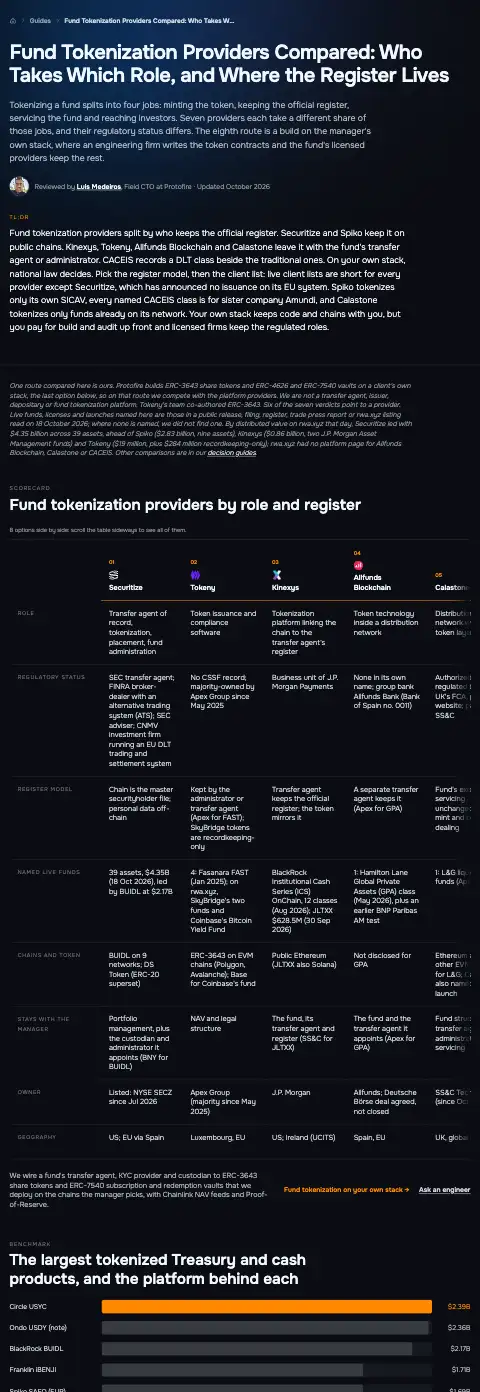
- Your fund wants one provider to act as its registered transfer agent as well. Protofire's fund tokenization providers guide places Centrifuge beside platforms built around the transfer agent role.
The issuer and its advisers are responsible for batch approvals, prices and NAV sign-off. They are also responsible for legal opinions on the fund's structure. Protofire is an engineering firm and holds no financial or crypto-asset license.
Related guides and services
FAQ
What is a Centrifuge integration?
Who can build a Centrifuge integration for a fund manager, a distributor or a lending market?
Does Centrifuge issue the fund's token?
Can a pool change its hub network or currency after launch?
Can investors move shares between networks?
What license covers the Centrifuge protocol code?
Get a proposal
Tell us what you are building. An engineer reads it, we have a short call, and the written proposal follows within one business day.