How an Institution Chooses a Chain: Ethereum, L2s, Solana, Stellar, Canton, Arc, Tempo and Private Ledgers Compared
This guide compares the networks regulated institutions use, or have announced, for tokenized deposits, funds, stablecoins and bonds, in nine options: Ethereum; its L2s Base and Arbitrum; Solana; Stellar and XRPL; Avalanche and Polygon PoS; Canton; Arc; Tempo; and private bank ledgers. Each is scored on the same nine rows, from who runs the validators to how a Basel capital test would see it.

Reviewed by Luis Medeiros, Field CTO at Protofire · Updated October 2026
Regulated institutions reach fund investors on Ethereum and its L2s, choose permissioned networks (Canton, Arc, Tempo or a private ledger) when validators must be approved, and Stellar or XRPL for issuer controls. Four tests decide: who validates, when a transfer is legally final, who sees the transaction, and where investors and counterparties hold assets. As of 18 October 2026, Ethereum holds the most investor-held tokenized assets. The largest wholesale volumes run off the open chains: on J.P. Morgan's Kinexys ledger, and on Broadridge's repo platform, which Broadridge says is built on Canton technology without naming the synchronizer. The conditions of the Basel Committee's cryptoasset standard, the capital rules for banks' crypto exposures, are hard to meet on open chains; EU market law names no chain.
Protofire is an onchain engineering firm founded in 2016; it issues no token on this page and is not one of the validators or operators named here. It builds smart contracts and infrastructure on EVM chains and Besu networks, can build Daml applications for Canton and has operated validators on proof-of-stake networks, Avalanche among them, as its validators page lists; that work is what the enterprise build link on this page and our Canton development page sell. Whether a bank should issue a deposit token or a stablecoin, a choice usually made before the chain, is weighed in tokenized deposits vs stablecoins.
Where do the nine options differ on validators, finality, privacy and fees?
9 options side by side: scroll the table sideways to see all of them.
Who runs each network, how final is a transfer, and what runs on it today?
Ethereum mainnet
- +Holds 43.0% of investor-held tokenized assets ($16.89B of $39.28B on rwa.xyz) and $144.1B of USD stablecoins on DefiLlama
- +Regulated issuers are already live: BlackRock's BUIDL, J.P. Morgan Asset Management's MONY and JLTXX, SG-FORGE's EURCV and USDCV
- +Finality has held since May 2023, including a client bug on 4 Dec 2025 that cut validator participation to 75%
- +Every main bridge and messaging route connects here: CCTP, CCIP, LayerZero, Wormhole and the rollups' own bridges
- −Finality takes about 15 minutes, and single-slot finality is not expected for several years
- −Balances and counterparties are public; who may hold a token is set only in its contract
- −Anyone with 32 ETH can validate, which is hard to square with Basel's condition that validators be regulated or follow risk standards
- −Fees are paid in ETH, as on every public chain here except Arc and Tempo, so the institution or a sponsor holds a volatile asset to transact (US national banks may, under OCC Interpretive Letter 1186)
Ethereum is a public chain that has run since 30 July 2015 and has used proof of stake since the Merge of 15 September 2022. It has about 830,000 active validators, by validatorqueue.com's count, holding 43.7 million staked ETH. Each validator is a key with at least 32 ETH, anyone can add one, and one operator can run many keys. Finality, the point after which a transfer cannot be reversed, comes once two-thirds of stake has attested across two epochs. Blocks arrive every 12 seconds, and ethereum.org puts finality at "about 15 minutes"; the same page says single-slot finality "is not expected to ship for several years". Finality has not been lost on mainnet since May 2023. During a Prysm client bug on 4 December 2025, participation fell as low as 75%, according to Prysm's post-mortem, and blocks kept finalizing.
More investor-held tokenized value sits on Ethereum than on any other chain: rwa.xyz counted $16.89 billion of the $39.28 billion in distributed real-world assets, stablecoins excluded, on 18 October 2026. BlackRock launched BUIDL there in March 2024, and on that reading it kept $452.0 million of the fund's $2.17 billion on Ethereum. J.P. Morgan Asset Management's JLTXX, a registered government money market fund launched on 13 May 2026, held $738.7 million there. The protocol has no identity layer, so who may hold a token is decided in its contract, through ERC-3643 or an allowlisted ERC-20. The platforms that issue such fund tokens are compared in fund tokenization providers.
Fifteen minutes is long for intraday settlement, and public state lets anyone reading the chain see the positions and transfers of an issuer's clients. Fees are paid in ETH: at a gas price of about 0.07 gwei and ETH at about $2,366, both read on 18 October 2026, a plain ETH transfer cost about $0.0035 and a token transfer about $0.011. A US national bank may hold the crypto "necessary to pay network fees" under the OCC's Interpretive Letter 1186. For a bank's own capital, the open validator set is the harder problem, set out under the Basel question below.
Base and Arbitrum (Ethereum L2s)
- +A plain ETH transfer cost about $0.0003 on Base and $0.001 on Arbitrum in October 2026, Ethereum's data fee included
- +Confirmation in a second or less: about 200 ms preconfirmations on Base, sub-second soft confirmation on Arbitrum
- +Base's B20 standard (25 Jun 2026) builds transfer policies, freeze-and-reissue controls and role-based access into the token
- +Live bank and fund tokens: J.P. Morgan's JPMD on Base since 12 Nov 2025; Spiko's EUTBL ($279.1M) on Arbitrum
- −Coinbase runs Base's sequencer and the Arbitrum Foundation maintains Arbitrum's, so one organization orders transactions on each
- −Native withdrawals to Ethereum wait 5 days on Base (1 day when both proof systems agree) and about 6 days 8 hours on Arbitrum, 2 days longer if a claim is challenged
- −Base upgrades need two signer groups but take effect with no delay, so users get no exit window before a change
- −Base stopped producing blocks for 116 minutes on 25 Jun 2026 and for 20 minutes the next day, by its own post-mortem
- −State is public, as on Ethereum; Base Ledgers, for private balances, is still in early access
Base and Arbitrum One are Ethereum layer 2 rollups: they execute transactions off Ethereum, post the data back to it and let holders withdraw to Ethereum after a proof window. L2Beat rates Base Stage 1, the middle of its three stages, between a rollup controlled by a few entities and one controlled fully by code. It records that Base left the Optimism Superchain's governance on 4 March 2026 with its own upgrade path. Coinbase runs Base's sequencer, the service that orders transactions before they are posted to Ethereum. A user can force a transaction in through Ethereum with up to a 12-hour delay, and upgrades approved by the Base Coordinator Multisig and the Base Security Council apply with no delay. Arbitrum One is also Stage 1, with permissionless validation under BoLD and a challenge period of 6 days 8 hours, extended by 2 days if a claim is challenged. Its sequencer is maintained by the Arbitrum Foundation.
Base's finality documentation puts a Flashblock preconfirmation at about 200 ms, an L2 block at about 2 seconds and finality on Ethereum at about 20 minutes. A withdrawal waits 5 days with one proof, or 1 day when both the TEE and ZK provers agree. Base also has the heavier recent incident record of the two: a 17-minute halt on 21 September 2024 and a 33-minute halt on 5 August 2025. Base's own post-mortem describes a 116-minute block production outage from 15:47 UTC on 25 June 2026, which recurred for 20 minutes the next day, caused by a bug in the sequencer's block-building logic. Arbitrum's own status page reports 100% sequencer uptime since November 2024.
J.P. Morgan describes JPM Coin (JPMD) as "a deposit token issued on the Layer 2 Ethereum network Base" and says it "operates on a public blockchain where only vetted counterparties transact". It went live for institutional clients on 12 November 2025 after a June 2025 pilot, and 1,001,000 JPMD were in supply on 18 October 2026. An allowlisted token on a public chain gives a bank's own clients public-chain reach without a private ledger; whether the instrument should be a deposit token at all is covered in tokenized deposits vs stablecoins. Base now offers such controls natively: its docs say the B20 token standard "ships with a built-in compliance toolkit". Base Ledgers, which keeps balances and counterparties off public explorers, was still in early access that day.
Solana
- +BUIDL's largest leg ($871.7M), State Street and Galaxy's SWEEP fund ($163.6M) and a JLTXX leg created on 28 Sep 2026
- +Visa launched US USDC settlement over Solana on 16 Dec 2025 within its settlement pilot, with Cross River Bank and Lead Bank settling first
- +Token-2022 extensions give issuers transfer hooks, default frozen accounts, a permanent delegate, pause and confidential balances
- +A base fee of 5,000 lamports per signature, about $0.0005 at the 18 Oct 2026 SOL price, which a separate fee payer can cover
- −Finality was about 12.8 s on 19 Oct 2026; Alpenglow, targeting about 150 ms, was scheduled to activate on 21 Oct 2026, with no measured figure at that date
- −18 of 680 vote accounts held over a third of stake, enough to withhold the two-thirds vote that confirms a block
- −Solana's Alpenglow page (19 Oct 2026) allows only Agave-based clients during the migration, not Firedancer, which ran 12.8% of stake
- −A 5-hour outage on 6 Feb 2024, the only incident on Solana's status page from 2024 to 18 Oct 2026
- −Programs are written in Rust for Solana's own virtual machine, so Solidity code and EVM tooling do not carry over
Solana is a public proof-of-stake chain with 680 vote accounts on 18 October 2026, 18 of which held more than a third of the 437 million SOL staked. Its docs count a block as confirmed once it is voted on by "more than two-thirds of the network's active stake". On 19 October 2026, Solana's Alpenglow page put finality at "about 12.8 seconds" and the upgrade's target at "roughly 150 milliseconds", and said it "activates on mainnet in epoch 1064, which starts on Wednesday, October 21, 2026, at approximately 15:00 UTC". A post-Alpenglow finality figure should be measured before it goes into a settlement design. For the migration, the page requires an Agave-based client and excludes Firedancer and Frankendancer.
Institutional use on Solana is mostly funds and dollar settlement. BUIDL's Solana share class, launched on 25 March 2025, is its largest leg, at $871.7 million. Visa launched US USDC settlement over Solana on 16 December 2025 as part of its stablecoin settlement pilot, with Cross River Bank and Lead Bank as the first banks settling. J.P. Morgan arranged a Galaxy commercial paper issue on Solana on 11 December 2025, settled in USDC, with Coinbase and Franklin Templeton as buyers. State Street and Galaxy launched their SWEEP fund there on 5 May 2026, and J.P. Morgan Asset Management added a JLTXX leg in September.
Issuer controls live in the token program. Solana's Token-2022 extensions add transfer hooks, a permanent delegate, a default account state, pause and confidential balances; confidential transfers were switched off after a bug in June 2025 and have been back on mainnet since 17 June 2026. Solana's fee docs set a base fee of 5,000 lamports per signature, about $0.0005 at the 18 October 2026 SOL price of about $102, half of it burned, plus optional priority fees. Its payments docs show how a separate fee payer can sponsor both. Programs are written in Rust, through Anchor, Pinocchio or native Rust, for Solana's own virtual machine rather than the EVM. USD stablecoins on Solana total $15.5 billion, third after Ethereum and Tron.
Stellar and XRP Ledger
- +Deterministic finality in seconds: about 5 s ledgers on Stellar, about 3 to 5 s on XRPL
- +Issuer controls in the protocol: authorization, revocation and clawback on Stellar; Credentials, Permissioned Domains, a Permissioned DEX, clawback and deep freeze on XRPL
- +Named institutions in Stellar's top validator tier, Franklin Templeton and MoneyGram among them
- +Bank and fund issuers are live: Franklin's BENJI ($441.6M on Stellar), SG-FORGE's EURCV on both, Aviva Investors' tokenized share class on XRPL
- −No native private transfers on 19 Oct 2026: Stellar's X-Ray added zero-knowledge building blocks only, and XRPL Confidential Transfers had 19 of 32 votes, 25 needed
- −Fewer routes out: Stellar has no CCIP, and XRPL is neither a CCTP domain nor on CCIP
- −Small blocking sets: four organizations can block Stellar's consensus, and 8 of the 35 validators on XRPL's default list can stall it
- −XRPL halted for 10 minutes on 25 Nov 2024 and for over an hour on 4 Feb 2025
- −Neither runs EVM contracts natively: Stellar's contracts are written in Rust, and XRPL's issuer features are protocol amendments
Stellar reaches consensus through the Stellar Consensus Protocol and closes a ledger about every 5 seconds. On 18 October 2026 its top tier held 30 validators from 10 organizations, according to OBSRVR's Radar network crawl. Among them were Franklin Templeton, MoneyGram, Blockdaemon, Figure Certificate Company and the Stellar Development Foundation, and four organizations formed a minimum blocking set. Issuers of regulated assets can require authorization, revoke it and claw tokens back through asset flags. Franklin Templeton's BENJI has used Stellar as its primary chain since April 2021, SG-FORGE added EURCV on 10 March 2026, and DTCC plans to connect its Tokenization Service to Stellar, with availability in the first half of 2027. How EURCV compares with EURC and five other euro tokens on redemption, payout time and reserve attestation is set out in our euro stablecoin guide.
The XRP Ledger's default Unique Node List names 35 validators, the same list at Ripple and the XRPL Foundation, and consensus needs 80% of them. Its compliance features came as amendments: Clawback in February 2024, DeepFreeze in May 2025, Credentials in September 2025, and Permissioned Domains and a Permissioned DEX in February 2026. SG-FORGE put EURCV on XRPL on 18 February 2026, Aviva Investors launched a tokenized share class of its USD Liquidity Fund there on 29 July 2026, and Ripple's RLUSD held $1.03 billion on the ledger. Axiology's EU DLT Pilot venue runs on a permissioned, modified version of the XRP Ledger rather than on the public one.
Stellar's base fee is 100 stroops, about $0.000002 at the 18 October 2026 XLM price of about $0.174, and a third party can pay it through a fee-bump transaction. XRPL burns 10 drops per transaction, about $0.00001 at that day's XRP price of about $1.27, and holds reserves of 1 XRP per account plus 0.2 XRP per object; its fee-sponsorship amendment had 9 of 32 votes. Stellar's Soroban contracts are written in Rust and compiled to WebAssembly, and no general smart-contract amendment is enabled on the XRP Ledger. Stellar connects through CCTP, LayerZero and Axelar; XRPL through Axelar and an EVM sidechain run under proof of authority since June 2025. Neither had native private transfers yet. XRPL halted for 10 minutes on 25 November 2024 and for over an hour on 4 February 2025, by its own vulnerability report and the rippled fix. Stellar did not halt, but the Stellar Development Foundation's post-mortem describes a state-archival bug that corrupted ledger entries from September 2025 until it was found that October.
Avalanche and Polygon PoS
- +An Avalanche L1 can be permissioned: under proof of authority only its owner changes the validator set, and allowlists decide who may transact or deploy
- +Since Etna (16 Dec 2024), L1 validators pay a continuous fee, about 1.33 AVAX a month at the minimum rate, instead of staking 2,000 AVAX
- +21X runs a BaFin-authorized EU DLT Pilot venue on Polygon PoS, and Securitize Europe is authorized for Avalanche's C-Chain
- +Finality in seconds: Polygon milestones in 2 to 5 s; Avalanche settlement 5 s after acceptance since Helicon (22 Sep 2026)
- −New Polygon PoS validators need a pass issued by Polygon governance or a permissioned address (since October 2026), and its code upgrades take effect with no delay
- −Polygon finality incidents on 10 Sep 2025 and 12 Jan 2026, the second about 1.5 hours without finalized blocks
- −Avalanche's C-Chain stopped finalizing blocks for about six hours on 23 Feb 2024
- −Avalanche's institutional chain examples are early: Avalanche's own posts describe Spruce only as a testnet, and no live Securitize Europe issuance was found
- −C-Chain and Polygon state is public; only an Avalanche L1 can restrict access
Avalanche runs a Primary Network, whose C-Chain is the public EVM chain, with 595 validators on 18 October 2026, and supports Avalanche L1s, chains with their own validators and rules. Since the Etna upgrade of December 2024, L1 validators no longer stake 2,000 AVAX. A permissioned L1 can use a proof-of-authority validator manager under which only the owner changes the validator set, and allowlist precompiles decide who may send transactions or deploy contracts. That is the closest public-chain design to a bank-run network, but the named institutional example, Spruce, with T. Rowe Price, WisdomTree, Wellington and Cumberland, is still described as a testnet in Avalanche's own announcements. On the C-Chain, BUIDL held $481.6 million, its second-largest leg, and the Helicon upgrade of 22 September 2026 set settlement 5 seconds after a block is accepted. On 18 October 2026 a C-Chain transfer cost about $0.001 in AVAX, at a base fee of 5 nAVAX per gas and AVAX at about $9.51.
Polygon PoS is a separate EVM chain that checkpoints to Ethereum, with 104 active validators (cap 105). Since an October 2026 upgrade, L2Beat says each new validator "needs approval from governance or a permissioned EOA", classes the chain "Other" and warns "There is no delay on code upgrades". Polygon's docs say milestones "typically finalize a transaction within 2 to 5 seconds". The chain had finality incidents on 10 September 2025, fixed by an emergency hard fork, and on 12 January 2026. In the second, no blocks were finalized for about an hour and a half, according to the post-mortems on Polygon's status page. On 18 October 2026 a transfer cost about $0.0005 in POL, with POL at about $0.089.
Both chains have a place in the EU's DLT Pilot. ESMA's 2025 report on the regime describes 21X on "a public, permissionless blockchain (Polygon PoS)" with access "permissioned through smart contract-based whitelisting", and Securitize on "Avalanche C-Chain (public, permissionless network with permissioned access)". ESMA's list of authorized DLT market infrastructures dates 21X's permission to 3 December 2024 and Securitize Europe's to 26 November 2025; no Securitize issuance on the venue had been found by mid-October 2026. On Polygon, Fasanara launched its FAST money market fund as an ERC-3643 token, with Tokeny and Apex, on 21 January 2025.
Canton Network
- +Each party receives only its own part of a transaction; parties without a stake in it receive nothing
- +A transaction is final once its verdict is sequenced, with no forks, reorganizations or rollbacks
- +Market infrastructure is live: Broadridge's DLR, built on Canton technology, processed $7.5T in Sep 2026, and DTCC ran production trades on 15 Jul 2026
- +Traffic is priced in dollars, USD 60 per MB above a free tier, though it is paid by burning Canton Coin; Canton Coin transfer fees were removed in Sep 2025
- +Named operators run the 13 Super Validator nodes, Digital Asset, Cumberland, Tradeweb, MPCH and Five North among them
- −13 Super Validator nodes order transactions, and most named institutions hold reward weight on other operators' nodes instead of running one
- −A new validator needs Tokenomics Committee approval, an allowlisted IP and a Super Validator sponsor
- −Contracts are written in Daml, so Solidity code and EVM tooling do not carry over, and Canton does not natively interoperate with Ethereum smart contracts
- −Canton Coin balances and transaction history are public, and a party hosted on another operator's validator has its contract data stored on that operator's node
- −Bank deposit use is early: HSBC's pilot was simulated, and JPMD issuance on Canton is announced but not confirmed live
- −Ordering stops if more than a third of the Super Validators' sequencer nodes go offline
Canton describes itself as "a public layer 1 blockchain designed for privacy-preserving transactions". Applications are written in Daml, and each validator stores only the data its parties are entitled to see. The Global Synchronizer, a two-thirds Byzantine fault tolerant (BFT) service, orders transactions as encrypted messages it cannot read and keeps no ledger state. It is run by Super Validators, organizations admitted by a vote of the existing ones, and governed by them and the Canton Foundation. MainNet has run since 25 June 2024, and CantonBFT replaced CometBFT as its consensus on 10 October 2026. The live MainNet rules list 13 Super Validator nodes, two each for Digital Asset and Cumberland plus Tradeweb, MPCH, Five North and the Canton Foundation's own node among them, and 9 votes are needed for governance. The Canton Foundation lists 56 Super Validator organizations, far more than the nodes, because most of them, DTCC, Nasdaq and Visa included, hold reward weight through another operator's node. LSEG, appointed a Super Validator on 28 September 2026, does the same and was not yet on that list.
A MainNet validator needs "approval by the Tokenomics committee, an IP on the allowlist, and an onboarding secret from your SV sponsor". Canton's FAQ says "currently sponsorship is needed", so this guide scores validation as permissioned even where Canton's releases call the network permissionless. Once a verdict is sequenced and delivered, "the transaction result is final. There are no forks, reorganizations, or rollbacks." Canton's own token is public: Canton Coin balances and transaction history are visible to anyone through the network's scan service. A validator also stores the contract data of the parties it hosts, so a party hosted on another operator's node shares its data with that operator. Traffic costs USD 60 per MB above a free allowance of 200,000 bytes per 20 minutes per validator, paid by burning Canton Coin (about USD 0.099 on 18 October 2026), and only the sending validator pays.
Broadridge reports that its Distributed Ledger Repo platform processed $7.5 trillion in September 2026, $359 billion a day, and its product page calls DLR "Built on Canton Technology". Neither page names the synchronizer DLR uses, public or private. DTCC's first production trades, on 15 July 2026 with more than 30 firms, used DTC-held assets tokenized on two networks: "The digital conversions occurred on LFDT's Besu (DTCC's private network) and Canton (a public network)". DTCC planned to launch its Tokenization Service in October 2026, with Canton and its private Besu network live at launch, per its summary of 16 October; no launch had been announced by 19 October. Digital Asset and J.P. Morgan's Kinexys announced plans in January 2026 to have JPMD issued natively on Canton "in phases throughout 2026". J.P. Morgan had not confirmed live issuance by mid-October 2026, and its JPM Coin page still named only Base. Dollars arrive as USDCx, backed by USDC held in Circle's xReserve on Ethereum. LayerZero, which announced its Canton integration on 26 March 2026, lists a Canton mainnet endpoint as active in its deployment registry, and Chainlink's CCIP directory lists Canton lanes to Ethereum and Base.
Arc (Circle)
- +Fees are paid in USDC, so a finance team never holds a volatile gas token
- +Deterministic finality once more than two-thirds of validators sign, benchmarked in the docs at under 350 ms
- +A founding validator cohort of known firms: BlackRock, DTCC, Galaxy, ICE, Mastercard, MoneyGram, SBI Group, Standard Chartered, Sumitomo Corporation, Visa and Worldpay (now Global Payments), with Circle
- +The USDC blocklist is enforced before the mempool, before execution and at transfer, and Circle's Entitlements contract allowlists the wallets that may mint and redeem USYC
- −Public mainnet only since 16 Sep 2026, after a testnet from 28 Oct 2025 and a private mainnet
- −Privacy features are "on the roadmap and not yet available"
- −Validators join in a "phased rollout", and Circle publishes neither a validator count nor which cohort members sign blocks
- −The fee target of about $0.001 per ERC-20 transfer sits on a docs page that still describes the testnet configuration, though mainnet fees matched it in October 2026
- −Third-party assets are mostly announced: BUIDL is "expected", and DTCC plans assets from the second half of 2027
- −The chain stops producing blocks if more than a third of validators go offline
Circle announced the public mainnet launch of Arc on 16 September 2026, after a public testnet from 28 October 2025 and a private mainnet whose first block dates to 15 May 2026. The release calls Arc "an open L1 blockchain" that is "operated by a permissioned validator set". It adds that "Along with Circle, Arc will have a phased rollout from the founding validator cohort", which names BlackRock, DTCC, Galaxy, ICE, Mastercard, MoneyGram, SBI Group, Standard Chartered, Sumitomo Corporation, Visa and Worldpay (now Global Payments). Which of them sign blocks today is not published. Consensus is Malachite, a Tendermint-style BFT engine, run under proof of authority, and Arc's consensus docs say the network "continues to produce blocks as long as more than two-thirds of validators are online and honest". The same release says Arc "has not been reviewed or approved by the New York State Department of Financial Services or any other regulatory authority". It also calls the 10 billion ARC genesis mint "not a commitment to publicly launch ARC"; fees stay in USDC.
On Episode 4 of The Protocol Roundtable, Circle's Gagan Mac, VP, Product & Engineering, Arc, said three questions enterprises put to a chain shaped Arc's design. They were how to account for a volatile gas token, who the validators are, and when a transaction is final. On the last he added: "Not just technically deemed final, but also legally the definition of completely settled." For gas, USDC is the native gas, and "The base fee floor targets approximately $0.001 per ERC-20 transfer", on a page that says its values "reflect the current testnet configuration". On mainnet the base fee sat at that floor in mid-October 2026, so an ERC-20 transfer cost about $0.001 in USDC. For finality, Arc's finality page describes deterministic finality once more than two-thirds of validators sign. On validators, Circle names a cohort but not who signs blocks. Arc's compliance page has the USDC blocklist checked before the mempool, before execution and at transfer.
Privacy and third-party assets are not there yet. "Privacy features are on the roadmap and not yet available on Arc." Circle said on 5 August 2026 that BlackRock "is expected to deploy BUIDL" on Arc and that DTCC would tokenize DTC-custodied assets on it "beginning in the second half of 2027". Circle's 16 September release then listed BUIDL among the assets for Arc's day-one markets, but rwa.xyz showed no BUIDL token on Arc on 18 October 2026, when stablecoins on Arc totalled $0.67 billion on DefiLlama. Visa said on 29 April 2026 that it is adding Arc, Base, Canton, Polygon and Tempo to its stablecoin settlement pilot, which now supports nine blockchains with Avalanche, Ethereum, Solana and Stellar. Circle's CCTP documentation lists Arc as domain 26, which connects it to other USDC chains.
Tempo (Stripe and Paradigm)
- +No native gas token: fees in a supported USD stablecoin, under a dynamic base fee capped at about $0.0006 per transfer and about $0.00003 when blocks are quiet
- +Deterministic finality, with blocks about every 600 ms
- +Named validators: Stripe, Visa and Zodia Custody since 14 Apr 2026, then MoneyGram and zerohash
- +Zones, private environments for enterprises, became generally available on 14 Oct 2026, with Deel first in production
- +Compliance in the token standard: pause, allowlists and blacklists, burning from blacklisted addresses and 32-byte memos that can reference Travel Rule messages
- −The validator set is permissioned, and a 2-of-5 multisig whose signers are not published controls the onchain registry of 15 active entries
- −The network halts if more than a third of validators go offline
- −The team schedules hardforks every two weeks to a month, and one of them, T7, changed the fee model on 9 Jul 2026; with no token there is no holder vote
- −A Zone's operator sees all activity inside it, and the docs index still calls Zones a limited preview with general token transfers disabled
- −Not a CCTP domain: assets arrive over LayerZero, Chainlink CCIP, Relay, Bungee or Tempo Routes (beta)
- −A young asset base: BUIDL on Tempo is $17.1M held by one address
Tempo, incubated by Stripe and Paradigm, launched mainnet on 18 March 2026 after a testnet from 9 December 2025. Its validator docs say "The active validator set is currently permissioned". Tempo named Stripe, Visa and Zodia Custody as validators on 14 April 2026 and MoneyGram and zerohash later. The chain showed 15 active validator entries on 18 October 2026, in a registry controlled by a 2-of-5 multisig whose signers are not published. Its consensus docs describe Simplex BFT, with blocks about every 600 ms and deterministic finality, and a network that "halts and resumes" if more than a third of validators go offline. The team schedules hardforks every two weeks to a month; with no token, there is no token vote.
"Tempo has no native gas token." Its fee docs let users pay in a supported USD-denominated TIP-20 stablecoin and let a separate account sponsor the fee. The base fee was fixed at launch so that a transfer cost about $0.001, but the T7 upgrade of 9 July 2026 made it dynamic. Tempo's protocol docs put a 50,000-gas transfer at about $0.0006 at the cap and about $0.00003 when blocks are quiet, the floor the public RPC quoted in mid-October 2026. Compliance sits in the token standard: TIP-20 and TIP-403 policies cover pause, allowlists and blacklists, burning from blacklisted addresses and memos that can reference Travel Rule messages. Privacy came on 14 October 2026, when Tempo said Zones "are generally available for enterprises", with Deel first in production. The same post says "The Zone operator, however, can see activity inside a Zone and can pause transfers to meet compliance requirements", and the docs still describe Zones as a limited preview in which "General TIP-20 transfers and user contract deployment are disabled", with a reference verifier that "still returns true without checking execution".
BlackRock's BUIDL came to Tempo through Securitize on 29 July 2026, as Tempo announced that day, and held $17.1 million with one holder on 18 October. Open Standard's OUSD, minted and redeemed through Coinbase, Stripe and Visa, went live on 30 September 2026 and stood at $528.9 million on DefiLlama. BlackRock's BRSRV, a tokenized government money market fund launched on 3 August 2026, keeps its official ownership record on Ethereum, Tempo and Solana, per its prospectus. Tempo is not a CCTP domain, so USDC moves in through bridges. Its status page shows public RPC outages on 28 September and 5 October 2026 and 100% chain uptime over 90 days.
Private and permissioned ledgers
- +The largest published single-bank volumes: Kinexys has processed over $4T since inception, at over $7B a day
- +Members only, the design the EBA says banks issuing tokenized deposits may opt for so that banks holding them could be eligible for Group 1a treatment
- +Besu QBFT and IBFT 2.0 give immediate finality with no forks
- +Settlement in central bank money is possible, as on SWIAT and through ECB Pontes since 21 Sep 2026
- +No crypto on the balance sheet: SWIAT pays its validators in fiat
- −A single-bank ledger moves money only between that bank's own customers
- −Shared bank networks have closed before: we.trade (2022), Marco Polo and Contour (2023), and ASX shelved its DLT-based CHESS replacement in 2022
- −Banks and consortia publish no incident data (the ECB posts Pontes' operational status), and J.P. Morgan, Partior and HSBC do not name their ledger software
- −Privacy tooling has moved: GoQuorum is no longer maintained, and Besu 25.6.0 removed Tessera privacy in favor of Paladin
- −A QBFT network stops producing blocks if more than a third of validators stop
Several of the largest institutional ledgers are run by banks for their own clients. J.P. Morgan says Kinexys, its blockchain business, "has processed over $4 trillion in transaction volume, with average daily transactions exceeding $7 billion" across its services. Its payments ledger, Kinexys Digital Payments, is a permissioned system for participating J.P. Morgan clients, with blockchain deposit accounts in eight currencies since June 2026. Moves between legacy accounts and those deposit accounts stop for three hours every Saturday. Citi Token Services was live in seven markets on 28 September 2026 on "a private-permissioned blockchain", and DBS and HSBC run deposit token services on their own networks. A 2026 Ledger Insights report for the Linux Foundation Decentralized Trust says Citi Token Services, DBS Token Services and Standard Chartered's platform each let clients move money instantly, "but only between customers of the same bank". The report adds that Citi has partly addressed this by linking its service to its 24/7 USD Clearing network.
Shared rails connect banks to each other. Partior "operates on a global private permissioned ledger" for financial institutions only. It has been live in USD and SGD since 2023 and in euros since May 2024, when Standard Chartered became its first euro settlement bank. It lists DBS, J.P. Morgan, Standard Chartered, Deutsche Bank and Emirates NBD among its users, and Deutsche Bank also joined its Series B as a strategic investor in November 2024. Swift operates a Besu-based ledger with 17 pilot banks, and HSBC and Standard Chartered announced the first live interbank transaction on it, a tokenized deposit payment, on 19 August 2026. In it, obligations were matched and netted before final settlement through existing systems. SWIAT, which its technology page describes as Enterprise Ethereum on Hyperledger Besu and whose validators are paid "in FIAT, no crypto-currencies involved", carried Siemens' EUR 300 million digital bond, settled in central bank money in September 2024. Since 21 September 2026, ECB Pontes has offered settlement of wholesale DLT transactions in central bank money, with final settlement in T2. It admits DLT operators by license, from CSDs and DLT Pilot operators to supervised banks, rather than by type of chain.
Besu's documentation says its QBFT and IBFT 2.0 consensus "have immediate finality; there are no forks", recommends at least four nodes, and notes that the network stops creating blocks if more than a third of validators stop participating. GoQuorum is no longer maintained by Consensys, and the Besu 25.6.0 release of June 2025 removed Tessera-based privacy and onchain permissioning, so privacy now comes from Paladin. Shared networks have also failed commercially: we.trade, built on Hyperledger Fabric, closed in 2022, and Marco Polo and Contour, both on R3's Corda, closed in 2023. ASX shelved its DLT-based CHESS replacement, built with Digital Asset's Daml, in November 2022 with a write-off of A$245 to 255 million.
Which institutions are live, piloting or announced on each network?
How we counted: scorecard and table figures come from live chain reads, regulator texts and issuer releases checked on 18 October 2026. Dollar fees use Coinbase spot prices read that day, 18:08 to 19:17 UTC (ETH about $2,366, SOL $102, XLM $0.174, XRP $1.27, AVAX $9.51, POL $0.089), and gas read from public nodes. The Basel row is our reading of condition 4, since no supervisor has classified any of these networks: private ledgers rank easiest; Canton, Arc, Tempo and an Avalanche L1 with supervised validators easier; and the open public chains and their L2s hard, though Hong Kong's rules and Singapore's interim treatment give them routes with extra measures. This table is a selection of named deployments. Sizes are token values on rwa.xyz at its data stamp for that day, DefiLlama's supply figure for OUSD, an onchain supply read for JPMD, or the issuer's own figure, and dates come from the issuer, operator and regulator releases cited in the sections above. Live means real value for clients, pilot means limited scope or simulated value, and announced means an intent or agreement only. Smaller fund and stablecoin legs are left out, so the rows show which institutions use each network, not how many do.
What should each institutional product settle on?
your investors already hold tokenized funds there (43.0% of investor-held tokenized assets, with BlackRock and J.P. Morgan Asset Management issuing), and 15-minute finality and public state are acceptable.
your holders are vetted clients and one company's sequencer and withdrawal windows of a day to about six and a half days are acceptable; J.P. Morgan runs JPMD for vetted clients on Base.
your fund or dollar flows sit where BUIDL's largest leg and Visa's US USDC settlement pilot already run; measure finality after Alpenglow's scheduled 21 October 2026 activation before you fix a settlement window.
you want authorization and clawback built into the protocol and finality in seconds, as Franklin Templeton has with BENJI on Stellar, where it also sits in the top validator tier, and SG-FORGE with EURCV on both.
an Avalanche L1 lets its owner admit validators alone, and 21X already runs a BaFin-authorized DLT Pilot venue on Polygon PoS; Avalanche's own posts still describe its institutional chain example, Spruce, as a testnet.
repo, collateral and Treasury trades need each party to see only its own leg, and a Daml build and validator approval fit the timeline; Zenith's EVM layer for Canton is still on testnet.
fees must be in USDC with deterministic finality under a second, and a one-month-old public mainnet, roadmap privacy and a phased validator rollout whose signers are not published are acceptable.
a transfer fee capped at about $0.0006 in a supported dollar stablecoin and enterprise Zones outweigh a young asset base, a permissioned validator set and hardforks the team schedules every few weeks.
holders are the bank's own clients or a club of banks. A single-bank ledger moves tokens only between that bank's clients, so payments to other banks need Partior, Swift's ledger, a link to conventional clearing such as Citi's 24/7 USD Clearing, or a public chain.
What else comes up when an institution picks a network?
- BNB Smart Chain: second by investor-held tokenized assets on rwa.xyz, with $6.09 billion on 18 October 2026. Its two largest legs, Circle's USYC ($2.35 billion) and Franklin Templeton's iBENJI ($1.53 billion), come from fund programs that Binance's institutional clients can use as off-exchange collateral. Its proof of staked authority elects 45 active validators daily, 21 of which produce blocks in each epoch.
- ZKsync and Prividium: ZKsync Era's investor-held tokenized value is one asset, Blockchain Capital's BCAP through Securitize ($948.7 million), L2Beat rates it Stage 0, and Matter Labs said in September 2026 that EraVM, the execution environment Era runs on, will be retired. Matter Labs' Prividium runs private ZKsync chains anchored to Ethereum. Its Q2 2026 report says it prepared a production environment for the bank-governed Cari Network, whose design-partner banks include Huntington, First Horizon and M&T. Its Q3 report of 12 October 2026 does not mention Cari, and Cari's status page said on 18 October 2026 that the network was "in pilot and operating in sandbox only", so no customer launch had been confirmed when this guide was written.
- Provenance: Figure's chain records $24.0 billion of asset-backed credit on rwa.xyz as represented value, against $64.6 million held by investors in their own wallets, and Figure runs at least one of its 100 bonded validators.
- Plasma and Stable: stablecoin chains launched in 2025 whose early supply has shrunk. Plasma is still "Mainnet Beta" with "a small group of known validators", and USDT on it fell from 4.79 billion on 1 October 2025 to about 705 million in mid-October 2026. Stable's USDT fell from 482.8 million on 10 December 2025 to 20.6 million.
- Robinhood Chain: a broker's own chain on the Arbitrum stack, settling to Ethereum, with a public mainnet since 1 July 2026 and whitelisted validators. L2Beat lists it under Others, because fewer than five external actors can submit challenges, and does not rate it Stage 0.
- Hedera and Polymesh: two more public networks run by approved operators. Hedera's public mirror node listed 30 consensus nodes in October 2026, each hosted by a named organization such as Google, IBM, Nomura, Shinhan Bank or Standard Bank, and the Hedera Council says its members run the nodes and approve updates. Polymesh's developer docs call it "a public, permissioned blockchain" optimized for regulated assets, whose node operators are typically regulated or licensed firms; its mainnet ran runtime version 8 in October 2026.
- Corda and Hyperledger Fabric: two other permissioned stacks that banks have used, both still maintained. Fabric released v3.1.5 on 18 June 2026, and the open-source Corda repository prepared release 4.14.3 on 18 August 2026.
- A rollup of your own: an institution that wants its own L2 picks a framework and a sequencer model, and OP Stack, Arbitrum chains, Polygon CDK and ZK Stack are compared in rollup stacks.
- Custody and bridges: on any of these chains, who holds the keys is a separate decision, and multisig, MPC and qualified custodians are compared in crypto custody. The messaging protocols in the scorecard's interoperability row are covered in cross-chain messaging.
- Protofire's blueprints: the fund tokenization as an admin service blueprint traces administrators that tokenized share classes for outside managers on Polygon PoS (Fasanara), Base (Coinbase Asset Management) and Ethereum (BlackRock). The euro e-money token issuance blueprint covers issuers that chose Ethereum (AllUnity's EURAU) and Polygon (ODDO BHF's EUROD).
FAQ
How do institutions choose a blockchain?
Can a bank use a public blockchain?
What is the Canton Network?
What is a Super Validator?
What is Arc by Circle?
What is Tempo?
Should a bank use a public or a permissioned blockchain?
Which blockchain has the most tokenized assets?
Is Solana used by institutions?
How does Basel treat public blockchains?
The Basel cryptoasset standard does not ban public blockchains, but its conditions are hard to meet on one. In December 2023 the Basel Committee said it did not propose any adjustments "to allow for the inclusion of cryptoassets that use permissionless blockchains in Group 1". Condition 4 of SCO60 requires that "all entities that execute redemptions, transfers, storage or settlement" be regulated and supervised or follow appropriate risk management standards. A tokenized traditional asset that passes (Group 1a) carries the capital of the asset it represents; one that fails falls into Group 2, where Group 2b carries a 1250% risk weight. Two supervisors offer a route for assets on any open chain here: Hong Kong's rules, with additional measures, and Singapore's interim treatment, within exposure caps. The infrastructure risk add-on is initially set at zero, though supervisors can raise it. The Committee, which is reviewing "targeted elements" of the standard, expects to provide an update by the end of the year.
Which countries apply the Basel cryptoasset standard?
Among Basel Committee members, only Hong Kong and Canada apply the Basel cryptoasset standard in October 2026, according to the Committee's adoption data at 30 September 2026. Hong Kong has applied it since 1 January 2026, and Canada through an OSFI guideline based on it since 1 November 2025. Hong Kong's CRP-1 lets permissionless-chain assets qualify if they meet additional measures. Singapore, which deferred its start to 2027 or later, consulted on a similar route and lets banks use it in the interim, within exposure caps and after notifying MAS. The UK PRA will consult "in 2028 at the earliest" (PRA letter). The EU's CRR3 treats tokenized traditional assets as the assets they represent, whatever the chain, under a transitional rule. In the US, the bank regulators have not implemented the standard and withdrew their 2023 warning on public networks in 2025.
Can a bank keep transactions private on a public chain?
How long does settlement finality take on each blockchain?
On 19 October 2026, settlement finality ranged from under a second on Arc and Tempo to about 15 minutes on Ethereum, longer for an L2 such as Base, with Solana at about 12.8 seconds. Finality is the point after which a transfer cannot be reversed, and for a bank the test is legal too: Basel asks that settlement finality be documented so it is "clear when the cryptoasset has become irrevocably and unconditionally transferred".
Finality is deterministic when a block is final as soon as the validators sign it, and probabilistic when the chance of reversal shrinks with each later block, which is why chains quote a time to finality. Base and Arbitrum confirm in a second or less but reach Ethereum finality later, about 20 minutes for a Base transaction, and their native withdrawals wait from 1 day to about 6.4 days, longer if a claim is challenged. Solana's figure predates Alpenglow, which was scheduled to activate on 21 October 2026 with a target of about 150 ms; measure finality again once it is live. Stellar closes ledgers in about 5 seconds and XRPL in 3 to 5, Polygon PoS milestones finalize in 2 to 5 seconds, and Avalanche settles 5 seconds after acceptance. Arc, Tempo, Canton and Besu QBFT networks give deterministic finality with no reorganizations. The same two-thirds design means each of them stops if more than a third of its validators, or on Canton its sequencer nodes, go offline.
Does MiCA or the EU DLT Pilot require a specific blockchain?
Neither MiCA nor the EU DLT Pilot Regime requires a specific blockchain. The DLT Pilot Regulation says "references to a specific type of distributed ledger technology are to be avoided", and MiCA names no chain either: what it asks about the chain is disclosure of the consensus mechanism and its climate impact.
ESMA's list showed seven authorized DLT market infrastructures on 16 October 2026. Two use public chains with whitelisting in smart contracts: 21X on Polygon PoS, which has also listed a Franklin Templeton fund token on Stellar since May 2026, and Securitize Europe, authorized for the Avalanche C-Chain. CSD Prague, 360X, Axiology and LISE run private or permissioned ledgers, and Boerse Stuttgart's Seturion, authorized on 16 October 2026, says it supports tokens on public and private blockchains. Under MiCA, white papers must describe the consensus mechanism and its climate impact, and crypto-asset service providers must publish that climate information on their websites. EU capital rules are chain-neutral too, since CRR3 treats tokenized traditional assets as exposures to the assets they represent, under a transitional rule. A reform of the DLT Pilot is under negotiation, with the Commission proposing a EUR 100 billion cap and the Council's position of 9 October 2026 EUR 300 billion; it is not law yet.
Who runs the validators on Canton, Arc and Tempo?
Which blockchains have had outages since 2024?
Since 2024, Solana, Avalanche, XRPL, Base and Polygon PoS have each stopped producing or finalizing blocks at least once, while Ethereum has not lost finality. The longest stops were Avalanche's block finalization stall of about six hours on 23 February 2024 and Solana's 5-hour outage on 6 February 2024, both recorded on the chains' own status pages.
XRPL halted for 10 minutes on 25 November 2024 and for over an hour on 4 February 2025. Base halted for 17 minutes on 21 September 2024 and 33 minutes on 5 August 2025, and by its own post-mortem stopped producing blocks for 116 minutes on 25 June 2026 and for 20 minutes the next day. Polygon PoS had finality incidents on 10 September 2025 and 12 January 2026, the second with no blocks finalized for about an hour and a half. Stellar did not halt but found a data-corruption bug in October 2025. For Canton, which has no public status page, we found only planned downtime. Arc, with a public mainnet since 16 September 2026, and Tempo, live since 18 March 2026, show no chain halt on their status pages over those shorter histories. The bank-run and consortium ledgers publish no incident data, though the ECB posts an operational status history for Pontes.
Which banks run their own private blockchain?
J.P. Morgan, Citi, DBS and HSBC run the best-known private bank ledgers, and each moves tokens only between the bank's own clients. Payments to other banks go through shared networks such as Partior, Swift's Besu-based ledger or Fnality's sterling payment system, a link to conventional clearing such as Citi's 24/7 USD Clearing network, or a token on a public chain, such as J.P. Morgan's JPMD on Base.
J.P. Morgan's Kinexys, whose payments ledger launched in 2019 as JPM Coin, had processed over $4 trillion across its services by mid-2026, at over $7 billion a day, and its blockchain deposit accounts now cover eight currencies. Citi Token Services ran in seven markets on 28 September 2026 on a private permissioned blockchain; DBS Token Services runs on the bank's EVM-compatible permissioned chain; and HSBC's Tokenised Deposit Service runs on HSBC's own network in six markets. J.P. Morgan and HSBC do not name their ledger software; the LFDT report says Citi's platform is built on Besu.
What is Kinexys?
What does it cost to send a transaction on each blockchain?
Transaction costs on the public networks here are paid in three ways: in the chain's own token, in dollar stablecoins (Arc, Tempo) or, on Canton, as traffic priced in dollars and paid by burning Canton Coin. Of the per-transfer figures read on 18 October 2026, Stellar's and XRPL's were the lowest, at about $0.000002 and $0.00001, and Ethereum's the highest, about $0.0035 for a plain ETH transfer.
A plain ETH transfer cost about $0.0003 on Base and $0.001 on Arbitrum, Ethereum data fee included. A transfer cost about $0.0005 on Polygon PoS and about $0.001 on the Avalanche C-Chain. Solana charges 5,000 lamports per signature, about $0.0005 at that day's SOL price; Stellar's base fee is 100 stroops and XRPL's is 10 drops. Arc's base fee floor targets about $0.001 per ERC-20 transfer in USDC, and mainnet sat at that floor the same day. Tempo charges a dynamic base fee in a supported USD stablecoin, about $0.0006 per transfer at the cap and about $0.00003 in quiet periods. Canton charges USD 60 per MB of traffic above a free tier, a price set in its live network rules. Of the nine options, only Arc and Tempo charge fees in a stablecoin, and a US national bank may hold a chain's own token to pay its fees, under OCC Interpretive Letter 1186.
Discussed on The Protocol Roundtable
All episodes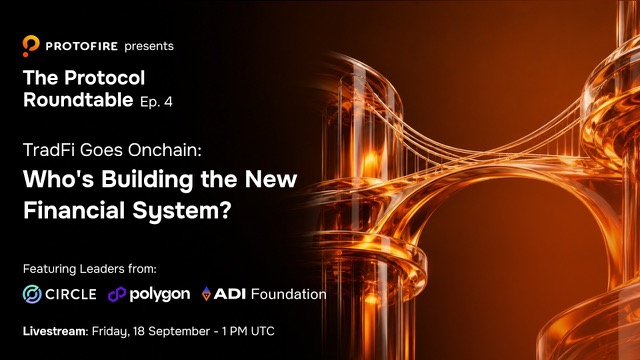
What enterprises ask before they commit to a chain
 Gagan Mac, Circle
Moment at 45:48Episode 4 · TradFi Goes Onchain: Who's Building the New Financial System?
What matters when an institution picks a chain
 Luis Medeiros, Protofire
Moment at 40:18Episode 4 · TradFi Goes Onchain: Who's Building the New Financial System?
We work out the network together with the compliance and custody design, then build on it. On an EVM chain or Besu ledger that means ERC-3643 tokens with onchain identity, KYC and sanctions checks in the contracts, Safe multisig or MPC custody with approval matrices, and Proof of Reserve, monitoring and indexing after launch; on Canton, Daml applications.
Enterprise builds on public or permissioned chains →Get a proposal
Tell us what you are building. An engineer reads it, we have a short call, and the written proposal follows within one business day.
Budget
An NDA is available from the first message and can cover anything you share. How it works