Reserve-Capped Mint Controls
An e-money token issuer that already has supply in circulation makes minting fail closed. Authority is divided and rate-limited, circulating supply is reconciled continuously against safeguarded reserves, and a deviation beyond tolerance halts issuance automatically - before a holder or a venue notices a shortfall.
The full blueprint adds all 10 risks with their controls and owners, the DORA third-party pack and the delivery plan in 4 phases.
Web document · ~16 pages · 23 min read · one link opens all 22 blueprints
- Maturity
- Emerging
- Model
- Reserve invariant
- Proven stack (4 of 7)
- Chainlink Proof of Reserve (Secure Mint) · Hypernative · Blockaid · The Network Firm (LedgerLens)
- Last verified
- August 2026

Reviewed by Andrei Yurkevich, Founding Member at Protofire
USDR and EURR minted against zero collateral at StablR, an EMI authorised in Malta, on 24 May 2026.
The mint contract required one valid signature of three possible signers; one key was compromised and the attacker added itself as administrator and removed the legitimate signers. A MiCA licence did not confer mint-authorisation security. This capability is bought as a control operation, not as a launch.
01. The opportunity
An institution that issues a fiat-referenced token holds two things in tension: an on-chain supply that a single transaction can increase, and an off-chain reserve that moves at the speed of bank settlement. Mint governance keeps the two tied together: who may authorise an issuance, how much may be issued in a window, what reserve evidence must exist first, and what halts issuance when evidence and supply disagree. It is a control operation bought for an issuance that is already live, by electronic money institutions and credit institutions that issue an e-money token under MiCA Title IV and safeguard the reserve funds under Art. 54.
What is at stake is the issuance franchise itself. The revenue an issuer earns is spread and float income on the reserve, and both stop entirely when minting and redemption are suspended. Gating issuance in contract code the issuer owns - divided authority, rate limits sized to normal business, and a continuous supply-versus-reserve check that halts minting on a deviation beyond tolerance - means a key compromise ends as a halted mint and a DORA incident report before a holder or a venue notices a shortfall.
02. The regulatory position
03. Who's already done this
Minting gated by Chainlink Proof of Reserve against safeguarded reserves at Bank Frick, with KPMG monthly attestation. Approximately 1,383,908 GBPT in circulation on 10 August 2026. The closest analogue in the set - a regulated fiat-backed issuer with the mint gate itself in production rather than merely reserve reporting. Small, which is the honest caveat.
Chainlink Proof of Reserve implemented across six named exchange-traded products at launch. Shows the reserve-transparency layer operating under a listed-product regime with exchange oversight. Not an issuance gate, and not an e-money token.
Chainlink Proof of Reserve on physically-backed exchange-traded products. A second, independent listed-product adoption of the same reserve layer, from a regulated market-infrastructure group.
Reserve verification for MTLK, a Turkish lira-referenced token, using Chainlink data feeds and Proof of Reserve. A deposit-taking institution running reserve verification on a fiat-referenced token - outside the EU, so the regulatory reading does not transfer.
04. Why this is on the agenda
On 24 May 2026 StablR, an e-money institution authorised in Malta, suffered a compromise of its minting arrangements. The mint contract required one valid signature of three possible signers; one key was compromised, and the attacker added itself as an administrator and removed the legitimate signers. 8.35 million USDR and 4.5 million EURR were minted against zero collateral and sold across decentralised exchanges, realising roughly 1,115 ETH - about USD 2.8 million. EURR traded about 23% below its euro peg, USDR about 30% below its dollar peg.
The issuer suspended minting and redemption, notified the MFSA of a major ICT-related incident under DORA, and activated its recovery plan. As at 22 July 2026 minting and redemption remained suspended. A MiCA authorisation was in place throughout and did not prevent it.
05. Does this fit you?
It fits if you already issue an e-money token under MiCA Title IV with supply in public circulation, safeguard reserve funds under Art. 54, and run your own minting arrangements.
It does not fit if you have not issued a token yet - this has a hard prerequisite and is not an entry point. It does not fit if you would rather not run issuance controls at all; that is a different blueprint, and the obligation moves to the issuer whose token you distribute rather than disappearing. And if you mint only in scheduled batches, by a single operator, against pre-funded reserves, with no programmatic mint path, periodic attestation may already be proportionate.
06. The stack, layer by layer
Most of these layers can be rented from a named vendor, and usually should be. The part that matters is the one layer you have to own yourself.
The authorisation, the reserve accounts and the existing mint
The issuance authorisation and the safeguarded reserve accounts, the token contracts and the existing minting arrangement, a finance function that already reconciles the reserve, and an ICT risk framework with a reporting line to the competent authority. BP-7 or an equivalent issuance capability must already be live.
Reserve feed, detection and attestation
A reserve figure delivered on-chain with contract libraries for gating a mint against it, behavioural detection over contracts and signer sets, and an accountant's attestation over a reserve balance. No policy, no thresholds, no ledger reconciliation and no incident decision rights, by design.
The invariant, the halt authority and the reconciliation
The invariant itself - which supply figures across which chains, against which reserve accounts, at what tolerance; the path from safeguarded balance to feed, including the control that stops it being a self-report; contract changes for gating and rate limits, and the migration if the token is not upgradeable; and the thresholds-to-actions matrix, the halt authority, and reconciliation into the regulated books.
07. Why this stack
At the reserve-feed and mint-gate layer, Chainlink Proof of Reserve with Secure Mint is the only option found running a contract-level mint gate in production at a regulated fiat-token issuer. That is a real concentration at the load-bearing layer. Detection has real alternatives - Hypernative and Blockaid, the latter having identified the StablR issuance while it was in progress. Attestation splits between continuous (The Network Firm, via LedgerLens) and the periodic incumbents (KPMG, Deloitte, Grant Thornton) that most issuers actually buy today.
All three assessed components are rated conditional in published readiness notes: the architecture contains the failure mode, and named compensating controls are required.
08. What we don't claim
- Proof of reserves is not a MiCA requirement. It is market practice layered on top of Art. 54 safeguarding, Art. 55 recovery plans, and - for significant tokens only, via Art. 58(1)(a) - Arts. 36 to 38.
- No MiCA EMT issuer runs the full pattern in production.
- The reserve feed is usually the issuer reporting on itself. Decentralised transport does not make the source independent; only the custodian or the attesting accountant does.
- No supervisor requires this. The regulatory pull is weak; it is bought after incidents and before listings.
- The euro EMT market this serves is small - roughly USD 673.9m averaged over the year to 28 June 2026.
- No elapsed-time dataset exists for this pattern, so the 3-to-9-month range should be read as an indicative shape. What moves it is whether the token contract can be upgraded in place or the supply must be migrated to a new contract.
Risks, controls and owners
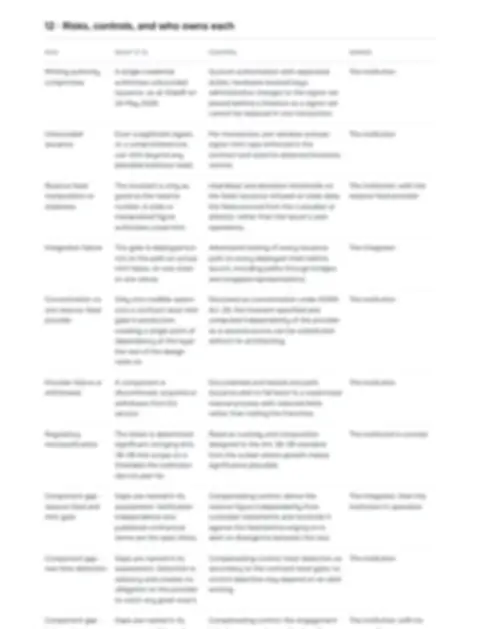
From the full blueprint · 3 of 10 shown, one with its control- Minting authority compromiseControl: in the full blueprintOwner: The institution
- Concentration on one reserve-feed providerControl: in the full blueprintOwner: The institution
- Regulatory misclassificationControl: Reserve custody and composition designed to the Art. 36-38 standard from the outset where growth makes significance plausible.Owner: The institution's counsel
The other 7 risks, and every control, are in the full blueprint.
Get all 10 with controls ↓Get the full BP-9
Web document · ~16 pages · 23 min read
This page is the short version. The full BP-9 adds all 10 risks with their controls and owners, the DORA third-party pack and the delivery plan in 4 phases. We email you a personal link, and it opens all 22 blueprints in the library.
We email your personal link and, now and then, a blueprint update. Privacy policy
Reviewed by Andrei Yurkevich, Founding Member at Protofire · last verified August 2026
What the full blueprint adds, by reader
- Counsel
- The regulatory position across 5 regimes, article by article
- Risk & compliance
- All 10 risks, each with its control and the party that owns it
- Third-party risk
- The DORA pack: critical-or-important classification, the Art. 28(4) pre-contract assessment, Art. 30(3) contract clauses and Art. 29 concentration. Any commission we may earn on a named vendor is disclosed
- Technical lead
- Which of the 8 building blocks are essential and which are optional, and why
- Delivery
- The delivery plan in 4 phases, with the decision that gates each, then monitoring and incident response once live
- Board
- For the board paper: what each function gets, and where this pattern does not work
FAQ
Is proof of reserves required under MiCA for an e-money token issuer?
No. Under the Issuance That Cannot Exceed the Reserve pattern, proof of reserves is not a MiCA requirement and is market practice layered on top. MiCA Art. 54 requires safeguarding under Art. 7(1) of Directive 2009/110/EC, with at least 30 per cent of funds received in separate accounts at credit institutions and the remainder in highly liquid instruments per Art. 38(1). The blueprint adds a control operation on top: minting fails closed, gated by a verified supply-versus-reserve invariant rather than trust in a signing key.
What incident shows why a MiCA licence alone does not secure minting?
On 24 May 2026, StablR, an EMI authorised in Malta, had 8.35 million USDR and 4.5 million EURR minted against zero collateral. The mint contract required one valid signature of three possible signers; one key was compromised, and the attacker added itself as administrator and removed the legitimate signers. A MiCA licence did not confer mint-authorisation security, which is why this capability is bought as a control operation rather than as a launch feature.
Who already gates minting against reserves in production, and what does the issuer build?
Blackfridge SC Limited, regulated by the Isle of Man FSA under Class 8(2)(a) and (4) money transmission, gates minting of its poundtoken (GBPT) with Chainlink Proof of Reserve against safeguarded reserves at Bank Frick, with KPMG monthly attestation and around 1,383,908 GBPT in circulation on 10 August 2026. The issuer rents the reserve feed, detection and attestation from vendors such as Chainlink Proof of Reserve, Hypernative and The Network Firm. It builds the invariant itself, the halt authority, and reconciliation into the regulated books.
Already evaluating this for your institution?
When you are ready, we scope a business case on your own numbers: the costed build, the controls, the SLA and the ROI your board needs to approve it. Or talk it through first.
Run this pattern in production, or tried to and stopped? .