Euro Stablecoin From a Licensed Issuer
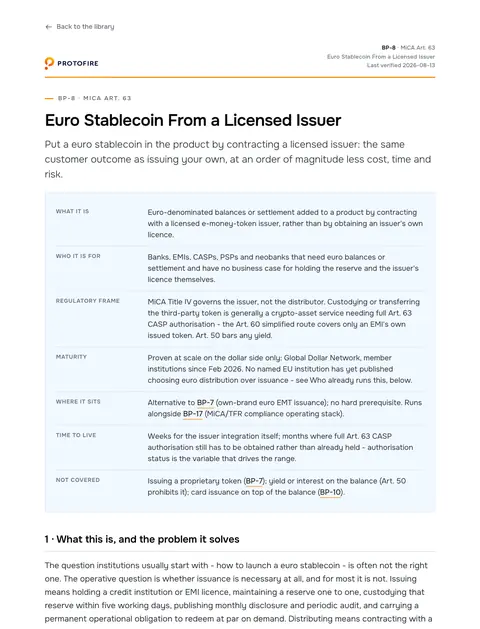
Put a euro stablecoin in the product by contracting a licensed issuer: the same customer outcome as issuing your own, at an order of magnitude less cost, time and risk.
The full blueprint adds all 9 risks with their controls and owners, the DORA third-party pack and the delivery plan in 4 phases.
Web document · ~13 pages · 19 min read · one link opens all 22 blueprints
- Maturity
- Emerging
- Regime
- MiCA Art. 63
- Proven stack (4 of 5)
- Circle · Monerium · Banking Circle · SG-FORGE
- Last verified
- August 2026

Reviewed by Ivor Jugo, Offer Owner at Protofire
combined market cap of the eight MiCA-compliant euro stablecoins an institution could distribute instead of issuing, as of 28 Jun 2026.
Two tokens hold roughly 84% of that market after 128% growth over twelve months - distributing means skipping the licence programme those numbers represent, not chasing volume.
01. The opportunity
Many institutions asking how to launch a euro stablecoin do not need to issue one. Issuing means holding a credit institution or EMI licence, maintaining a reserve one to one, custodying that reserve within five working days, publishing monthly disclosure and periodic audit, and carrying a permanent obligation to redeem at par on demand. Distributing means contracting with a licensed issuer and placing its token in the product. Both reach the same customer outcome, and they differ by an order of magnitude in cost, time and risk.
The market itself is small. Eight euro stablecoins met MiCA requirements as of June 2026, up from five at the start of the year, with combined market capitalisation of USD 673.9 million after 128 per cent growth over twelve months. EURC averaged USD 430.4 million of that total, EURCV USD 137.8 million, EURI USD 51.1 million and EURE USD 29.9 million; the remaining four - EUROP, EURR, EURQ and EURAU - each averaged under USD 13 million, so two tokens hold roughly 84 per cent of the compliant euro market, and AllUnity's EURAU, backed by Deutsche Bank and DWS, sits in the bottom four. On the dollar side the same choice is already visible at scale: Bitpanda joined the Global Dollar Network in February 2026 with roughly 7 million registered users, alongside Kraken, SwissBorg, Zodia and CoinsPaid.
02. The regulatory position
03. Who's already done this
Global Dollar Network member with roughly 7M registered users - distribution at scale on the dollar side, the pattern this blueprint applies to euro.
Global Dollar Network members alongside Bitpanda - confirms distribution without issuance as a repeatable institutional choice.
04. Does this fit you?
- Yes if there's a board mandate or product need for euro balances or settlement, and no genuine need to control the reserve, balance sheet or token brand.
- Not if the case requires controlling the reserve itself, or only works if customers earn on the balance - Article 50 rules that out regardless of architecture.
05. The stack, layer by layer
Most of these layers can be rented from a named vendor, and usually should be. The part that matters is the one layer you have to own yourself.
Customers, rails and compliance the institution already has
Customers, KYC and the product surface; fiat rails and a treasury function; compliance and reporting; whatever authorisation it already holds.
The issuer's rail
The token, the reserve and the licence behind it; mint and redeem against SEPA; attestation and monthly disclosure; chain deployments and contract maintenance - not float policy, not failover, not reconciliation.
The integration and switch-resilience layer
Issuer integration and the redemption path; float sizing and treasury policy, or the just-in-time mint flow; dual-issuer abstraction so a switch is configuration rather than a rebuild; reconciliation between ledger and chain state; issuer monitoring and the exit runbook; screening on tokens arriving from outside the institution's own rail.
06. Why this stack
- Issuing means a credit institution or EMI licence, a one-to-one reserve, five-working-day custody, monthly disclosure and a permanent redemption obligation. Distributing means a contract and an integration.
- Eight euro stablecoins met MiCA requirements as of June 2026 with a combined market cap of USD 673.9 million. That is a small market, so the reason to run an own-brand licence programme is control of the instrument; the available volume does not carry the case on its own.
- A second, uncorrelated issuer keeps a single issuer's problems from taking down the distributor's own product - see the StablR/EURR incident of May 2026.
Risks, controls and owners
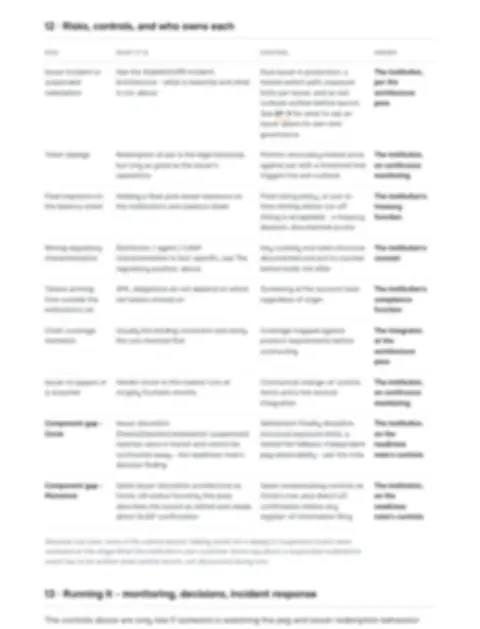
From the full blueprint · 3 of 9 shown, one with its control- Issuer incident or suspended redemptionControl: in the full blueprintOwner: The institution, per the architecture pass
- Token depegsControl: Monitor secondary market price against par with a threshold that triggers the exit runbookOwner: The institution, on continuous monitoring
- Float exposure on the balance sheetControl: in the full blueprintOwner: The institution's treasury function
The other 6 risks, and every control, are in the full blueprint.
Get all 9 with controls ↓Get the full BP-8
Web document · ~13 pages · 19 min read
This page is the short version. The full BP-8 adds all 9 risks with their controls and owners, the DORA third-party pack and the delivery plan in 4 phases. We email you a personal link, and it opens all 22 blueprints in the library.
We email your personal link and, now and then, a blueprint update. Privacy policy
Reviewed by Ivor Jugo, Offer Owner at Protofire · last verified August 2026
What the full blueprint adds, by reader
- Counsel
- The regulatory position across 4 regimes, article by article
- Risk & compliance
- All 9 risks, each with its control and the party that owns it
- Third-party risk
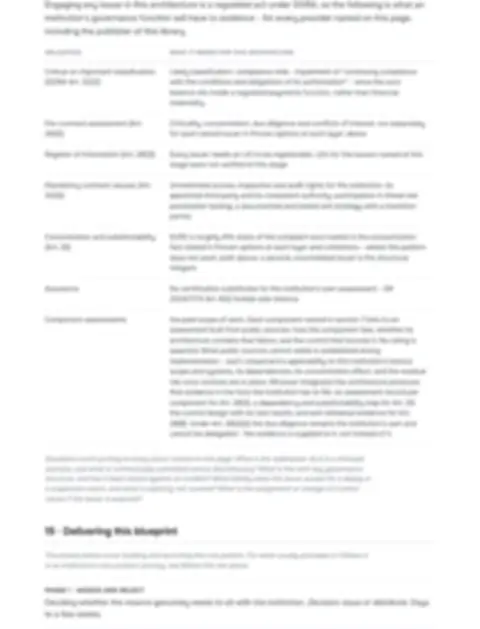
- The DORA pack: critical-or-important classification, the Art. 28(4) pre-contract assessment, Art. 30(3) contract clauses and Art. 29 concentration. Any commission we may earn on a named vendor is disclosed
- Technical lead
- Which of the 6 building blocks are essential and which are optional, and why
- Delivery
- The delivery plan in 4 phases, with the decision that gates each, then monitoring and incident response once live
- Board
- For the board paper: what each function gets, and where this pattern does not work
FAQ
What authorisation is needed to distribute a third-party euro e-money token rather than issue one?
Distributing or custodying a third-party euro EMT is a crypto-asset service that generally needs a full MiCA Art. 63 CASP authorisation, working through a licensed issuer's own Art. 48-58 authorisation. The simplified Art. 60 notification only covers an EMI's own issued EMT, so it does not extend to distributing someone else's token. Art. 50 bars any yield or holding-linked benefit. The pattern puts a euro stablecoin in the product by signing with a licensed issuer instead of becoming one.
Which institutions choose to distribute a euro stablecoin instead of issuing their own?
Bitpanda, on the MiCA CASP track in Austria, joined the Global Dollar Network in February 2026 with roughly 7 million registered users, showing distribution at scale on the dollar side that this blueprint applies to euro. Kraken, SwissBorg, Zodia and CoinsPaid are Global Dollar Network members alongside Bitpanda, which confirms distribution rather than issuance is a repeatable institutional choice. Across the eight MiCA-compliant euro stablecoins, two tokens hold roughly 84 per cent of a USD 673.9 million market.
Who is distribution the right choice for, and what does the institution still build?
Distribution fits banks, EMIs, CASPs, PSPs and neobanks that need euro-denominated balances or settlement but have no board mandate or business case to hold the reserve, the licence and the redemption obligation themselves. It is not for institutions whose business case genuinely requires control of the reserve, the balance-sheet treatment or the brand on the token. The institution still builds the issuer integration and redemption path, a dual-issuer abstraction so a switch is configuration rather than a rebuild, reconciliation between ledger and chain, and the exit runbook.
Already evaluating this for your institution?
When you are ready, we scope a business case on your own numbers: the costed build, the controls, the SLA and the ROI your board needs to approve it. Or talk it through first.
Run this pattern in production, or tried to and stopped? .