Lapsed VASP Migration to a Licensed CASP
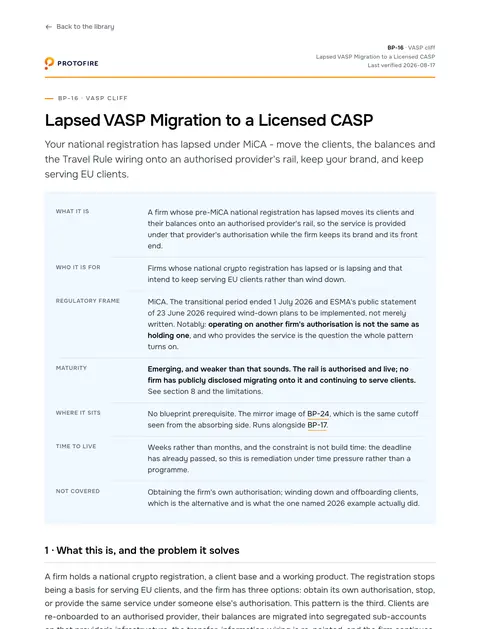
Your national registration has lapsed under MiCA - move the clients, the balances and the Travel Rule wiring onto an authorised provider's rail, keep your brand, and keep serving EU clients.
The full blueprint adds all 8 risks with their controls and owners, the DORA third-party pack and the delivery plan in 4 phases.
Web document · ~16 pages · 25 min read · one link opens all 22 blueprints
- Maturity
- Emerging
- Model
- VASP cliff
- Proven stack
- BitGo Europe GmbH · Zodia Custody Europe · Boerse Stuttgart Digital
- Last verified
- August 2026

Reviewed by Rado Patus, Offer Owner at Protofire
authorised CASPs on the ESMA register at 12 Aug 2026, against more than 3,000 pre-MiCA registered VASPs in Europe.
209 crypto-native and 116 from traditional finance. Estimates put 75-80% of the old population out of registration. The transitional period ended 1 July 2026 with no extension.
01. The opportunity
A firm holds a national crypto registration, a client base and a working product, and the registration stops being a basis for serving EU clients. Three options remain: obtain its own authorisation, stop, or provide the same service under an authorised provider's authorisation. This pattern is the third. Clients are re-onboarded to an authorised provider, their balances are migrated into segregated sub-accounts on that provider's infrastructure, the transfer-information wiring is re-pointed, and the firm keeps the customer relationship and the front end while the regulated act belongs to the provider.
The pressure behind it is dated and specific. MiCA's transitional period ended on 1 July 2026 with no extension, and ESMA's public statement of 23 June 2026 told unauthorised providers to stop onboarding EU clients immediately, cease marketing, and have wind-down plans already implemented. A large majority of the pre-MiCA population is expected to lose registration, and national regimes closed ahead of the cliff - Lithuania's on 31 December 2025, Poland's on 30 June 2026. For a firm with an EU client base worth keeping, this is a regulated way to go on serving those clients on an authorised provider's rail while keeping its own brand and front end.
02. The regulatory position
03. Who's already done this
Nobody has said so publicly.
What is documented is the other half. The rails exist, they are authorised, and one of them is marketed at exactly this situation:
- BitGo Europe GmbH holds a BaFin crypto-asset service provider authorisation dated 12 May 2025, extended in September 2025 to add regulated trading, passported across 30 EEA states. On 17 June 2026 it launched a service for firms displaced by expiring national regimes: integrate the wallet system, clients are identified by BitGo, assets sit in segregated custody accounts, and you keep your brand and front end. No client of that service has been named.
- Zodia Custody Europe holds a CSSF crypto-asset authorisation with EU passporting and, since June 2026, a CSSF payment institution licence covering e-money token custody and transfer. Its shareholders include Northern Trust, SBI Holdings, National Australia Bank and Emirates NBD. It publishes no product for displaced firms, so the option rests on what the licence permits rather than on an offer.
The one named client transfer of 2026 went the other way: MEXC announced on 12 August 2026 that it is exiting the Netherlands and referring its clients there to Kraken, which holds a Central Bank of Ireland MiCA authorisation from June 2025. That is the wind-down route, not this one - MEXC stops serving those clients rather than continuing to.
04. Does this fit you?
It fits a firm whose registration has lapsed, with an EU client base worth keeping, that can accept the regulated service becoming somebody else's, on their fee schedule and their risk appetite, and that has a brand and front end worth preserving.
It does not fit you if you already hold your own authorisation; you are the absorbing side. It does not fit if you are leaving the EU, in which case winding down is the honest answer. And it does not fit if you intend to keep holding client assets or issuing client instructions yourself, which is still unauthorised activity whatever it is called.
Two limits belong in view from the start. Identification cannot be inherited: every client re-onboards with the provider and some never will, so attrition is a certainty to forecast. And this route does not cure the past: activity since your registration lapsed is a separate exposure that belongs with counsel before anything is designed.
05. The stack, layer by layer
Most of these layers can be rented from a named vendor, and usually should be. The part that matters is the one layer you have to own yourself.
Client relationship, brand and front end
The clients, the interface they recognise, the firm's own historic records, and whatever national AML obligations survive the change. This is what the pattern exists to preserve, and it is also where the perimeter question concentrates: the more the front end behaves like the service, the harder the legal analysis becomes.
The authorisation, custody, execution and onboarding
An authorised provider onboards the clients under its own licence, holds their assets in segregated custody, and executes and transfers on their behalf. The regulated duties genuinely move. What no provider supplies is the client consent, the cutover reconciliation, or any opinion on whether the firm's continuing role is lawful.
The migration itself, and the evidence it leaves behind (built and operated by Protofire)
The perimeter pack counsel opines on, a dated reconstruction of what was provided since the registration lapsed, the book profile, consent and its audit trail, sub-account mapping, transfer-information switchover with a live overlap, and a cutover reconciliation that survives a supervisor reading it a year later. No product exists for this layer; it is built.
06. Why this stack
The numbers behind the pressure are dated and specific. The ESMA register held 325 authorised providers on 12 August 2026 - 209 crypto-native, 116 from traditional finance - against more than 3,000 pre-MiCA registered firms in Europe, Poland alone accounting for over 1,400. Estimates put 75 to 80 per cent of the old population out of registration. Lithuania's regime closed on 31 December 2025, Poland's on 30 June 2026, and the transitional period ended on 1 July 2026 with no extension.
The build itself is well understood: an authorised rail, client re-onboarding, balance migration into segregated sub-accounts, transfer-information re-pointing, and a reconciliation across the cutover. Two parts carry the difficulty. The reconciliation layer has no vendor - no product reconciles a lapsing firm's ledger against a provider's sub-account structure, so it is built. And the legal characterisation is the harder one to settle: MiCA regulates the person providing the service, so what has to be established is whether an authorised provider genuinely provides it, or whether the firm still does under a different label.
Risks, controls and owners
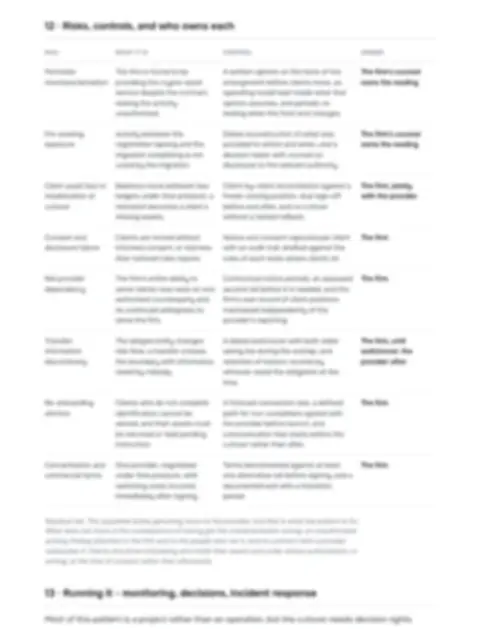
From the full blueprint · 3 of 8 shown, one with its control- Perimeter mischaracterisationControl: A written opinion on the facts of the arrangement before clients move, an operating model kept inside what that opinion assumes, and periodic re-testing when the front end changes.Owner: The firm's counsel owns the reading
- Pre-existing exposureControl: in the full blueprintOwner: The firm's counsel owns the reading
- Client asset loss or misallocation at cutoverControl: in the full blueprintOwner: The firm, jointly with the provider
The other 5 risks, and every control, are in the full blueprint.
Get all 8 with controls ↓Get the full BP-16
Web document · ~16 pages · 25 min read
This page is the short version. The full BP-16 adds all 8 risks with their controls and owners, the DORA third-party pack and the delivery plan in 4 phases. We email you a personal link, and it opens all 22 blueprints in the library.
We email your personal link and, now and then, a blueprint update. Privacy policy
Reviewed by Rado Patus, Offer Owner at Protofire · last verified August 2026

What the full blueprint adds, by reader
- Counsel
- The regulatory position across 6 regimes, article by article
- Risk & compliance
- All 8 risks, each with its control and the party that owns it
- Third-party risk
- The DORA pack: critical-or-important classification, the Art. 28(4) pre-contract assessment, Art. 30(3) contract clauses and Art. 29 concentration. Any commission we may earn on a named vendor is disclosed
- Technical lead
- Which of the 9 building blocks are essential and which are optional, and why
- Delivery
- The delivery plan in 4 phases, with the decision that gates each, then monitoring and incident response once live
- Board
- For the board paper: what each function gets, and where this pattern does not work
FAQ
Is it lawful under MiCA to keep serving EU clients on an authorised provider's rail after a VASP registration lapses?
It depends on identity rather than activity. MiCA regulates the person providing the service, so if an authorised provider genuinely onboards the clients, holds their assets and owes them the duties, a firm that introduces clients and operates a front end may not itself be providing a crypto-asset service. Whether that holds on the facts is unsettled, undocumented by any supervisor, and needs an opinion per jurisdiction. A white label that leaves the firm in the service position is unauthorised activity with extra steps.
What changed on 1 July 2026 for unauthorised crypto providers in the EU?
MiCA's transitional period ended on 1 July 2026 with no extension. ESMA's public statement of 23 June 2026 required unauthorised providers to stop onboarding EU clients immediately, cease marketing, and have wind-down plans already implemented, stating that a plan on paper would not suffice. At 12 August 2026 there were 325 authorised CASPs on the ESMA register against more than 3,000 pre-MiCA registered VASPs, with estimates putting 75 to 80 per cent of the old population out of registration.
In a VASP-cliff migration, what is rented and what has to be built?
The firm keeps its clients, brand, front end and historic records, which is what the pattern exists to preserve. It rents the regulated core from an authorised provider such as BitGo Europe, Zodia Custody Europe or Boerse Stuttgart Digital, which onboards the clients under its own licence, holds their assets in segregated custody, and executes and transfers on their behalf. No product exists for the migration itself, so it is built: the perimeter pack counsel opines on, client consent and its audit trail, sub-account mapping, the transfer-information switchover, and a cutover reconciliation a supervisor can read a year later.
Already evaluating this for your institution?
When you are ready, we scope a business case on your own numbers: the costed build, the controls, the SLA and the ROI your board needs to approve it. Or talk it through first.
Run this pattern in production, or tried to and stopped? .