Digital Share Class on an Existing Fund
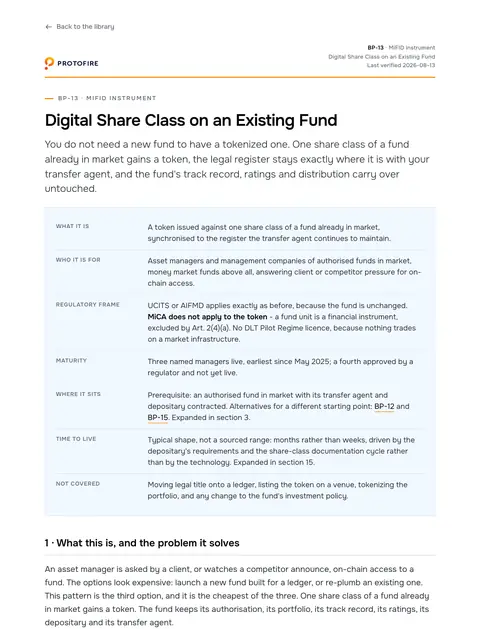
You do not need a new fund to have a tokenized one. One share class of a fund already in market gains a token, the legal register stays exactly where it is with your transfer agent, and the fund's track record, ratings and distribution carry over untouched.
The full blueprint adds all 7 risks with their controls and owners, the DORA third-party pack and the delivery plan in 4 phases.
Web document · ~15 pages · 25 min read · one link opens all 22 blueprints
- Maturity
- Proven
- Regime
- MiFID instrument
- Proven stack
- J.P. Morgan Kinexys · Allfunds Blockchain · Tokeny (T-REX) · BNP Paribas Securities Services
- Last verified
- August 2026

Reviewed by Rado Patus, Offer Owner at Protofire
tokenised across six UCITS money market funds and live on 4 Aug 2026, the largest instance located.
One figure is routinely misquoted: the six underlying funds held a combined USD 311 billion as at 30 Jun 2026, which is the funds' assets and not the tokenized classes'. No figure for the tokenized classes themselves was located, and that absence is worth knowing.
01. The opportunity
An asset manager is asked by a client, or watches a competitor announce, on-chain access to a fund. The obvious options are expensive: launch a new fund built for a ledger, or re-plumb an existing one. This pattern is a third and cheaper route. One share class of a fund already in market gains a token, while the fund keeps its authorisation, its portfolio, its track record, its ratings, its depositary and its transfer agent. MiCA does not apply, because a fund unit is a MiFID II financial instrument that Art. 2(4)(a) excludes, and UCITS or AIFMD applies exactly as before because the fund itself is unchanged.
The largest managers have now done it in a form regulators have seen, disproportionately in money market funds where demand for an on-chain cash-equivalent sits. Twelve tokenised share classes across six money market funds went live on 4 August 2026, and a national regulator approved a further tokenised class on 6 August 2026. For an incumbent manager it is a way to give existing clients on-chain access to the fund they already know, on regulated rails, without a new authorisation or a change to the register of record.
02. The regulatory position
03. Who's already done this
Twelve tokenised share classes on its Institutional Cash Series, on public Ethereum via Kinexys, with 24/7 peer-to-peer transfer between approved wallets and minting only during fund hours. The asymmetry between continuous transfer and fund-hours issuance is the design worth copying.
A natively tokenised money market share class on an existing fund, reported as the first cross-border digital-asset transaction between Luxembourg and France, executing orders against the NAV receipt rather than in batches. The earliest live instance located, and proof the native route works on a fund that already exists.
A tokenised share class on its Global Private Assets Fund. Instructive by contrast: the same architecture outside money market funds, where the dealing cycle is slower and the liquidity tension is different.
04. Does this fit you?
- Yes if you manage an authorised fund already in market - money market funds most of all - a client or a competitor has raised on-chain access, and you would rather extend the fund you have than launch one you do not.
- Not if the fund does not exist yet (tokenizing the register from the start is a different blueprint), if you are the administrator wanting to sell this to your manager clients (different buyer, different economics), or if the token has to trade on a venue - that changes the regime entirely.
05. Continuous transfer, minting on fund hours
A token can move around the clock, while the fund redeems at a cut-off. If holders treat continuous transfer as continuous redemption, the mismatch can become a run, and the ECB named exactly this as the central risk of tokenised money market funds in April 2026.
The largest live instance answers it with an asymmetry worth copying exactly: secondary transfer between approved wallets runs 24/7, while minting and redemption stay on the fund's own hours. Transfer is continuous and primary dealing is unchanged. Because a top-tier manager has already built it, it is a straightforward design to put in front of a risk committee.
06. The stack, layer by layer
Most of these layers can be rented from a named vendor, and usually should be. The part that matters is the one layer you have to own yourself.
The fund, the register and everyone contracted to it
The fund with its authorisation, portfolio and track record; the transfer agent, depositary, administrator and auditor; investor onboarding, the dealing cycle and NAV production; and the distribution that generates the demand. The universal truth across every credible example is that the legal register stays with the licensed transfer agent and the token is a synchronised representation.
Token contracts and the chain-facing sync
Audited token and identity contracts with chain deployment, the chain-facing half of the synchronisation, and position and transfer reporting interfaces. No register, no depositary function, no NAV and no distribution, by design.
The register seam and the controls around it (built and operated by Protofire)
The register-facing half of the synchronisation, for which no standard transfer-agency integration exists; the daily reconciliation control and its escalation to the depositary; the fund-hours minting gate and eligible-holder policy enforcement; and out-of-hours detection and response with two tested exit paths. That sync layer is the one unambiguously integrator-shaped component in the whole tokenization stack.
07. Why this stack
- The register does not move. The token is a synchronised representation of a register your transfer agent already keeps. Nothing about the fund's authorisation, portfolio, depositary or administrator changes, which is why this is the lowest-friction route in the tokenization cluster.
- MiCA does not apply to the token. A fund unit is a MiFID financial instrument and MiCA Art. 2(4)(a) excludes it, so no crypto-asset authorisation enters the picture. No DLT Pilot Regime licence either, because nothing lists on a venue.
- Two variants, and the choice is a documentation question: tokenize an existing class (what most incumbents do first) or create a natively tokenized class on the same fund (rarer, more capable, more paperwork).
- The sync layer is the only genuinely rentable piece in the whole stack: a bank-operated translation platform, a distribution platform's variant, or an open compliance-token standard. Two credible alternatives at every layer.
Risks, controls and owners
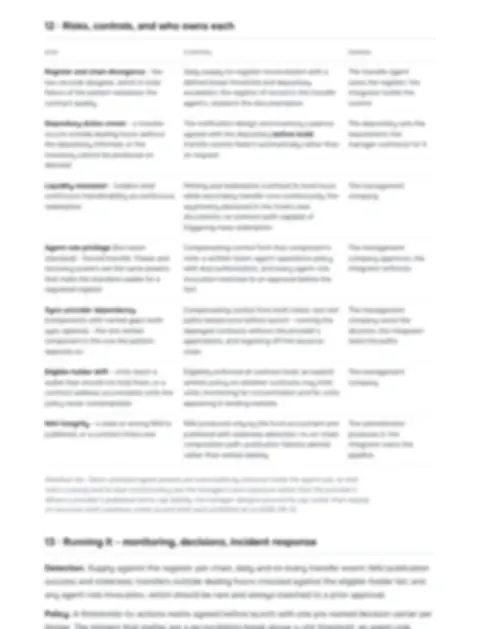
From the full blueprint · 3 of 7 shown, one with its control- Register and chain divergenceControl: Daily supply-to-register reconciliation with a defined break threshold and depositary escalation; the register of record is the transfer agent's, stated in the documentationOwner: The transfer agent owns the register; the integrator builds the control
- Depositary duties unmetControl: in the full blueprintOwner: The depositary sets the requirement; the manager contracts for it
- Liquidity mismatchControl: in the full blueprintOwner: The management company
The other 4 risks, and every control, are in the full blueprint.
Get all 7 with controls ↓Get the full BP-13
Web document · ~15 pages · 25 min read
This page is the short version. The full BP-13 adds all 7 risks with their controls and owners, the DORA third-party pack and the delivery plan in 4 phases. We email you a personal link, and it opens all 22 blueprints in the library.
We email your personal link and, now and then, a blueprint update. Privacy policy
Reviewed by Rado Patus, Offer Owner at Protofire · last verified August 2026
What the full blueprint adds, by reader
- Counsel
- The regulatory position across 5 regimes, article by article
- Risk & compliance
- All 7 risks, each with its control and the party that owns it
- Third-party risk
- The DORA pack: critical-or-important classification, the Art. 28(4) pre-contract assessment, Art. 30(3) contract clauses and Art. 29 concentration. Any commission we may earn on a named vendor is disclosed
- Technical lead
- Which of the 9 building blocks are essential and which are optional, and why
- Delivery
- The delivery plan in 4 phases, with the decision that gates each, then monitoring and incident response once live
- Board
- For the board paper: what each function gets, and where this pattern does not work
FAQ
Does adding a tokenised share class change a fund's authorisation or its register of record?
No. In A Tokenized Share Class on a Fund That Already Exists, MiCA does not apply to the token because the fund unit is a MiFID II financial instrument excluded by MiCA Art. 2(4)(a), and UCITS or AIFMD applies exactly as before because the fund is unchanged. The legal register stays with the licensed transfer agent and the token is a synchronised representation. Register maintenance is a delegated function, while depositary oversight of issue and redemption is non-delegable under UCITS Art. 22a(1).
Who has already added a tokenised share class to an existing fund?
BlackRock tokenised twelve share classes across six existing UCITS money market funds on its Institutional Cash Series, live on 4 August 2026 on public Ethereum via Kinexys, with 24/7 peer-to-peer transfer between approved wallets and minting confined to fund hours. BNP Paribas Asset Management created a natively tokenised money market share class on an existing Luxembourg fund in May 2025, with BNP Paribas Securities Services as transfer agent, the earliest live instance located. Hamilton Lane added one on its Global Private Assets Fund in May 2026.
What is rented versus built when tokenising a share class?
The fund keeps its authorisation, portfolio and track record, and the transfer agent, depositary, administrator and auditor all stay in place. The token contracts and the chain-facing half of the synchronisation are rented from providers such as J.P. Morgan Kinexys, Allfunds Blockchain or Tokeny (T-REX, ERC-3643). What gets built is the register-facing half of the synchronisation, for which no standard transfer-agency integration exists, the daily reconciliation control escalating to the depositary, the fund-hours minting gate, and eligible-holder policy enforcement.
Already evaluating this for your institution?
When you are ready, we scope a business case on your own numbers: the costed build, the controls, the SLA and the ROI your board needs to approve it. Or talk it through first.
Run this pattern in production, or tried to and stopped? .