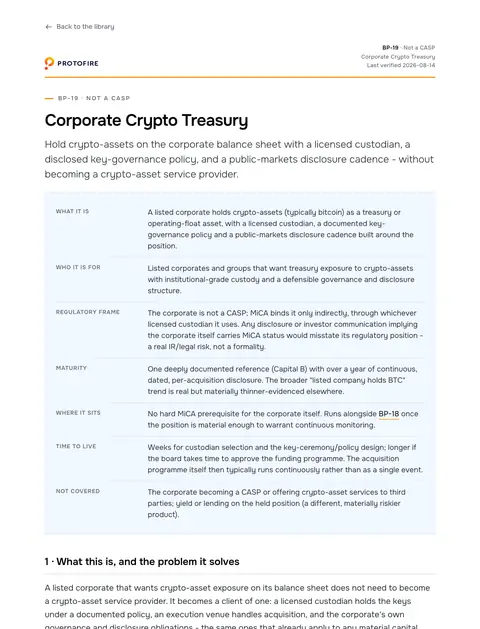
Corporate Crypto Treasury
Hold crypto-assets on the corporate balance sheet with a licensed custodian, a disclosed key-governance policy, and a public-markets disclosure cadence - without becoming a crypto-asset service provider.
The full blueprint adds all 9 risks with their controls and owners, the DORA third-party pack and the delivery plan in 4 phases.
Web document · ~13 pages · 17 min read · one link opens all 22 blueprints
- Maturity
- Emerging
- Model
- Not a CASP
- Proven stack
- Swissquote Bank Europe · Taurus · Fireblocks · Utila
- Last verified
- August 2026

Reviewed by Ivor Jugo, Offer Owner at Protofire
Capital B's disclosed bitcoin treasury (3,140 BTC), as of 3 Aug 2026.
The deepest-documented reference for this pattern - one continuously-disclosed position, not a market aggregate. The broader listed-company-holds-BTC trend is real but materially thinner-evidenced elsewhere.
01. The opportunity
A listed corporate that wants crypto-asset exposure on its balance sheet does not need to become a crypto-asset service provider. It becomes a client of one: a licensed custodian holds the keys under a documented policy, an execution venue handles acquisition, and the corporate's own governance and disclosure obligations - the same ones that already apply to any material capital allocation - carry the position. The asset held is typically bitcoin, kept as a treasury or operating-float asset with a documented key-governance policy and a public-markets disclosure cadence built around it.
The pattern reached genuine public-markets scale in Europe through Capital B, formerly The Blockchain Group, listed on Euronext Growth Paris and, since 5 August 2026, also on Cboe Europe. The company discloses each bitcoin acquisition individually through the exchange's regulatory news service - price, quantity, cumulative holding and year-to-date bitcoin yield - rather than only in a periodic filing, which is itself a governance choice this pattern depends on.
02. The regulatory position
03. Who's already done this
Bitcoin treasury of 3,140 BTC as of 3 Aug 2026 (~USD 198.9M); Swissquote Bank Europe as sole custodian; an ATM equity programme via TOBAM; stated target of 210,000 BTC (1% of total bitcoin supply) by 2033 (Capital B's own target, not independently verified). Over a year of continuous, dated, per-acquisition disclosure.
Bitcoin treasury since June 2025, targeting 3,000+ BTC, custodied via Coinbase Prime rather than a European custodian - instructive by contrast, not used as EU-custodian proof.
04. Does this fit you?
- Yes if there's a board mandate for treasury exposure to crypto-assets and a willingness to build real governance and disclosure around the position, rather than simply acquire and hold silently.
- Not if the goal is becoming a crypto-asset service provider, or earning yield on the position. Both are different, larger undertakings.
05. The stack, layer by layer
Most of these layers can be rented from a named vendor, and usually should be. The part that matters is the one layer you have to own yourself.
Governance and capital-markets access the corporate already has
Capital-markets access and its existing disclosure/governance function; a board and treasury committee; whatever ATM or capital-raise programme it already runs.
Custody and execution
Custody of the crypto-asset under the custodian's own licence; execution venue access; audited custody technology, where a technology vendor sits alongside the bank custodian - not the treasury policy itself, not the disclosure cadence, not the corporate's own key-ceremony quorum decisions.
The treasury policy and governance layer
The treasury policy and its limits; the key-ceremony design and quorum/allowlist configuration; the disclosure cadence and KPI definitions (BTC yield, cumulative holding); auditor evidence gathering and continuous monitoring once the position is material.
06. Why this stack
- The corporate is a client of a licensed custodian, not a crypto-asset service provider itself. MiCA binds it only indirectly.
- Per-acquisition disclosure through the exchange's regulatory news service is the governance choice that makes this pattern's evidence strong and independently checkable.
- Bank custody (Swissquote Bank Europe) keeps the position under an entity already carrying its own banking licence and supervision.
Risks, controls and owners
From the full blueprint · 3 of 9 shown, one with its control- Custody concentration on a single providerControl: in the full blueprintOwner: The institution's treasury function
- Overclaiming MiCA relevanceControl: Counsel-reviewed disclosure language stating the indirect-only MiCA relationship preciselyOwner: The institution's counsel
- Custodian's own DORA/operational failureControl: in the full blueprintOwner: The custodian, with oversight by the institution
The other 6 risks, and every control, are in the full blueprint.
Get all 9 with controls ↓Get the full BP-19
Web document · ~13 pages · 17 min read
This page is the short version. The full BP-19 adds all 9 risks with their controls and owners, the DORA third-party pack and the delivery plan in 4 phases. We email you a personal link, and it opens all 22 blueprints in the library.
We email your personal link and, now and then, a blueprint update. Privacy policy
Reviewed by Ivor Jugo, Offer Owner at Protofire · last verified August 2026
What the full blueprint adds, by reader
- Counsel
- The regulatory position across 4 regimes, article by article
- Risk & compliance
- All 9 risks, each with its control and the party that owns it
- Third-party risk
- The DORA pack: critical-or-important classification, the Art. 28(4) pre-contract assessment, Art. 30(3) contract clauses and Art. 29 concentration. Any commission we may earn on a named vendor is disclosed
- Technical lead
- Which of the 6 building blocks are essential and which are optional, and why
- Delivery
- The delivery plan in 4 phases, with the decision that gates each, then monitoring and incident response once live
- Board
- For the board paper: what each function gets, and where this pattern does not work
FAQ
Does a listed company holding bitcoin on its balance sheet become a CASP under MiCA?
No. In A Listed Corporate Runs a Regulated Digital-Asset Treasury, the corporate is not a CASP, and MiCA binds it only indirectly, through whichever licensed custodian it uses. DORA does not attach to the corporate directly, because it is not typically a DORA financial entity, though the custodian is. Overclaiming MiCA relevance for the corporate itself is a named risk on this pattern. The company holds crypto with a licensed custodian, a disclosed key-governance policy and a public-markets disclosure cadence.
Which listed corporate is the deepest-documented reference for a bitcoin treasury?
Capital B, listed on Euronext Growth Paris and Cboe Europe from 5 August 2026, disclosed a bitcoin treasury of 3,140 BTC as of 3 August 2026, worth approximately USD 198.9 million, with Swissquote Bank Europe as sole custodian and an ATM equity programme via TOBAM. It has a stated target of 210,000 BTC, 1 per cent of total bitcoin supply, by 2033, and over a year of continuous, dated, per-acquisition disclosure. Sequans Communications is a contrasting case, custodied via Coinbase Prime rather than a European custodian.
What does the corporate build versus rent, and who is this treasury pattern not for?
The corporate keeps its capital-markets access, its existing disclosure and governance function, and its board and treasury committee. It rents custody and execution from providers such as Swissquote Bank Europe, Taurus, Fireblocks or Utila. What it builds is the treasury policy and its limits, the key-ceremony design with quorum and allowlist configuration, the disclosure cadence and KPI definitions, and auditor evidence gathering. It is not for a company seeking to become a CASP or offer services to third parties, nor for one that wants yield on the position.
Already evaluating this for your institution?
When you are ready, we scope a business case on your own numbers: the costed build, the controls, the SLA and the ROI your board needs to approve it. Or talk it through first.
Run this pattern in production, or tried to and stopped? .