Protofire and the Ethereum Foundation: A Journey of Open Source Collaboration
At Protofire, our commitment to strengthening the Ethereum ecosystem has deep roots — dating back to the earliest days of Web3. Founded in 2016 as a blockchain spin-off , Protofire was born from the vision of building reliable foundations for a decentralized internet. Our team of passionate engineers and innovators quickly established itself as a trusted partner, supporting some of the most ambitious Ethereum projects with both frontend and backend expertise.
From day one, Protofire’s mission has been clear: empower builders, advance open standards, and ensure the security and usability of decentralized systems. Our journey reflects the growth and maturation of the Ethereum ecosystem itself:
- 2016
Protofire is founded to focus on building core infrastructure and tooling for the Ethereum community and its rapidly expanding suite of EVM-compatible networks. - 2017
By receiving our first grants from leading Web3 organizations — including Gnosis, Chainlink, Filecoin, and The Graph — we began long-term partnerships that allowed us to contribute code, resources, and best-in-class developer practices to projects that would shape DeFi, oracle networks, and data layers. - 2019
Recognizing the rising importance of decentralized governance, Protofire initiated its own transition toward DAO-based operations to better support and contribute to top-tier projects in EVM ecosystems. We expanded our focus to deliver services vital to the burgeoning DeFi landscape: securing TVL, deploying compatible oracles across networks, and providing in-depth smart contract audits to safeguard billions in digital assets. - 2023
With renewed support from the Ethereum Foundation and Optimism Collective, Protofire deepened its contribution to open-source developer tooling — delivering essential resources now considered must-haves for Ethereum devs worldwide.
Over the years, Protofire has consistently helped scale and secure EVM networks by building, maintaining, and integrating core technologies across more than 50 Ethereum-compatible chains. From multisig security deployments using Safe to designing protocols for DAOs and driving the adoption of on-chain governance best practices, our footprint now supports millions of users and secures hundreds of millions of dollars in digital assets.
A testament to this ongoing commitment: In 2025, we were proud to receive a grant from the Ethereum Foundation’s Ecosystem Support Program (ESP) to maintain, evolve, and champion Solhint — a vital open-source Solidity linter now relied on by thousands of developers to reinforce smart contract standards and security.
Learn more about Solhint: https://protofire.io/solhint
Get involved on GitHub: https://github.com/protofire/solhint
Tackling the Pains of Solidity Development: The Solhint Story
At Protofire, we understand firsthand the challenges that Solidity developers face every day. Writing Ethereum smart contracts comes with high stakes: a single error can mean lost funds or compromised protocols. However, when we examined the state of Solidity tooling in 2017, the landscape was far from favorable. Developers were on their own, trying to keep up with evolving security standards, best practices, and rapidly changing syntax — with little more than their wits and manual code reviews to guide them.
The Pressure Points
Imagine sitting down to write code that will potentially control millions in assets. You’re under pressure to deliver fast, but you know there’s no room for mistakes — blockchain contracts are immutable, so bugs can be catastrophic. The Ethereum community is vast and collaborative, but with so many contributors from everywhere, enforcing a consistent code style and catching subtle bugs becomes a gargantuan task.
Each new version of Solidity introduces changes and new deprecations, requiring devs to scramble, cross-referencing changelogs or GitHub issues to avoid outdated patterns. Reviewing dozens or hundreds of contract files line by line is tedious, error-prone, and exhausting, especially as projects grow in size and scope. The risk is a security vulnerabilities that can slip past even vigilant eyes.
That’s why we at Protofire created Solhint. We believed developers deserved better: powerful, automatic checks tuned for the unique risks and nuances of Solidity, so they could focus on building rather than worrying about hidden landmines in their code.
How Solhint Changes the Game
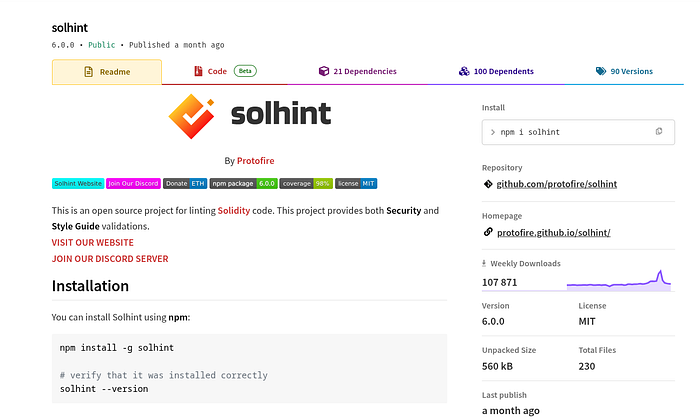
Solhint is more than a linter; it’s a response to these pains we — and so many others — felt. It provides a growing collection of customizable rules that surface possible security flaws (like risky fallback functions, dangerous patterns, deprecated syntax, or missing visibility specifiers) well before code ever sees mainnet. It checks not just the style, but also flags known security problems and enforces up-to-date Solidity best practices. With Solhint, checking dozens of files becomes a matter of seconds, not hours.
We made sure Solhint is blazingly fast, thanks to our advanced ANTLR4-based parser that delivers 2x–4x performance improvements over alternative solutions. It can be plugged into workflows through VS Code, JetBrains IDEs, or a simple command-line interface, offering instant, actionable feedback right where developers work. Developers can tune rules for their project’s needs, silence warnings, or enforce custom team conventions through flexible .solhint.json configuration files.
Open, Evolving, and Community-Driven
Because Solidity and Web3 move so quickly, we knew Solhint had to evolve just as rapidly — which is why we built it as a true open source project, guided by developer feedback and the ever-shifting landscape of Ethereum. Protofire leads, but the community shapes our roadmap, submits rule proposals, and helps ensure Solhint keeps pace with every Solidity release and emerging threat.
Impact: Raising the Bar for Everyone
Perhaps most importantly, our vision extended beyond what Protofire alone could build. We designed Solhint as a community platform — a place where the collective wisdom of Ethereum developers could be encoded into automated checks that benefit everyone.
The numbers reflect this success:
- Approximately 112,000 weekly downloads demonstrate sustained developer trust
- Over 8 million cumulative downloads
- 912 dependent projects across the ecosystem show widespread integration
- 1,083 GitHub stars indicate strong community support
- Used by over 1 million developers globally
Through our open-source approach, plugin architecture, and community feedback channels, Solhint has become a repository of best practices from across the ecosystem.
Teams that once feared missing a critical bug now ship code with more confidence, knowing Solhint is watching their backs. It’s a foundational piece of developer infrastructure — helping prevent costly errors, building trust, and raising quality standards across the entire ecosystem.
Our vision for Solhint ultimately serves a larger purpose: enabling the next generation of decentralized applications by making secure smart contract development accessible to more developers. By removing the need for deep security expertise to write reasonably secure code, we’re lowering the barriers to entry for innovation in the Web3 space while simultaneously raising the overall security standards of the ecosystem.
You can download or install the NPM package using the following link:
- Solhint v6.0.0 — NPM package: https://www.npmjs.com/package/solhint (latest version 6.0.0, published about 12 days ago)
The latest version 6.0.0 represents a significant milestone with major rule revisions aimed at modernizing Solidity development practices.
Rules Demoted from Recommended:
- payable-fallback: Removed due to becoming outdated with the introduction of receive() functions; rarely needed in modern Solidity development
Rules Promoted to Recommended:
This version significantly expanded the recommended ruleset with 12 new rules focused on gas optimization, code quality, and modern best practices.
New Features:
- Added comprehensive use-natspec rule that promotes the use of natspec and makes several checks to enforce it
Learn more about Solhint: https://protofire.io/solhint
Get on GitHub: https://github.com/protofire/solhint
Share this article on
Share this article on